Chat with us
Let's talk

Dominate LinkedIn Brand Awareness: Ultimate Guide in 2026

LinkedIn Brand Awareness Network Ripple Effect - Visualizing Your Brand's Expanding Reach

In the professional landscape of 2026, LinkedIn brand awareness isn’t just a marketing tactic—it’s a strategic imperative. With over 810 million professionals worldwide, LinkedIn offers an unparalleled opportunity to position your brand in front of decision-makers, industry leaders, and potential partners. But in an increasingly crowded digital space, how do you cut through the noise and build genuine brand recognition that translates into business growth?

This comprehensive guide will walk you through the exact strategies and techniques needed to build a powerful brand presence on LinkedIn. From optimizing your company page to leveraging advanced advertising features like Thought Leader Ads, you’ll learn how to create a LinkedIn brand awareness strategy that delivers measurable results and positions your company as an industry authority.

Why LinkedIn Brand Awareness Matters in 2026

LinkedIn brand awareness is more than just accumulating followers—it’s about creating top-of-mind recognition among your target audience when they’re in a professional mindset. According to recent studies, LinkedIn was one of the top three most trusted platforms among social media sites, making it an ideal environment for building credible brand presence.

Reach Decision-Makers Directly

LinkedIn provides direct access to executives, managers, and professionals who have purchasing power and influence within their organizations.

Establish Thought Leadership

Consistent, valuable content positions your brand as an authority in your industry, building trust with potential customers.

Influence Buying Committees

As highlighted by LinkedIn’s marketing solutions, effective brand awareness can influence entire buying committees, creating multiple touchpoints within target accounts.

Cost-Effective Lead Generation

Strong brand awareness makes future lead generation efforts more effective and cost-efficient, as prospects are already familiar with your brand.

The benefits extend beyond mere visibility. When one member of a buying committee reaches out to another and says, “Hey, should we take a look at this solution from Company X?” and the other responds, “Oh yeah, I know them, they share a lot of great content on LinkedIn,” that’s the ultimate sign you’re getting brand awareness right.

Foundation: Optimizing Your LinkedIn Presence

Before implementing advanced strategies, you must ensure your LinkedIn foundation is solid. An optimized presence increases your visibility in LinkedIn search results and makes a strong first impression on visitors.

Company Page Optimization

Your LinkedIn Company Page serves as your brand’s headquarters on the platform. According to LinkedIn data, pages with complete information get 30% more weekly views. Here’s how to optimize yours:

  • Logo and Cover Image: Use high-quality, professionally designed visuals that reflect your brand identity
  • Compelling “About” Section: Incorporate relevant keywords naturally while clearly explaining your value proposition
  • Website URL and Contact Information: Make it easy for prospects to connect with you outside of LinkedIn
  • Showcase Pages: For larger organizations, create dedicated showcase pages for specific products, services, or business units
  • Regular Updates: Keep your page fresh with current information, news, and featured content

Pro Tip: Use relevant keywords throughout your Company Page content to improve visibility in LinkedIn search results and external search engines. Think about what your ideal customers would search for when looking for solutions you provide.

Personal Profile Optimization

While your Company Page is crucial, don’t neglect personal profiles—especially for executives and customer-facing team members. These profiles often rank highly in search results and contribute significantly to your overall brand perception.

LinkedIn Thought Leadership Tower - Building Authority Through Personal Branding

Strong personal profiles form the foundation of your thought leadership strategy

Key elements to optimize:

  • Professional Headlines: Go beyond job titles to include value propositions and keywords
  • Featured Section: Showcase your best content, articles, and media appearances
  • Experience Descriptions: Focus on achievements and results rather than just responsibilities
  • Skills and Endorsements: Build credibility through third-party validation of your expertise

Content Strategy for Maximum Visibility

Content is the engine of your LinkedIn brand awareness strategy. The right content, distributed consistently, positions your brand as a helpful resource rather than just another company trying to make a sale.

Content Types That Drive Awareness

Different content formats serve different purposes in your awareness strategy. A mix of formats keeps your content fresh and appeals to different audience preferences.

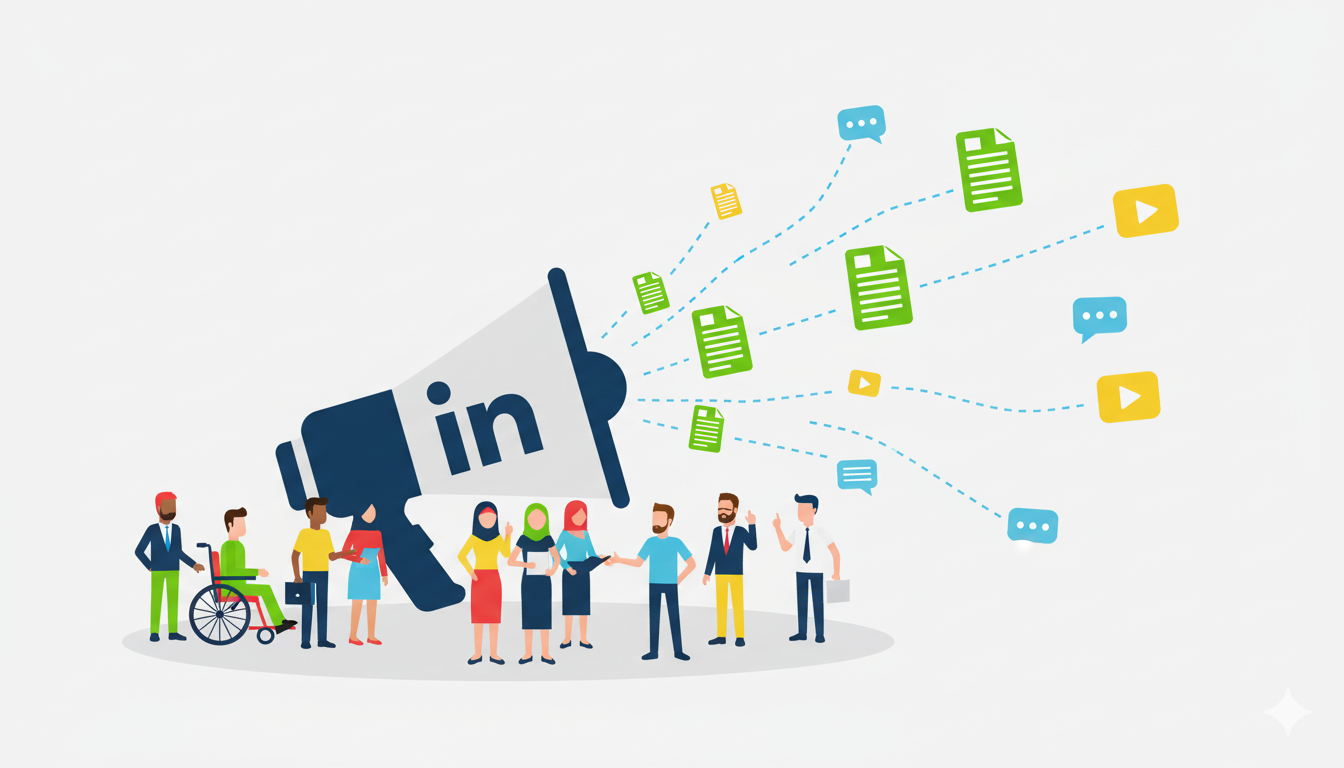
LinkedIn Brand Awareness Content Megaphone - Amplifying Your Message with Different Content Types

A diverse content strategy acts as a megaphone for your brand message

Educational Content: Share insights, how-tos, and industry analysis that helps your audience do their jobs better. This positions your brand as a knowledgeable authority.

Behind-the-Scenes Content: Humanize your brand by sharing company culture, team spotlights, and day-in-the-life content. This builds emotional connections with your audience.

Visual Content: Posts with images receive 98% more comments, while videos are shared 20 times more than other content types. Use compelling visuals that stand out in the feed.

Storytelling Content: Share customer success stories, case studies, and challenges you’ve overcome. Stories are memorable and help prospects envision themselves working with you.

Content Calendar and Posting Strategy

Consistency is crucial for building brand awareness. A well-planned content calendar ensures you maintain a steady presence without last-minute scrambling.

  • Posting Frequency: Aim for 3-5 posts per week to stay top-of-mind without overwhelming your audience
  • Optimal Timing: Test different posting times, but generally, Tuesday through Thursday mornings tend to perform well
  • Content Mix: Balance promotional content (20%) with educational (60%) and engaging/content (20%)
  • Hashtag Strategy: Use a mix of popular and niche hashtags to increase discoverability

Avoid These Common Mistakes: Many brands make the error of only posting company updates or overly promotional content. This approach fails to provide value and often leads to audience disengagement. Similarly, irregular posting makes it difficult to build momentum and brand recognition. If you’re running paid campaigns, avoid the common PPC mistakes that burn through budget without delivering awareness results.

Leveraging LinkedIn Thought Leader Ads

One of the most powerful tools for LinkedIn brand awareness in 2026 is Thought Leader Ads. This ad format allows companies to promote organic posts from individuals within their organization, typically executives or subject matter experts.

What Are Thought Leader Ads?

LinkedIn Thought Leader Ads are sponsored content that promotes organic posts from individuals rather than company pages. These ads appear in users’ feeds as regular posts from the individual, with a small “Promoted by [Company]” label. According to LinkedIn data, they deliver up to 1.7× higher click-through rates and 1.6× higher engagement rates than standard single-image ads.

The power of this format lies in its authenticity. People trust messages from individuals more than branded sources—61% of users say they trust influencer recommendations. Thought Leader Ads tap into this trust while still providing the reach of paid promotion.

How to Set Up Thought Leader Ads

Step 1: Choose Your Campaign Objective

In Campaign Manager, select either “Brand Awareness” or “Engagement” as your objective—these are the only two options available for Thought Leader Ads.

Step 2: Select the Right Post Format

Choose either “Single-image ad” or “Video ad” based on the original organic post you plan to promote. The format must match the original post.

Step 3: Request Content Permission

Browse existing content from qualified individuals in your organization and request permission directly through Campaign Manager. The post author must approve before you can proceed.

Step 4: Define Your Target Audience

Use LinkedIn’s powerful targeting options to reach your ideal customer profile based on industry, job title, company size, or other relevant criteria.

Step 5: Set Budget and Launch

Determine your budget and bidding strategy, then launch your campaign. Monitor performance closely and be prepared to optimize based on results.

Best Practices for Thought Leader Ads

  • Choose the Right Voices: Select individuals with established credibility and engaging content styles
  • Promote High-Performing Organic Content: Boost posts that have already demonstrated organic success
  • Maintain Authenticity: Don’t over-polish or corporate-ize the content—the personal touch is what makes it effective
  • Align with Business Objectives: Ensure the content supports your broader brand awareness goals

Employee Advocacy: Multiplying Your Reach

Your employees are your most credible brand ambassadors. An effective employee advocacy program can significantly amplify your LinkedIn brand awareness efforts by extending your reach beyond your company’s immediate followers.

LinkedIn Employee Advocacy Puzzle - How Team Members Complete Your Brand Awareness Strategy

Each team member represents a crucial piece of your brand awareness puzzle

Building an Employee Advocacy Program

Successful employee advocacy doesn’t happen by accident—it requires structure, support, and motivation.

Provide Shareable Content: Make it easy for employees to share company content by creating a resource library with pre-written posts, images, and suggested messaging.

Offer Training and Guidelines: Educate employees on best practices for LinkedIn engagement and provide clear social media guidelines.

Recognize and Reward Participation: Acknowledge active advocates through internal recognition programs or incentives.

Lead by Example: Ensure executives are actively participating and modeling effective LinkedIn engagement.

Measuring Advocacy Impact

Track the impact of your employee advocacy program through metrics such as:

  • Total reach and impressions generated by employee shares
  • Engagement rates on content shared by employees versus company page
  • Website traffic referred from employee LinkedIn profiles
  • Lead generation influenced by employee advocacy

Pro Tip: Start small with a pilot group of enthusiastic employees before rolling out your advocacy program company-wide. This allows you to refine your approach and demonstrate early success stories that can encourage broader participation.

Engagement and Community Building

Building LinkedIn brand awareness isn’t just about broadcasting your message—it’s about fostering genuine engagement and building community around your brand.

LinkedIn Brand Awareness Engagement Magnet - Attracting and Retaining Your Audience Through Active Engagement

Active engagement acts as a magnet, attracting your target audience to your brand

Strategic Engagement Practices

Passive content distribution won’t build the connections needed for lasting brand awareness. You need proactive engagement strategies.

Respond to All Comments: Acknowledge every comment on your posts with thoughtful responses. This encourages further interaction and shows you value your audience’s input.

Participate in Relevant Conversations: Monitor industry hashtags and join conversations where you can add value without being overly promotional.

Engage with Other Companies’ Content: Comment thoughtfully on posts from complementary businesses, industry publications, and thought leaders.

Ask Questions and Spark Discussions: Pose thoughtful questions in your posts and actively participate in the resulting conversations.

LinkedIn Groups Strategy

LinkedIn Groups remain powerful hubs for community building and targeted engagement when used strategically.

Identify Relevant Groups: Find and join groups where your target audience spends time, focusing on those with active, quality discussions.

Provide Value First: Before sharing your own content, establish credibility by answering questions and contributing to discussions.

Share Exclusive Insights: Offer group members special content, early access, or unique perspectives they can’t get elsewhere.

Consider Creating Your Own Group: For established brands with specific expertise, creating and nurturing your own group can position you as a community leader.

Measuring Your Brand Awareness Success

Effective LinkedIn brand awareness requires tracking the right metrics to understand what’s working and where to optimize. While brand awareness can feel intangible, these metrics provide concrete evidence of your progress.

LinkedIn Brand Awareness Growth Dashboard - Tracking Key Metrics and KPIs

A comprehensive dashboard helps you track progress across multiple brand awareness metrics

Key Brand Awareness Metrics

According to LinkedIn’s marketing resources, these are the essential metrics for measuring brand awareness:

Metric What It Measures Why It Matters
Impressions How many times your content was displayed Indicates overall visibility and reach
Follower Growth Rate of new followers acquiring Shows increasing audience interest
Engagement Rate Percentage of engaged impressions Measures content resonance and quality
Share of Voice Your brand mentions vs. competitors Indicates market position and mindshare
Website Referrals Traffic from LinkedIn to your website Shows interest beyond the platform
Content Amplification How often your content is shared Measures audience advocacy and content value

Advanced Measurement Techniques

For sophisticated brand awareness tracking, consider these advanced approaches:

Brand Awareness Dashboard: Create a centralized dashboard that consolidates multiple data sources to provide a comprehensive view of your brand awareness performance across different channels and over time.

Sentiment Analysis: Use social listening tools to analyze the sentiment of conversations mentioning your brand, helping you understand not just visibility but perception.

Lead Source Analysis: Track how many leads mention LinkedIn as their first touchpoint or primary source of awareness.

Competitive Benchmarking: Monitor competitors’ LinkedIn presence to understand your relative position in the market.

Pro Tip: Set baseline measurements before implementing your brand awareness strategy, then track progress at regular intervals (monthly or quarterly). This allows you to correlate specific activities with results and make data-driven decisions about where to focus your efforts.

FAQs: LinkedIn Brand Awareness

How long does it take to see results from LinkedIn brand awareness efforts?

Initial metrics like impressions and engagement can improve within weeks, but meaningful brand awareness that influences business outcomes typically takes 3-6 months of consistent effort. Building genuine brand recognition is a marathon, not a sprint.

What’s more important for brand awareness: organic content or paid advertising?

Both play crucial roles. Organic content builds genuine engagement and community, while paid advertising accelerates reach and targeting. The most effective strategies combine both—using organic content to build foundation and paid amplification to extend reach to new audiences.

How often should we post on LinkedIn for optimal brand awareness?

For most brands, 3-5 posts per week strikes the right balance between maintaining visibility and avoiding audience fatigue. Quality consistently outperforms quantity, so focus on creating valuable content rather than simply hitting a posting quota.

Can small businesses with limited budgets build effective brand awareness on LinkedIn?

Absolutely. While paid options accelerate results, small businesses can build substantial awareness through consistent organic activity—especially by leveraging employee advocacy, engaging in relevant groups, and creating niche content that resonates with specific audiences.

How do we measure ROI from brand awareness activities?

Beyond direct metrics like engagement and reach, look for correlations between awareness activities and business outcomes like website traffic from LinkedIn, lead quality, reduced cost per acquisition, and customer mentions of LinkedIn as a discovery channel.

Ready to Transform Your LinkedIn Brand Awareness?

Building meaningful brand awareness on LinkedIn requires strategy, consistency, and the right expertise. If you’re ready to elevate your LinkedIn presence but need guidance on implementation, our team at LineUp specializes in developing data-driven LinkedIn strategies that deliver measurable results.

Get Your Free LinkedIn Strategy Consultation

From Chaos to Control: A 90-Min Social Media Content Plan

Let’s talk about “The Dread.” It’s that feeling of chaos you get around 2 PM on a Tuesday when you realize you need to post something on social media. This guide offers a powerful system to create a social media content plan efficiently, freeing you from that daily pressure and giving you back control.

You open Instagram or LinkedIn, stare at the blank “What’s on your mind?” box, and… nothing. You scroll through your camera roll, hoping for inspiration. An hour goes by, and you either give up or post something generic that gets two likes. This is the “content treadmill,” and it’s the biggest reason most businesses fail. They are trapped in a reactive cycle with no real strategy. Having a solid social media content plan is the only way to break free.

For over 25 years, I’ve worked with global brands and solo entrepreneurs. The secret to success has never been about posting *more*. It has always been about posting with purpose and consistency. A solid plan is everything.

What if you could replace daily stress with a calm, repeatable system? What if you could build a full, high-quality social media content plan for an entire month in the time it takes to watch a movie? This is not a gimmick. This is a system. It’s a 90-minute framework I’ve refined over decades, and it’s one of the most valuable time-saving social media tips I can share.

This guide will walk you through that exact 90-minute process. We will break it down into three manageable sprints:

  • The 30-Minute Strategy Sprint: Where we’ll build the foundation for your social media content plan.
  • The 45-Minute Creation Sprint: Where we’ll batch-create a month’s worth of content.
  • The 15-Minute Scheduling Sprint: Where we’ll put the system on autopilot.

By the end of this article, you will have a complete blueprint to build and execute your social media content plan efficiently. You will have a clear social media content strategy that you can execute month after month, freeing you from “The Dread” and allowing you to finally use social media as the powerful business-building tool it’s meant to be.

Let’s start the clock.

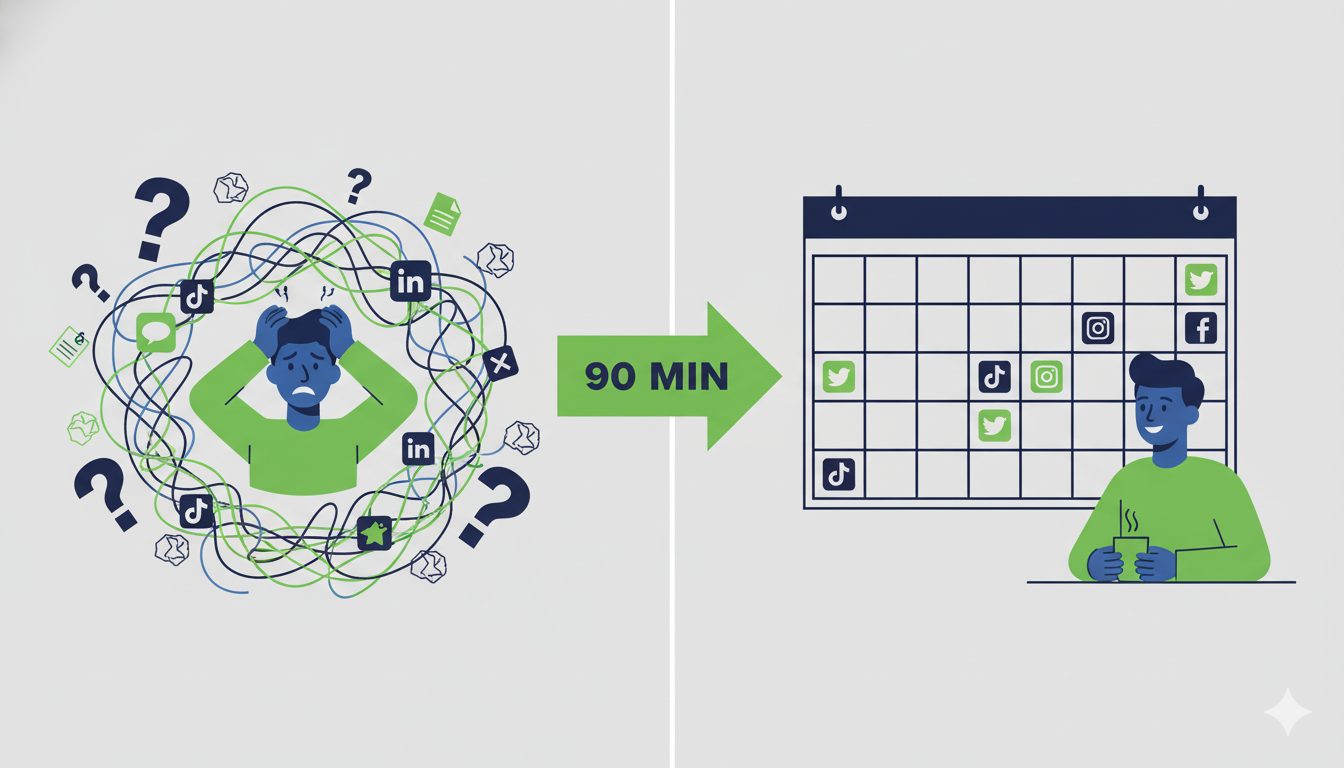
An illustration showing the transformation from a chaotic approach to a structured social media content plan.
Our 90-minute system is designed to turn daily social media chaos into calm, strategic control.

The Prerequisite: Before You Start the Clock, Define Your Pillars

Our 90-minute system is a powerful engine, but an engine is useless without a steering wheel. Your Content Pillars are that steering wheel. They are the 3-5 core themes that your brand will own. Every single post in your social media content plan will relate back to one of these pillars.

The Mentor’s Insight: Think of your brand as a house. You need strong, foundational pillars to hold up the roof. These pillars ensure your structure is stable and cohesive. A business without content pillars is just a pile of random social media posts. A business *with* content pillars is an authority. This is the absolute core of a successful social media content strategy.

This is a one-time setup. Once your pillars are defined, they will guide your content for months. They turn the terrifying question of “What should I post today?” into the simple question of “Which pillar am I talking about today?” To learn more about this concept, resources from authorities like HubSpot are invaluable.

An illustration of four strong pillars supporting a roof, representing a stable social media content strategy.
Content pillars are the foundation that gives your social media content plan structure and purpose.

How to Find Your 3-5 Content Pillars: A Simple Framework

Your content pillars lie at the intersection of what your audience cares about and what you are an expert in. This is the first step in building an effective social media content plan.

Step A: Identify Your Customer’s Core Problems & Desires

Forget your product. Who is your ideal customer? What are their biggest questions, fears, and aspirations *related to your industry*?

Step B: Identify Your Unique Expertise & Values

What are you uniquely good at? What makes your business different? This isn’t just about what you sell, but *how* and *why* you sell it.

Step C: Find the Intersection & Name Your Pillars

Where do their problems and your expertise meet? Group these overlaps into 3-5 broad themes. These pillars are the foundation you’ll use to build your social media content plan for the long term.

Suddenly, you have clear themes for your content creation for business. Every post now has a purpose. Once you have your 3-5 pillars, you are ready to start the clock on your new social media content plan.

Sprint 1: The 30-Minute Strategy Sprint (Brainstorming Your Ideas)

Set a timer for 30 minutes. The goal of this sprint is to generate a surplus of *ideas*, moving from high-level themes to specific post concepts. This is a crucial step if you want to effectively build a social media content plan for an entire month.

The Mentor’s Insight: This is the most crucial sprint. By separating the “idea” phase from the “creation” phase, you free up your creative mind. This is one of the most effective time-saving social media tips there is.
An infographic showing the process of turning brainstormed ideas into a monthly content calendar template.
In just 30 minutes, you can turn a cloud of ideas into a clear, actionable social media content calendar.

From Brainstorm to Calendar

Organize your brainstormed ideas into a simple calendar. This becomes your **monthly content calendar template**. Don’t overcomplicate it. The goal is to create a balanced mix, rotating through your pillars to keep your content varied. This is the tangible output of your work to create a social media content plan.

In just 30 minutes, you’ve gone from a blank page to a complete, strategic roadmap for the entire month. The hardest part—the thinking—is done. This is the difference between reactive posting and having a real social media content strategy.

Sprint 2: The 45-Minute Creation Sprint (Batching Your Raw Content)

Set a timer for 45 minutes. This sprint is about getting the raw materials for your posts created. We are not aiming for perfection, but for *completion*. This phase of your social media content plan is about production.

The Mentor’s Insight: This is the heart of the system. The technique is called “batching.” You do all of one task at once. This keeps your brain in a single “mode,” which is exponentially more efficient than daily context-switching. Learning to do content batching for social media is essential if you want to build a social media content plan without burning out.
An illustration comparing chaotic multitasking with the efficiency of content batching for social media.
Batching your tasks—writing all captions at once, then planning all visuals at once—is the secret to efficient content creation.

Phase A: The Caption-Writing Blitz (25 minutes)

Open your content calendar and write a draft caption for every post. Use a simple formula: Hook, Value, Call to Action (CTA). Don’t worry about hashtags yet. Just get the core message down. This is the essence of efficient content creation for business.

Phase B: The Visual “Shot List” (20 minutes)

Go back through your calendar. For each post, decide what visual you need. You are creating a “shot list” or a to-do list for your visuals. This is about planning, not perfection. You’re not just creating posts; you’re building assets for your brand. Remember that a good plan is useless if your site has issues; you can read about some of these in our guide to critical technical SEO errors.

In 45 minutes, you’ve gone from a list of ideas to a folder full of draft captions and planned visuals. Your social media content plan is now taking tangible form.

Sprint 3: The 15-Minute Scheduling Sprint (Putting It on Autopilot)

Set a timer for 15 minutes. This final sprint is your victory lap, where you’ll load your content into a scheduling tool.

The Mentor’s Insight: Scheduling guarantees consistency, the single most important factor for social media success. It allows you to be “present” online even when you’re busy. This is one of the most crucial time-saving social media tips when executing a social media content plan.
An illustration of a social media dashboard, showing how to schedule social media posts for the month.
Scheduling tools put your social media content plan on autopilot, guaranteeing consistency and saving you hours every week.

Your Action Plan: Load the System

You’ll need a social media scheduling tool to know **how to schedule social media posts** effectively. For Facebook and Instagram, Meta Business Suite is free and effective. For other platforms, tools like Buffer or Hootsuite offer excellent free plans. The process is simple:

  1. Open your scheduler and your content calendar.
  2. Copy and paste your draft caption.
  3. Upload your designated visual.
  4. Add your hashtags.
  5. Select the date and time from your calendar and click “Schedule.”
  6. Repeat until your entire month is loaded.

That’s it. Your social media content plan is now automated for the month.

Your 90-Minute Victory: From Daily Chaos to Strategic Control

Let’s step back and look at what you’ve just accomplished. In 90 minutes, you have built a complete, strategic social media content plan for the next 30 days. You have successfully executed a professional-level workflow that is central to a strong social media content strategy.

A Final Mentor’s Tip: Automate the Post, Not the Conversation
This system automates *publishing*. It does not automate *conversation*. Dedicate 10-15 minutes each day to engage with your audience. Respond to comments and answer messages. This combination of automated consistency and real, human engagement is the true secret to building a thriving social media presence that drives business growth. It’s a vital part of a smart social media content plan. For further reading on this, check out experts like Social Media Examiner.

You now have the blueprint and the system. You have reclaimed your time and taken control of your brand’s story, all because you took the time to create a powerful social media content plan. What will you do with all the hours you’ve just saved?

Ready to Go Beyond the 90-Minute Plan?

If you’ve read this guide and feel empowered but still want an expert partner to help build your brand, we’re here to help. Let’s create a content strategy that drives real business results, together.

Get Your Free Consultation

Unmasking 10 Data Voids Secretly Devastating Your Growth

Let’s be brutally honest for a second.

You’re pouring money into acquiring new customers. The ads are running. The content is flowing. But it feels like you’re trying to fill a leaky bucket. For every new customer that comes in, another one quietly slips out the back door.

This is the silent revenue killer. This is the problem that stifles growth.

We lived this reality. Our acquisition costs were climbing, and our growth had plateaued. We knew we had a retention problem, but we didn’t know why. We were guessing. We were relying on hunches and anecdotal feedback.

Then, we made a pivotal decision. We stopped guessing and started listening to our data.

The business impact was nothing short of transformational. By uncovering and acting on ten specific, data-driven insights, we didn’t just improve our customer retention; we skyrocketed it. This single shift in strategy became the most significant driver of our sustainable revenue growth.

This is the exact blueprint of how we did it.

Business impact of data-driven insights showing retention skyrocketing on a graph.
The moment we switched from guesswork to data-driven insights, our retention metrics began to climb.

Insight #1: The 30-Day “Activation Gap” Was Our Silent Killer

Our first major data-driven insight came from analyzing the user journey timeline. We plotted customer longevity against their initial actions. The correlation was staggering.

Customers who performed three key actions within their first 30 days—completing their profile, using the core feature three times, and inviting a team member—were 400% more likely to still be active users after one year.

The business impact was clear. We were failing to guide new users across this critical activation threshold. We were losing them before they ever experienced the core value of our product.

Our Action Plan:

  • We redesigned our onboarding flow to explicitly guide users toward these three “Aha!” moments.
  • We implemented a targeted 30-day email sequence focused on feature education and value demonstration.
  • We created a “First 30-Days Success” checklist directly within the user dashboard.

The result? We closed the activation gap. User churn within the first 90 days dropped by 35%. This single data-driven insight laid the foundation for everything that followed.

Insight #2: Feature Adoption, Not Just Satisfaction, Predicts Long-Term Loyalty

We used to survey customers with the standard, “How satisfied are you?” question. The scores were decent, but they were a lagging indicator. They told us how people felt yesterday, not whether they would stay tomorrow.

Our breakthrough came when we analyzed product usage data alongside these satisfaction scores. We discovered that “satisfied” customers who only used one or two basic features churned at nearly the same rate as “dissatisfied” customers.

The real predictor of loyalty was feature adoption depth. Customers who used five or more features, especially one of our advanced “power” features, had a lifetime value (LTV) that was 8x higher.

The business impact of this data-driven insight was a fundamental shift in our customer success strategy.

Our Action Plan:

  • We stopped focusing solely on satisfaction (CSAT) and started tracking a “Feature Adoption Score.”
  • Our success team began proactively reaching out to “satisfied but low-adoption” customers to demo additional features relevant to their use case.
  • We developed in-app tooltips and mini-tutorials that highlighted underutilized features based on user behavior.

This proactive approach to driving adoption directly increased customer stickiness and dramatically reduced churn.

Data-driven insights connecting customer behavior to business impact.
Connecting the dots between feature usage and long-term loyalty was a game-changing data-driven insight.

Insight #3: The “Support Response Time” Threshold We Never Knew Existed

Everyone knows support is important. But we discovered a specific, quantifiable threshold that massively influenced customer sentiment.

By cross-referencing support ticket data with subsequent customer behavior, we found a magic number: 2 hours.

Customers whose initial support query was answered within 2 hours showed no increase in churn risk, regardless of whether their problem was fully resolved immediately. Customers who waited longer than 2 hours for a first response saw their likelihood to churn within the next 60 days increase by 25%. Even if their problem was eventually solved perfectly!

This data-driven insight revealed that perceived neglect was as damaging as the actual product issue.

The business impact forced us to overhaul our support priorities from “solve everything” to “acknowledge everyone quickly.”

Our Action Plan:

  • We implemented a strict SLA for first-response time, prioritizing it over full resolution time.
  • We created a library of “first-response” templates to ensure quick, helpful acknowledgments.
  • We used automated tagging to identify customers who crossed the 2-hour threshold, triggering a personal follow-up from a manager.

This simple change dramatically improved customer perceptions and built immense goodwill.


Insight #4: Price Sensitivity Was Highest After The First Renewal, Not Before

Conventional wisdom told us to fear the first annual renewal date. Our data told a different story.

We analyzed churn events across the customer lifecycle and made a shocking discovery. While we did lose customers at the first renewal, the highest risk period was actually between months 13 and 18—after the customer had already renewed once.

This data-driven insight indicated that the initial purchase was often driven by hope and potential. The second renewal was driven by a cold, hard assessment of value received versus price paid. If the value wasn’t crystal clear, they left.

The business impact was a complete restructuring of our customer engagement calendar.

Our Action Plan:

  • We created a “Value Reinforcement” campaign that kicked in after the first renewal, highlighting ROI, showcasing past successes, and demonstrating future roadmaps.
  • We instituted mandatory “Business Review” calls for all customers approaching their 18-month mark.
  • We developed case studies specifically for this cohort, showing how similar companies achieved massive ROI.

By addressing the real point of price sensitivity, we secured long-term loyalty and drastically improved second-time renewal rates.


Insight #5: “Power Users” Are Your Best Salespeople (And We Were Ignoring Them)

We were spending a fortune on referral programs and affiliate marketing. Then we looked at the data on how new customers actually found us and decided to stay.

The most powerful driver of high-quality, sticky new business was unsolicited word-of-mouth from “Power Users.” But we weren’t actively cultivating this group. They were just… there.

We defined a “Power User” by a composite score of login frequency, feature adoption, and workspace activity. This segment was responsible for bringing in new users who had a 60% higher LTV than users from other channels.

The business impact of leveraging this organic advocacy channel was a dramatic reduction in our CAC and a simultaneous increase in the quality of new sign-ups.

Our Action Plan:

  • We created an exclusive “Power User” community with early access to features, direct lines to product managers, and exclusive content.
  • We started a simple “Bring a Colleague” program that made it effortless for these users to share, without the tacky feel of a cash-for-referrals scheme.
  • We featured these users in our webinars and case studies, giving them a platform and recognition.

This transformed our most loyal customers into a formal, extension of our marketing team.

(Image Suggestion)

  • Placement: After Insight #5.
  • Pexels Search Term: “Community of diverse people networking”
  • Alt Text: The business impact of building a community around data-driven insights.
  • Caption: Identifying and empowering your “Power Users” is a data-driven insight that pays compounding dividends.
The business impact of building a community around data-driven insights.
Identifying and empowering your “Power Users” is a data-driven insight that pays compounding dividends.

Insight #6: The “Quiet Quitters” in Our Free Tier Were a Goldmine

We were so focused on converting the active free-tier users that we were ignoring the vast majority who went dormant. Our analysis revealed a segment we called “Quiet Quitters”—users who signed up, used the product lightly for a week, and then went silent.

Conventional marketing said to let them go. Our data said otherwise.

By running a reactivation campaign targeting users who had been dormant for 90 days, we discovered that a specific subset—those who had initially used a specific advanced feature—had a 15% conversion rate to paid when re-engaged with a targeted message about that feature.

This data-driven insight revealed untapped potential in a segment we had written off as lost causes.

The business impact was the creation of an entirely new, highly efficient lead conversion stream.

Our Action Plan:

  • We segmented our dormant user list based on their last-performed action before going quiet.
  • We created hyper-personalized email sequences that reminded them of the specific feature they used and what they could accomplish by upgrading.
  • We offered a limited-time, guided onboarding call to help them get re-started.

This “win-back” campaign became one of our most cost-effective acquisition channels.

Insight #7: NPS Was Useless Without a “Follow-Up” Action Funnel

We tracked Net Promoter Score (NPS) religiously. We had a big number on a dashboard. And it did nothing.

The real data-driven insight came when we stopped looking at the score and started looking at the individual responses, especially the Detractors (scores 0-6) and the Passives (scores 7-8).

We realized that a Detractor who received a personal follow-up within 24 hours had a 40% chance of becoming a Passive or even a Promoter within 30 days. A Detractor who was ignored had a 90% chance of churning.

The business impact was about operationalizing feedback, not just collecting it.

Our Action Plan:

  • We automated a workflow that instantly alerted a customer success manager when a Detractor survey was submitted.
  • We mandated a personal phone call or detailed email to every single Detractor, not to argue, but to understand and help.
  • We tracked the resolution of these follow-ups as a key performance indicator for the success team.

This turned a vanity metric into a powerful, proactive retention engine, saving countless at-risk accounts and providing invaluable product feedback. The direct business impact was a measurable reduction in churn from the Detractor segment.


Insight #8: Customer Health Scores Were Flawed (We Fixed Them)

We had a “Customer Health Score” built on a dozen data points. It was complex, but it was wrong. It often gave us false positives (predicting healthy customers who churned) and false negatives (flagging at-risk customers who were actually fine).

The data-driven insight came from applying machine learning to find which factors truly correlated with churn, rather than relying on our assumptions. The model revealed that three “soft” factors we were ignoring were more predictive than half of our “hard” data points:

  1. A decrease in the number of logins from multiple users in a team workspace.
  2. A customer who had not contacted support in over 6 months (suggesting disengagement, not satisfaction).
  3. A failure to download a quarterly usage report we offered.

The business impact of refining our health score was immense. We could now allocate our retention resources with pinpoint accuracy.

Our Action Plan:

  • We rebuilt our health score algorithm based on the ML model’s findings.
  • We created tiered alert levels: “Watch,” “At-Risk,” and “Critical,” each with a defined playbook for the success team.
  • We focused our highest-touch efforts on the “At-Risk” and “Critical” segments, leading to a 5x improvement in our save rate.

This precise targeting ensured we were helping the customers who truly needed it, maximizing the business impact of our customer success team’s efforts.

Refining our customer health score was a data-driven insight with a major business impact.
A true, data-driven customer health score allows you to see the real story behind the numbers.

Don’t Let Hidden Technical Errors Undermine Your Data Efforts

Our journey to fix our flawed customer health score was an internal cleanup. It was about fixing our own processes to see the data clearly.

But what if the very foundation of your website—its technical health—is flawed? You can have the most brilliant data-driven insights, but if search engines can’t properly crawl, index, and understand your site, you are invisibly bleeding the traffic and potential customers that fuel your analysis.

Before you can master the complex business impact of customer behavior, you must first master the fundamentals of your online real estate. Ignoring critical technical SEO errors is like trying to run a data-driven company with a broken internet connection.

Fixing these errors is the essential first step to ensuring your website is a reliable source of traffic and leads, allowing you to gather the clean data needed to truly skyrocket your growth. It’s a foundational business impact you cannot afford to ignore.


Insight #9: The “Onboarding Call” Conversion Multiplier

We offered onboarding calls to all new customers, but only about 15% took us up on it. We viewed it as a nice-to-have service. Our data showed it was a necessity.

By comparing the lifetime value of customers who had an onboarding call versus those who didn’t, we uncovered a staggering correlation. The LTV of customers who completed a call was 3 times higher. Furthermore, their time-to-activation was 50% faster, and their feature adoption breadth was significantly wider.

This data-driven insight proved that a single human interaction at the very beginning of the relationship set the tone for the entire customer journey.

The business impact was clear: we needed to make onboarding calls not an option, but a standard part of our process for certain segments.

Our Action Plan:

  • We made onboarding calls mandatory for all customers on our premium and enterprise plans.
  • For self-serve sign-ups, we implemented a more proactive and persuasive scheduling system, framing the call as a “success session.”
  • We trained our onboarding specialists to not just demo the product, but to identify and document the customer’s specific goals for the first 90 days.

This investment in the initial handshake paid for itself many times over in increased retention and expansion revenue.


Insight #10: Product Update Communication Was Driving People Away

This was our most counterintuitive data-driven insight. We were proud of our product updates and blasted email announcements to our entire user base. We assumed everyone wanted to know.

Our email open and engagement data told a different story. A significant portion of our user base never opened these emails. More alarmingly, when we correlated email sends with product usage, we saw a small but consistent drop in activity from certain user segments after a product update email.

We realized we were overwhelming our less-technical users with information about features they didn’t understand or need. It made the product feel more complex and intimidating.

The business impact of this misguided communication was unintentionally increasing churn risk.

Our Action Plan:

  • We segmented our product announcement emails based on user role, feature adoption, and plan tier.
  • We created “What’s in it for me?” style update notes, focusing on benefits and use cases rather than just technical features.
  • We developed an in-app notification system that was far less intrusive and could be targeted with surgical precision.

By communicating smarter, not louder, we increased the relevance of our messages and eliminated the negative business impact of our well-intentioned announcements.

Targeted communication based on data-driven insights has a positive business impact.
Stop blasting. Start targeting. Personalized communication is a data-driven insight that builds loyalty.

The Collective Business Impact: By the Numbers

Implementing these ten data-driven insights wasn’t an overnight fix. It was a cultural and operational shift. But the collective business impact was undeniable and profound. Within 12 months, we saw the following results:

  • Customer Churn Rate: Reduced by 45%.
  • Customer Lifetime Value (LTV): Increased by 68%.
  • Net Revenue Retention (NRR): Surpassed 120%, meaning our existing customer base was growing itself without a single new logo.
  • Support Ticket Volume: Decreased by 20% due to better onboarding and proactive feature education.
  • Cost of Customer Acquisition (CACA): Reduced by 18% due to the powerful effect of word-of-mouth from our “Power User” program.

This was the ultimate business impact of becoming truly data-driven. We moved from reactive firefighting to proactive, predictable, and profitable growth.

How to Start Your Own Data-Driven Retention Revolution

You don’t need to boil the ocean. The goal is to start. Here is a simple framework to uncover your own data-driven insights:

  1. Ask a Single, Specific Question: Start with one burning question. “Why do customers churn after 14 months?” or “What do our best customers do in their first week?”
  2. Gather the Raw Data: Pull the data from your CRM, analytics platform, support desk, and financial reports. Don’t overcomplicate it; start with exports to a spreadsheet.
  3. Look for Correlations, Not Just Totals: Don’t just look at averages. Compare Group A (customers who stayed) to Group B (customers who left). What was different?
  4. Form a Hypothesis: “We think customers churn because they never use Feature X.”
  5. Test and Measure: Launch a small-scale initiative to address your hypothesis. For example, create a campaign to promote Feature X to at-risk customers. Did it move the needle?

This iterative process will consistently yield powerful data-driven insights that you can scale, creating a massive, positive business impact on your own customer retention and bottom line.

Conclusion: Stop Guessing, Start Knowing

The journey from leaky bucket to loyal community is not built on grand gestures. It’s built on a commitment to listening to the story your data is telling you. Each of these ten data-driven insights was a puzzle piece, and when assembled, they revealed a clear picture of how to build unbreakable customer loyalty.

The monumental business impact—the skyrocketing retention, the surge in lifetime value, the sustainable growth—was not the result of a single magic bullet. It was the direct result of a disciplined, persistent culture of seeking truth in data and having the courage to act on it.

Your data is speaking. Are you ready to listen?

Need help?

Our experts are best at helping you, and your needs. Contact us for free diagnostics!

Stay Ahead of the Curve

Get the latest SEO strategies and marketing insights delivered to your inbox.