Services · Video Production
Your ads are fine.
Your creative is the problem.
Most campaigns do not stall on targeting or bidding. They stall because there is one video, it is ninety seconds long, and it was cut for a conference stand. We produce the footage your channels are actually short of, in the formats they actually run.
“What do we get back, and where does each piece run?”
- 16 Master film for the homepage
- 9 Vertical cutdowns for Reels and TikTok 6 variants
- 1 Square cuts for feed and Performance Max
What comes out of a production day
- Creative Brief
- On-Location Shoots
- Studio Days
- Vertical Cutdowns
- Ad Creative Variants
- Subtitles & Captions
- Motion Graphics
- Source Files
Our video strategy
-
01
Start from the placement
We decide where each cut will run before we decide how it looks, because the placement sets the length, the ratio and the first two seconds.
-
02
Script for volume
One shoot day planned properly yields a batch of pieces. Planned badly it yields one, plus a folder nobody opens.
-
03
Cut for testing
Paid channels need variants to compare. Producing them in the edit costs a fraction of commissioning them later.
-
04
Hand everything over
Raw footage, project files, graphics and audio are yours at the end, whoever runs the next campaign.
Video production is the work of planning, filming and editing footage for a commercial purpose, then cutting it into the specific lengths and shapes each placement requires. The filming is the visible part. The decisions that determine whether the footage is usable are all made before the camera comes out of the bag, and after it goes back in.
Every other channel is waiting on this
Video is rarely bought for its own sake. It is bought because paid campaigns have nothing left to test, social has nothing worth stopping for, and the website explains in four paragraphs what thirty seconds would have shown.
Paid needs something to test
Modern ad platforms improve by comparing creative, not by being tuned harder. A paid campaign running one video has nothing to compare it against, which is why creative volume usually moves cost per lead more than another round of bid changes.
Short form is the default
Vertical video is no longer a format one team handles. It is how the major platforms distribute anything at all, which is why social media management without a production capability behind it runs out of material in about six weeks.
Pages that show, convert
A product nobody has seen working is a product buyers have to imagine. Video on a landing page replaces that imagining with watching, and it does so without adding another four paragraphs nobody reads.
What we film, and what each piece is for
Different jobs need different footage. Ordering the wrong type is the most expensive mistake in video, because it is only obvious once the shoot day is gone.
| Type | What it is | Where it earns its keep |
|---|---|---|
| Brand film | One longer piece covering who you are and what you do, shot to last a couple of years | Homepage, sales decks, trade stands and the first thing a new hire is shown |
| Ad creative | Short pieces built around a single claim, produced in enough variants to compare against each other | Google, Meta and Performance Max, where the platform needs options to choose between |
| Short-form social | Vertical cuts built for the first two seconds, captioned because most of it is watched on mute | Reels, TikTok and Shorts, and as organic support for whatever paid is running |
| Product and process | The thing actually working, filmed close enough that a buyer can see how it behaves | Product pages, quotes in progress, and any sale where trust is the blocker |
| Talking head and interview | Your people answering the questions buyers actually ask, filmed in a batch | FAQ pages, sales follow up email, and the steady supply social needs |
| Testimonial | A customer describing the problem before you, in their words, on camera | Case study pages and the moment in a pitch where a claim needs somebody else to say it |
Who this is for
Video pays off fastest where something has to be seen to be believed, or where a channel is already running and starved of material.
Advertisers out of creative
The campaign was fine for a quarter and then costs crept up. Nothing broke. The audience simply saw the same two assets until they stopped noticing them, and there was nothing in the folder to rotate in.
Businesses with something physical
A machine, a venue, a build, a process. If the thing you sell is impressive in person and flat in photographs, you are losing the part of the pitch that used to close it, and text will not get it back.
Teams posting on empty
Someone internal is producing the content between other jobs, quality swings week to week, and the calendar is the first thing to slip when the month gets busy. A batch shoot puts a quarter of material in hand at once.
Companies whose people are the product
Consultancies, clinics and agencies sell judgement, and judgement is hard to evidence in writing. Getting your specialists on camera answering real questions is the shortest route from stranger to shortlist.
How our video production works
Most of the work happens before and after the shoot. The day itself only goes well because of what was decided in step two.
-
1
Placement and purpose
We start from where each finished cut will run, because that sets length, aspect ratio and how much can happen before the viewer decides. Deciding this after the edit is how footage gets reshot.
-
2
Brief, script and shot list
One document covering the claim each piece makes, the questions anyone on camera will be asked, and every shot the edit will need. You approve it before a date is booked.
-
3
Pre-production
Location or studio, crew, kit, sound, permissions and a schedule for the day. Where your staff appear on camera, they get the questions in advance so they are not reading anything cold.
-
4
The shoot
We work to the shot list and film the coverage the edit will need, including the cutaways nobody asks for until the edit is halfway done. Footage is backed up twice before we leave.
-
5
Edit and versioning
Master edit first, then the cutdowns: vertical, square, short, and the variants paid needs to test. Colour, sound, graphics, subtitles and thumbnails are part of this, not an extra.
-
6
Delivery and handover
Finished files named by placement, plus raw footage, project files, graphics and audio. If we stop working together, the material stays usable by whoever comes next.
What you actually receive
Everything below is handed over in a form your team can keep using if we stop working together tomorrow.
Before the shoot
- Creative brief tied to where each cut will run
- Script or question list, approved by you
- Shot list and schedule for the day
The finished cuts
- Master edit in landscape and vertical
- Platform cutdowns at the lengths each placement takes
- Ad creative variants built to be tested against each other
The finishing
- Subtitles and burned-in captions for muted viewing
- Thumbnails and end cards
- Colour, sound mix and licensed music
The handover
- Raw footage from the shoot
- Edit project, graphics and audio files
- Files named by placement so nobody has to guess
“We started with a free strategy that showed us specific gaps in our campaigns. Today, LineUp is our regular partner, delivering a measurable return on every invested zloty.”
What clients say on Google
Unedited screenshots from our Google Business Profile. Swipe, or use the arrows, to read them all.

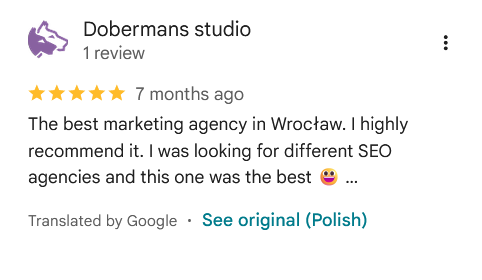


Read these reviews on Google. Reviews written in Polish or Turkish are shown in Google’s own translation.
Questions we get asked
What does a video production project actually include?
A creative brief and shot list agreed before anything is filmed, the shoot itself with our crew and kit, the edit, and the cutdowns each platform needs. You also get subtitles, thumbnails, the raw footage and the project files, so nothing about the work is locked to us.
How many videos come out of one shoot day?
That depends entirely on how much is scripted in advance, which is why the shot list matters more than the camera. A day built around a single hero film produces one film and a handful of cuts. A day built for volume produces a batch of short pieces. We agree which of the two we are doing before booking.
Do we need a script, or do we just show up?
There is always a script, even when nobody reads from one. For interview style pieces it is a question list and a rough running order, so your people sound like themselves rather than like an advert. Turning up without one is how a day of footage becomes an afternoon of usable material.
Why do you produce so many versions of the same video?
Because paid platforms are creative testing machines. Google and Meta campaigns need several variants to compare, and the same edit rarely works at sixteen by nine, nine by sixteen and as a six second bumper. Producing the versions during the edit costs far less than commissioning them later.
Does video help our SEO?
Not directly, and anyone promising rankings from video is selling you something. What it does do is hold attention on the page, which is a real signal of a page worth landing on, and it gives social and content marketing something people actually stop for. Treat it as a multiplier on the rest of the work.
Who owns the footage?
You do. Raw footage, the edit project, graphics and audio are handed over at the end of the project. If you bring the work in house or move to another agency, you take the material with you.
Show us what you are running now.
We will look at the creative currently in your campaigns and on your site, tell you which pieces are doing work and which are filling space, and show you what one production day would need to produce to change the numbers.
Last reviewed 31 July 2026.