Estate Agent Marketing Plan: A 12-Week UK Template
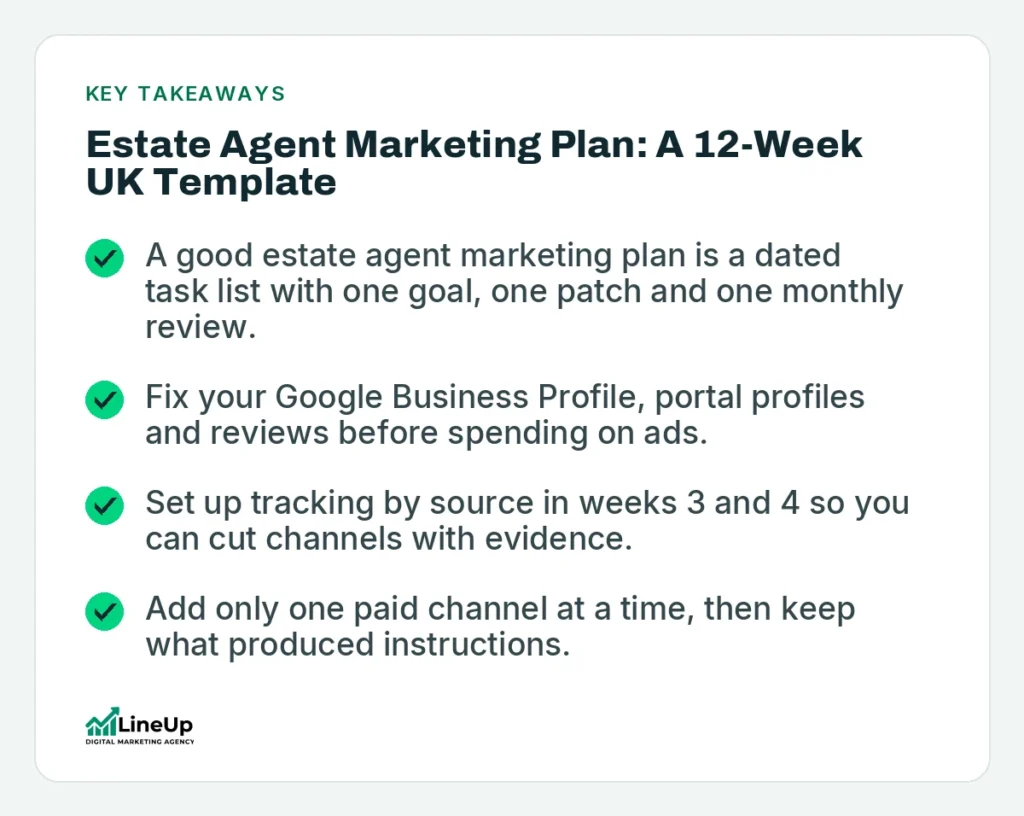
- A good estate agent marketing plan is a dated task list with one goal, one patch and one monthly review.
- Fix your Google Business Profile, portal profiles and reviews before spending on ads.
- Set up tracking by source in weeks 3 and 4 so you can cut channels with evidence.
- Add only one paid channel at a time, then keep what produced instructions.
 Ekrem Abdulkerim
26/10/2026
7 min read

An estate agent marketing plan is a dated list of what you will do each week, who does it, and which number tells you it worked. Twelve weeks is a sensible first block. It is long enough to see instructions move and short enough to change course.
This post gives you that 12-week plan for a UK branch or small group. It sits underneath our wider piece on real estate marketing in the UK, which covers the channels. Here the question is order: what to do first, what to leave until later, and how to keep it going when valuations get busy.
The plan assumes one branch, one or two people with marketing in their job description, and a modest budget. Scale it up or down, but keep the order.
What an estate agent marketing plan should contain
Most plans we see are a list of channels. A usable one has five parts:
- One goal in numbers. For example, valuation requests per month, or instructions won from a named postcode area.
- A patch. The streets and villages you want more of. “Everyone nearby” is not a patch.
- A weekly calendar. Specific tasks with names and dates against them.
- A budget by line. Even if the total is small.
- A monthly review. Thirty minutes, same day each month, same four numbers.
If your plan does not fit on two pages, nobody will follow it.
Weeks 1 to 2: fix what people already see
Start with what a seller finds when they search your name. Do this before you spend on anything.
- Search your agency name and your town plus “estate agent” on a phone. Screenshot the results.
- Open your Google Business Profile. Check the address, opening hours, categories, phone number and website link. Google says complete and accurate information makes a business more likely to appear in local results, and inaccurate details can stop a profile showing for searches in its area (Google Business Profile help).
- Check your Rightmove and Zoopla branch profiles for the same details.
- Read your last ten reviews on Google and Trustpilot. Reply to any that have no answer.
Weeks 3 to 4: set the goal and the tracking
Pick one goal and one baseline. Say your branch averages a certain number of valuation requests a month from all sources. Count them properly for four weeks, by source: phone, web form, portal, referral, walk-in. A spreadsheet is enough.
Then set up three things:
- A tracked phone number or a “how did you hear about us” field on your valuation form.
- Google Analytics and Search Console on your website, with the valuation form set as a conversion.
- A simple log for every instruction: the source, the date of first contact and the date of signing.
This is the dull part. It is also the part that lets you drop a channel in month three without an argument.
Weeks 5 to 8: build the pages that win valuation requests
Now spend your time on the website and the profile. Seller searches are local and specific, so your pages should be too.
One page per patch
Write a page for each area you want to win: who lives there, typical property types, how long sales take for you, recent sold examples you have permission to show, and a clear valuation form. Keep each one factual. Our guide to local SEO for estate agents covers the profile and map side of this.
Answer the questions from week 1
Turn each valuation-visit question into a short page or post. Put a real answer at the top, then detail. If you are unsure how far to go, see our guide to content marketing for estate agents.
Reviews as a routine
Ask every completed vendor for a Google review within a week of completion, while they are pleased. Google lists review volume and ratings as part of prominence, one of the three things behind local ranking alongside relevance and distance. It also says you cannot pay for a better local ranking, so there is no shortcut here.
Weeks 9 to 10: switch on one paid channel
By now you have a tracked form and pages worth sending traffic to. Choose one paid channel only.
| Option | Best for | Watch out for |
|---|---|---|
| Google Ads search | Sellers searching “estate agents in [town]” or “valuation” | Broad match wasting money on tenants and renters |
| Meta ads to a local audience | Reaching homeowners before they search | Weak intent, so expect more form-fillers who never book |
| Direct mail with QR code | A tight patch where you want name recognition | Print lead times, and no tracking unless the QR goes to a unique page |
Start small and cap the daily spend. Our posts on property PPC and canvassing with direct mail and QR postcards go through the set-up.
Weeks 11 to 12: review and decide
Sit down with your log and compare it with the baseline from weeks 3 and 4. Four numbers are enough:
- Valuation requests by source
- Valuations that became instructions
- Cost per valuation request for the paid channel
- New Google reviews gained
Then make three decisions. Keep what produced instructions. Cut what produced only clicks. Choose the next patch.
A rough budget by line
Costs vary a great deal by town, agency size and whether you do the work yourself. As a guide, these are the lines to price, not figures to copy:
- Website changes: mostly time if you have a CMS, more if a developer is involved.
- Photography and video for area pages: priced per shoot or per day.
- Paid ads: whatever daily cap you set, plus management time.
- Print and postage: driven by quantity, design and the size of your patch.
- Tools: reporting and email software, usually a monthly subscription.
Our property marketing strategy playbook goes further on how to split a budget across a year.
Frequently asked questions
How long should an estate agent marketing plan be?
Two pages is enough. Put the goal, the patch, a week-by-week task list, the budget lines and the monthly review date on it. A longer document tends to sit in a drawer.
How far ahead should I plan?
Plan twelve weeks in detail and the following nine months in outline. Local SEO and reviews build slowly, so judge them on trends over several months, and judge paid channels on weekly cost per valuation request.
Should I start with ads or the website?
Start with your Google Business Profile and website. Ads sent to a weak page or an untracked form waste money and teach you nothing.
What should I track each month?
Valuation requests by source, the number that turned into instructions, paid cost per request and new reviews. Anything beyond those four is optional until they are stable.
Can a small independent agent do this without an agency?
Yes. Weeks 1 to 4 need no agency at all. Bring one in for the parts that take specialist time, such as website builds, ad set-up or reporting.
Want help running the plan?
We can audit your profile and website, set up tracking and run the first twelve weeks with you. Get in touch and tell us your patch.
Ekrem Abdulkerim
SEO Strategist and Founder of LineUp. I help brands dominate search through technical precision and measurable growth.
Stay Ahead of the Curve
Get the latest SEO strategies and marketing insights delivered to your inbox.
Ready to win more instructions?
See how LineUp helps estate agents and property developers own local search and turn it into valuations.