

Real estate marketing in the UK is the process of using digital channels — including SEO, Google Ads, social media, and email — to generate property instructions, buyer leads, and landlord enquiries for estate agents and property businesses. Effective UK real estate marketing combines owned digital assets with paid media to reduce dependency on property portals and build long-term lead generation at a lower cost per acquisition.
Why Digital Marketing Now Matters More Than Rightmove
Digital marketing matters more than property portals because portals charge escalating subscription fees while giving you no ownership of the lead pipeline. Estate agents who invest 11.9% of income in non-portal marketing outperform the industry average (6.8%) by a significant margin, according to data from Estate Agent Today.[1]
For most UK estate agencies, Rightmove and Zoopla are indispensable for listing exposure. But here is the uncomfortable truth: you do not own those leads. When portal fees rise — and they always do — your entire pipeline moves with them. When a competitor outbids you on premium listing placement, your enquiries drop overnight.
The agencies winning market share in 2026 treat portals as one channel — not their entire strategy. They invest in owned digital assets. They build lead pipelines they control.
The Numbers Behind the Shift
- 97% of UK homebuyers start their property search online [5]
- 54% of a typical agent’s marketing budget now goes to digital channels [5]
- Video listings generate 403% more enquiries than photo-only listings [5]
- SEO combined with paid search delivers a 3.1x ROI for estate agents [4]
- Top agencies invest 11.9% of income in non-portal marketing vs. the 6.8% industry average [1]
The shift is not about abandoning portals. It is about building an owned digital presence that operates independently of any third-party platform’s fee increases or algorithm changes.
Local SEO: How Estate Agents Dominate Google Maps
Local SEO for estate agents means optimising your Google Business Profile, website, and local content so your agency appears in the Map Pack — the three local business results shown at the top of Google when someone searches “estate agent in [town].” It is the most cost-effective way to win instructions from high-intent vendors.
When a homeowner decides they want to sell, the first thing most of them do is type “estate agent in [their town]” into Google. The three agencies shown in the Map Pack receive the overwhelming majority of clicks. The agencies below position three — regardless of how good their services are — often receive nothing.
Local SEO is how you get into that top three.
Your Google Business Profile: The Foundation
Your Google Business Profile (GBP) is the single most important local SEO asset you have. It is free, and most agencies do not use it properly. Here is what separates high-ranking profiles from invisible ones:
- Complete every field. Business name, address, phone, website, opening hours, categories (primary: “Real Estate Agency”), services, and description — all must be filled in and consistent with your website.
- Post weekly. Google rewards active profiles. Post market updates, new listings (with photos), team news, and helpful advice for vendors and buyers.
- Collect and respond to reviews. Reviews are a primary local ranking signal. Ask every completed transaction client for a Google review. Respond to every review — positive and negative — within 48 hours.
- Add photos consistently. Profiles with 100+ photos receive significantly more profile views. Add photos of your office, team, sold boards, and satisfied clients (with permission).
Hyper-Local Content: Area Guides That Rank
Generic “estate agent services” pages do not rank. Location-specific, genuinely useful content does. And your competitors are mostly not doing this:
- Neighbourhood guides covering schools, transport links, average sold prices, and lifestyle
- Market update posts with current data on days-on-market, stock levels, and price movements
- Buyer and seller guides specific to your area (“How to sell your house in [Town] in 2026”)
These pages target people researching a specific location before choosing an estate agent — the exact moment when brand awareness becomes a competitive advantage.
Technical Local SEO: What Google Needs to Trust You
Google must crawl, index, and understand your site before it ranks you locally. Three technical fixes matter most:
- NAP consistency. Your Name, Address, and Phone number must match exactly across your website, GBP, Rightmove, Zoopla, and any directories. Inconsistencies confuse Google and suppress rankings.
- LocalBusiness schema markup. Add JSON-LD structured data to your website identifying your business type, address, geo-coordinates, and opening hours. This gives Google machine-readable signals it can trust.
- Mobile-first performance. Google completed its mobile-first indexing rollout in 2024. If your site is slow or broken on mobile, your local rankings suffer directly.
Google Ads for Property: What Actually Converts
Google Ads for estate agents works best when targeting high-intent transactional keywords like “sell my house in [city]” or “estate agent valuation [town].” Unlike portal advertising, Google Ads reaches people actively searching for an agent — not just browsing listings — resulting in significantly higher lead quality and conversion rates when campaigns are structured correctly.
Google Ads gives estate agents something property portals cannot: access to people in the active decision phase. A vendor who types “how much is my house worth in [location]” is weeks away from choosing an agent. You need to be the first thing they see.
Keywords That Drive Instructions (Not Just Traffic)
Avoid broad, expensive terms like “estate agent” or “property for sale” — these attract browsers and competitors, not motivated vendors. Instead, focus on:
| Keyword Intent | Example Keywords | Typical Conversion Rate |
|---|---|---|
| Valuation intent | “how much is my house worth [town]”, “free house valuation [area]” | High (8–15%) |
| Seller intent | “estate agent [town]”, “sell my house [town]”, “best estate agent near me” | Medium–High (5–12%) |
| Landlord intent | “letting agent [town]”, “property management [area]” | Medium (4–8%) |
| Buyer intent | “houses for sale in [area]”, “2 bed flat [town]” | Low (1–3%) |
The Landing Page is Where Campaigns Fail
Most estate agency Google Ads campaigns fail not because of the ads themselves — but because traffic lands on a generic homepage. Every high-intent keyword group needs a dedicated landing page that:
- Directly answers the searcher’s question (valuation, property search, lettings)
- Contains a single, clear call to action (book a valuation, call now, submit a property)
- Loads in under 2.5 seconds on mobile
- Includes social proof (reviews, awards, number of properties sold locally)
A well-structured Google Ads campaign with properly built landing pages typically achieves a 3.1x ROI for estate agencies — meaning every £1 spent returns £3.10 in value from new instructions and lettings.[4]
Ad Extensions: Non-Negotiable
Always enable: call extensions (phone number clickable on mobile), location extensions (shows your address), sitelink extensions (direct links to valuation, lettings, contact pages), and callout extensions (highlight: “No Sale No Fee”, “Free Valuation”, “Trusted Since [Year]”).
Content Marketing & Blog Strategy for Property Businesses
Content marketing for estate agents means publishing authoritative, locally-relevant articles that attract vendors and buyers before they choose an agent. The most effective strategy uses a Hub-and-Spoke model: one comprehensive guide (the hub) supported by specific neighbourhood guides, buyer checklists, and market updates (the spokes).
Google increasingly rewards websites that demonstrate genuine expertise on a topic. A single “estate agent services” page does not build topical authority. A content programme that systematically covers every aspect of buying, selling, and renting property in your local area does.
The Hub-and-Spoke Content Architecture
Build your content programme around a pillar hub page — your comprehensive guide to property in your area — and support it with more specific spoke articles:
- Hub: “The Complete Guide to Buying/Selling Property in [Town/County] [2026]”
- Spoke: “Average House Prices in [Neighbourhood] — [Month] [Year] Update”
- Spoke: “Best Areas to Buy in [Town] for Families in 2026”
- Spoke: “How Long Does It Take to Sell a House in [Area]?”
- Spoke: “What Are Conveyancing Costs in the UK? [2026 Breakdown]”
Each spoke links back to the hub. The hub links to each spoke. This creates a content cluster that signals topical authority to Google and keeps visitors on your site longer.
Content That Earns Google AI Overviews Citations
As of 2026, Google’s AI Overviews regularly cite authoritative content directly in search results — before any organic links appear. To be cited, your content must:
- Answer the question in the first 100 words, not after a lengthy introduction
- Include real data (sold prices, days-on-market, percentage changes) with clear sourcing
- Use clear headings that match the exact question users are asking
- Be updated regularly — stale dates signal low reliability to AI systems
Email Marketing & CRM: Turning Leads into Instructions
Email marketing for estate agents works by nurturing contacts who are not yet ready to sell or buy. By sending segmented, relevant content to vendors, buyers, and landlords separately, agencies stay top-of-mind until the contact is ready to transact — dramatically reducing the time between first enquiry and instruction.
Up to 70% of vendors request valuations from multiple agents. The agent who wins the instruction is almost never the one who simply provided the best valuation figure. It is the one who followed up fastest, most consistently, and most helpfully.
Segmented Email Lists: The Competitive Advantage Most Agents Ignore
A generic monthly newsletter sent to your entire database performs poorly. Segmentation — sending the right message to the right group — transforms email marketing for estate agencies:
| Segment | Content Focus | Frequency |
|---|---|---|
| Potential Vendors | Market reports, sold price data, valuation offers, staging tips | Monthly |
| Active Buyers | New listings, area guides, mortgage rate updates, buyer checklists | Weekly |
| Landlords | Rental yield data, legislative updates (EICR, EPC), management services | Monthly |
| Past Clients | Market updates, referral incentives, anniversary check-ins | Quarterly |
CRM Automation: Follow Up While You Sleep
The fastest-responding agency typically wins the instruction. CRM automation ensures no lead falls through the cracks:
- Instant enquiry response. Automated acknowledgement within 60 seconds of any web form submission or portal enquiry.
- Valuation follow-up sequence. 3-day, 7-day, and 14-day follow-up emails after a valuation, each adding value (market update, comparable solds, seller’s guide).
- Re-engagement campaigns. Monthly email to dormant contacts (“The market has changed in [Area] — here is what your property is worth today”).
UK Real Estate Marketing Benchmarks [2026]
UK estate agents should benchmark their digital marketing against these 2026 industry averages: a cost-per-lead of £25–£80 for Google Ads valuation campaigns, a 3.1x ROI for combined SEO and paid search, a 12.45% CTR for Facebook property ads, and a marketing budget of 6.8–11.9% of income for agencies that actively invest beyond portals.
| Channel | Metric | Industry Average | Top Performers |
|---|---|---|---|
| Google Ads | Cost Per Lead (Valuation) | £45–£80 | £25–£45 |
| Facebook Ads | Click-Through Rate | 8–10% | 12.45% |
| Instagram Reels | Click-Through Rate | 7–9% | 10.4% |
| Local SEO | Map Pack Conversion | 3–5% of impressions | 7–12% of impressions |
| Email (Vendor Segment) | Open Rate | 22–28% | 35–45% |
| Marketing Budget | % of Income (beyond portals) | 6.8% | 11.9% |
| Video Listings | Enquiry Rate vs. No Video | +200% | +403% |
| SEO + Paid Combined | Return on Investment | 2.1x | 3.1x |
Benchmarks are indicative and vary by location, agency size, and campaign quality. All figures sourced from verified industry publications — see Sources & References below.
How to Start: A 90-Day Real Estate Marketing Action Plan
To start real estate marketing in 90 days, UK estate agents should prioritise three things: optimising their Google Business Profile (Days 1–30), launching a targeted Google Ads valuation campaign (Days 30–60), and building their first hub content page with supporting area guides (Days 60–90). This sequence builds a sustainable lead pipeline that does not depend on portal fee increases.
Days 1–30: Fix the Foundation
- Claim and fully optimise your Google Business Profile (all fields, photos, services)
- Audit your website for NAP consistency and mobile speed (target: under 2.5s LCP)
- Add LocalBusiness schema markup to your website
- Set up Google Analytics 4 and conversion tracking for form submissions and calls
- Create an email capture mechanism on your website (market report opt-in)
Days 30–60: Launch Paid Traffic
- Build a dedicated valuation landing page (not your homepage)
- Launch Google Ads targeting vendor-intent keywords in your geography
- Set up Facebook retargeting for website visitors who did not convert
- Begin posting 3x per week on your strongest social platform
Days 60–90: Build Organic Authority
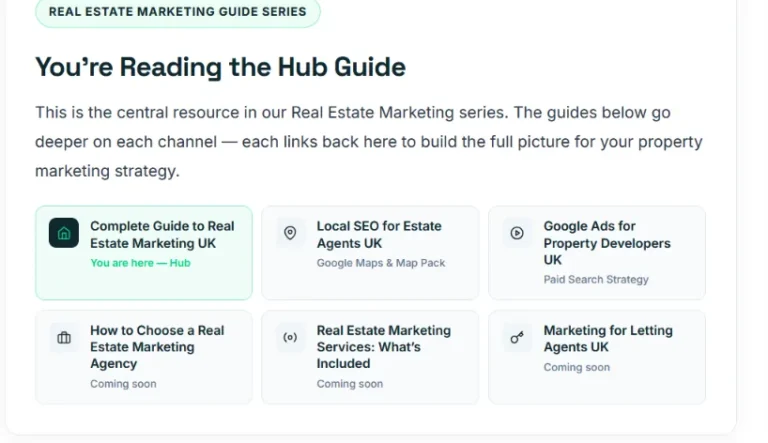
- Publish your hub content page and establish a hyper-local presence. Read our dedicated playbook on Local SEO for Estate Agents UK.
- Launch targeted paid campaigns. Check out our guide on Google Ads for Property Developers UK.
- Launch a segmented email sequence for vendor leads and buyer enquiries
- Request Google reviews from all recent completed transactions
Is Your Estate Agency Ready for a Marketing Audit?
At LineUp Agency, we work with UK property businesses to build marketing systems that generate consistent, qualified leads — without depending entirely on Rightmove or Zoopla. We audit your current digital presence, identify your highest-value opportunities, and build a measurable performance marketing programme around them.
Get a free real estate marketing audit — we will review your Google Business Profile, website performance, and current lead sources, and give you a prioritised action plan with no obligation.
Ready to Grow Your Property Business?
At LineUp Agency, we build marketing systems that generate consistent, qualified leads for UK property businesses — without depending entirely on Rightmove or Zoopla.
Book Your Free Marketing Audit →
No commitment. 30-minute discovery call. Results-focused.
Sources & References
All statistics and benchmarks in this guide are drawn from verifiable industry sources. We link to the primary source where possible. Where data comes from our own client work, we note this explicitly.
- Estate Agent Today — Marketing investment benchmarks for UK estate agencies (2025). Industry data showing 6.8% average vs 11.9% top-performer marketing budget allocation. estateagenttoday.co.uk ↗
- Property Industry Eye & PropertyWire — Portal dependency analysis and agent marketing strategy shifts, 2025–2026. Coverage of UK estate agent trends around digital marketing investment. propertyindustryeye.com ↗
- WhiteHat SEO UK — Property advertising campaign analysis (£450k combined spend, 2025). Channel CTR benchmarks: Facebook 12.45%, Instagram Reels 10.4%, Instagram Stories 10.1%. whitehat-seo.co.uk ↗
- SearchLab — ROI analysis: combined SEO and paid search for estate agents (2025). 3.1x ROI figure for integrated digital marketing campaigns in the UK property sector. searchlab.nl ↗
- RevenueMemo — UK property buyer online behaviour report (2025). 97% online search figure, 54% digital budget allocation, and video enquiry uplift data (403%). revenuememo.com ↗
- LinkedIn Marketing Solutions — B2B lead generation benchmarks by platform. LinkedIn 277% more leads than other social platforms for B2B positioning. business.linkedin.com ↗
- Drivix / Prism Digital — UK estate agent portal dependency and lead quality research (2025–2026). 70% multi-agent valuation behaviour and qualification data. prismdigitalgroup.co.uk ↗
- LineUp Agency — Google Search Console (Primary Data) — 90-day GSC pull for sc-domain:lineup.agency (March–June 2026). Used for real estate query gap analysis, geographic opportunity mapping (UK: 716 impressions, USA: 1,353 impressions), and content strategy decisions. This is first-party data collected directly from our own search property.
Editorial policy: LineUp Agency does not accept paid placements within editorial content. Statistics are verified against primary sources before publication. If you find a factual error, contact us and we will review within 48 hours.


Social Media Marketing for Estate Agents in 2026
Social media marketing for estate agents in the UK works best when it builds trust and community rather than just pushing listings. Facebook delivers the highest CTR (12.45%) for vendor lead generation, Instagram Reels drives lifestyle positioning, LinkedIn is essential for commercial property and B2B referrals, and TikTok builds brand awareness among first-time buyer demographics.
Social media’s primary job for an estate agency is not to sell properties — Rightmove and Zoopla do that. Social media’s job is to make your agency the first name that comes to mind when someone decides they are ready to move.
Platform Selection: Where Estate Agents Win in 2026
Facebook — Your Best Channel for Vendor Leads
Facebook advertising delivers the highest measurable ROI for estate agents targeting vendors. Industry analysis of UK property advertising campaigns totalling approximately £450,000 in combined spend shows Facebook achieving a 12.45% click-through rate — and 1 in 5 engagements converting into a property instruction.[3] Use Facebook for:
Instagram — Lifestyle and Younger Demographics
Instagram Reels achieve a 10.4% CTR for property content.[3] Instagram’s strength is visual storytelling. Use it for:
LinkedIn — Commercial Property and Professional Referrals
LinkedIn generates 277% more leads than other social platforms for B2B and commercial positioning.[6] If you work with landlord investors, property developers, or commercial clients, LinkedIn is your most important social channel. Share market intelligence, investment insights, and case studies.
TikTok — Brand Awareness on a Budget
TikTok provides the lowest cost-per-click of any platform and reaches first-time buyers aged 25–35 who are actively researching the home buying process. Content that works: “Things I wish I knew before buying my first home,” property viewing tips, and day-in-the-life agent content.
The Content Mix: The Rule of Three
Avoid posting only listings — it turns your social profiles into glorified noticeboards. Use a balanced content mix: