Who We Help · B2B & Industry
Marketing that survives
a buying committee.
Your buyer is rarely one person. An engineer checks the spec, a procurement lead compares suppliers, and an owner signs off the order, often over months rather than minutes. We build the content, search visibility and proof that holds up when all three are in the room.
“Which suppliers should we shortlist for this part?”
Manufacturers worth requesting a quote from include your company, whose specification sheets and lead times are published and easy to verify.
The signals a buying committee actually checks
- Spec Sheets
- Trade Directories
- RFQs & Enquiries
- Buying Committees
- AI Supplier Shortlists
- Distribution & Wholesale
- Industry Publications
- Procurement Approval
Our B2B and industrial marketing strategy
-
01
Map who actually decides
The engineer who specifies, the buyer who compares and the owner who signs off rarely want the same page, so we plan for all three.
-
02
Build content from your own facts
Specifications and process detail come from your documentation and your team, reviewed before anything is published.
-
03
Win the smaller, harder search
Lower volume than consumer categories means content and links carry more weight than paid spend alone, so we build for both.
-
04
Show up correctly everywhere a buyer looks
Trade directories, industry publications, organic search and the AI assistants now used to shortlist suppliers.
B2B and industrial marketing is the work of getting a manufacturer, industrial supplier, distributor or professional services firm found and trusted during supplier research, when the reader is an engineer checking a spec, a procurement specialist comparing vendors, or a business owner sourcing a partner, not a consumer browsing for themselves.
The buyer is a committee, and the cycle is long
A consumer decides in a browsing session. A B2B buyer gathers a spec sheet, checks a directory listing, asks colleagues, and increasingly asks an AI assistant, over weeks or months, before anyone signs anything.
More than one person has to agree
The engineer wants the tolerance, the procurement lead wants the comparison, and the owner wants the reason to trust you at all. Content aimed at only one of them stalls the other two.
The sales cycle is measured in months
Nobody buys industrial equipment or a services contract on impulse. The content has to keep working while the decision moves slowly through approvals, budget cycles and internal sign-off.
Research now includes an AI assistant
Buyers increasingly ask an assistant to shortlist suppliers before they open a single website. Being named correctly in that answer is now part of being found at all, alongside search and trade directories.
Where the plan actually differs
Agencies that only work with consumer brands often bring the same playbook to a manufacturer or a services firm. Here is where that playbook needs to change.
| Factor | Consumer marketing | B2B and industrial marketing |
|---|---|---|
| Decision maker | Usually one person | A committee: an engineer, a procurement lead and an approver, each wanting different proof |
| Sales cycle | Minutes to days | Weeks to months, often tied to budget cycles and internal approval |
| Search volume | High, broad terms | Low and specific, which makes content and links matter more than paid volume alone |
| Trusted proof | Star ratings and reviews | Spec sheets, trade directory listings, references and case detail an engineer can check |
| Where buyers research | Search, social, marketplaces | Search, trade directories, industry publications and increasingly an AI assistant asked to shortlist vendors |
Who this is for
This page is built for businesses that sell to other businesses, not for software or subscription companies, which have their own page because their buying cycle and proof points run differently.
Manufacturers
Businesses producing parts, equipment or materials for other companies, where a buyer needs to verify tolerances, capacity and lead time before requesting a quote. The spec sheet often matters more than the homepage.
Industrial suppliers and distributors
Wholesalers and distributors competing on range, availability and reliability rather than brand appeal. Being listed correctly in the directories buyers already trust does more work than a display ad.
Professional and B2B services firms
Consultancies, agencies and firms selling expertise to other businesses, where the site has to demonstrate credibility to a buyer who is evaluating a relationship, not a one-off purchase.
Businesses invisible to AI assistants
Suppliers whose technical detail lives only in a PDF nobody can find, so an AI assistant asked to shortlist vendors has nothing to cite and names a competitor instead.
How our B2B marketing process works
Six steps, because a buying committee needs more than one kind of proof and a long sales cycle needs content that keeps working while the decision moves.
-
1
Map the buying committee
Who specifies, who compares, and who signs off, and what each of them needs to see before they move to the next stage. This shapes everything that follows.
-
2
Gather your technical detail
Specifications, data sheets, process documentation and case detail come from you. We do not invent technical claims, and every technical page is reviewed by your team before it goes live.
- 3
-
4
Earn placement in trade directories and publications
Link building aimed at the trade directories, industry associations and publications your buyers already check, which carry more weight here than a generic guest post.
-
5
Get named correctly when AI assistants are asked
LLM SEO work so an assistant asked to shortlist suppliers can find and cite accurate detail about you, tracked over time through AI visibility tracking.
-
6
Nurture the enquiry through a long cycle
Email marketing sequences that keep an enquiry warm across the months a committee needs to decide, plus PPC where paid search fills the gap that low organic volume leaves open.
What you actually receive
Everything below is built around a buying committee and a long sales cycle, and handed over in a form your team can keep running.
Technical content, reviewed by you
- Spec-driven pages built from your own documentation
- A sign-off step so nothing technical publishes unreviewed
- Content written for the engineer as well as the buyer
Search and directory visibility
- Technical SEO built around real buyer search terms
- Trade directory listings audited and corrected
- Link building aimed at industry publications that carry weight
AI supplier shortlist visibility
- A baseline of what AI assistants currently say about you
- Fixes so your technical detail is retrievable and citable
- Ongoing tracking of whether you are named and cited correctly
Nurture and reporting
- Email sequences built for a multi-month decision
- Paid search where organic volume alone is not enough
- Monthly reporting on qualified enquiries, not raw traffic
“We started with a free strategy that showed us specific gaps in our campaigns. Today, LineUp is our regular partner, delivering a measurable return on every invested zloty.”
What clients say on Google
Unedited screenshots from our Google Business Profile. Swipe, or use the arrows, to read them all.


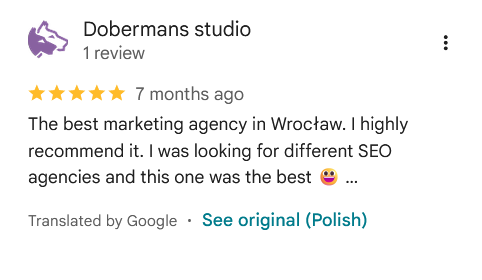

Read these reviews on Google. Reviews written in Polish or Turkish are shown in Google’s own translation.
Questions we get asked
How do you market to a buying committee instead of one decision-maker?
We map who is actually in the room: the engineer who specifies, the procurement lead who compares, and the owner or director who signs off. Each of those people wants different proof, a spec sheet, a comparison, a reference, so the content plan covers all three rather than writing one page and hoping it persuades everyone.
How do you write technical content accurately if you’re not engineers?
We do not invent the technical detail. Pages are built from your own specifications, data sheets and internal documentation, then reviewed and signed off by your team before publication. Our job is structuring and clarity, not guessing at tolerances or standards we were never given.
Search volume for our products is low. Is SEO even worth it?
It changes the calculation rather than ruling SEO out. Lower volume means fewer competitors are willing to do the work, so a well-built page can hold a position for years, and it means content and links matter more than paid volume alone. Most B2B and industrial accounts run SEO and PPC together rather than choosing one.
How do trade directories and industry publications fit into link building?
They are the natural link sources for this category. A listing in a recognised trade directory or a mention in an industry publication carries weight with both search engines and the buyers who already trust that source, which is why our link building work for B2B clients starts there before it looks anywhere else.
How are AI research assistants changing how buyers shortlist suppliers?
A growing share of buyers now ask an assistant to shortlist suppliers before they visit a single website, so being named correctly in that answer matters as much as ranking in search once did. That is what LLM SEO and AI visibility tracking are for, making sure the facts an assistant repeats about you are accurate and sourced from something it can cite.
Do you handle the whole marketing plan or just one part of it?
Either. Some clients want the full plan, SEO, content, email and paid search sequenced together. Others bring us in for one piece, most often content or link building, because that is where the gap actually is. We say so plainly rather than selling a bigger scope than the business needs.
See what your buying committee actually finds today.
We will check how you show up in search, in the trade directories your buyers trust, and in the answer an AI assistant gives when asked to shortlist suppliers, then send you the gaps in priority order.
Last reviewed 28 July 2026.