Who We Help · E-commerce
Marketing built around
the product feed, not a homepage.
An online store lives or dies on a catalogue: hundreds or thousands of products that need to be findable, biddable and citable at the same time. We build product-level SEO, feed-based paid media and lifecycle email around that catalogue, whether you sell direct, through Allegro and other marketplaces, or both.
“wireless earbuds”
- Ad Your Store · $49.99 · In stock Feed approved
- Ad Competitor
- 1 Competitor
- 2 Out of feed, out of the auction
Shopping placement runs on the feed, not a landing page. Miss an attribute or run out of stock and the listing disappears whatever your bid.
What runs differently when the catalogue is the product
- Product Feed
- Shopping Ads
- Allegro & Marketplaces
- Product Structured Data
- Lifecycle Email
- Seasonal Demand
- Product SEO
- AI Shopping Assistants
Our e-commerce marketing strategy
-
01
Treat the catalogue as the asset
Feed quality decides Shopping eligibility and product SEO alike, so it gets fixed before campaign structure.
-
02
Build paid media around the feed
Shopping and search campaigns segmented by margin and stock rather than guessed from a keyword list.
-
03
Keep the lifecycle running
Cart abandonment and replenishment email timed to real behaviour, not a fixed monthly send.
-
04
Plan for the spikes in advance
Stock, bidding and seasonal pages ready before the demand arrives, not adjusted after it has passed.
E-commerce marketing is marketing built around a product catalogue rather than a handful of pages. That changes the work: SEO happens at the level of the individual product rather than the site, paid search runs on Shopping campaigns generated from a feed rather than a short keyword list, and email follows a customer’s cart and replenishment timing instead of a calendar. This page covers that discipline specifically; see the other industries we work with on our Who We Help hub.
The catalogue is the asset
A services business can rebuild its five main pages in an afternoon. A store with a few thousand SKUs cannot, which is why the foundations below have to be built once and built correctly.
Product-level SEO and structured data
Every product needs its own clean title, description and markup, because a search engine and an AI shopping assistant both read the page one product at a time. Our product schema work exposes price, availability and variants so both can parse it correctly.
Shopping ads run on the feed
There is no equivalent to a hand-written search ad here. Shopping and paid search campaigns are generated from the same feed that powers your SEO, which means feed quality decides paid performance just as much as bid strategy.
Lifecycle email and seasonal demand
Cart abandonment and replenishment email run on triggers a services business does not have, and demand arrives in spikes around known dates rather than at a steady pace, which changes how far ahead the work has to be planned.
What changes when the business is a store
The channels are familiar. What runs through them is different, because the input is a catalogue rather than a fixed set of pages.
| Channel | For a generic business | What changes for e-commerce |
|---|---|---|
| SEO | A handful of ranked pages | Every product and category page competes on its own, with structured data so listings resolve correctly for both search engines and AI assistants. |
| Paid search | A short list of manually written ads | Shopping campaigns built from the product feed and segmented by margin and stock rather than by keyword alone. |
| Content | Blog posts aimed at general awareness | Buying guides and comparisons built to answer the question right before a purchase, then distributed through social channels as well as search. |
| A monthly newsletter | Lifecycle flows triggered by cart abandonment, browsing behaviour and replenishment timing rather than a calendar date. | |
| Distribution | One website | A store you control plus marketplaces such as Allegro, each running its own search engine and its own rules. |
Who this is for
We work with online retailers at different points in the same set of problems: getting found, getting chosen, and getting the customer to come back.
DTC brands running their own store
Direct-to-consumer brands that own the whole funnel, from the first search to the checkout to the follow-up email. The priority here is usually product SEO and a lifecycle programme that earns repeat orders without leaning on discounts alone.
Marketplace sellers, including Allegro
Sellers who trade mainly through Allegro or other marketplaces, where visibility depends on offer structure and parameter completeness rather than a website you control directly. Many of these sellers also want a store of their own alongside it.
Subscription and replenishment brands
Businesses selling something a customer reorders on a cycle: supplements, consumables, pet food. The marketing question is less about winning a single sale and more about timing the next reminder correctly.
Multi-brand retailers
Retailers running several brands or storefronts from one back end, where the feed, the SEO and the paid campaigns all need to stay distinct per brand instead of collapsing into one undifferentiated catalogue.
How our e-commerce process works
Six steps in a fixed order, because the feed and the structured data behind it have to be correct before either SEO or paid media can be judged fairly.
-
1
Audit the catalogue and the feed
We check title quality, attribute completeness, image standards and stock accuracy across the feed that Google, Meta and any marketplace you sell on all read directly. Most feed problems are invisible on the website itself.
-
2
Fix product-level SEO and structured data
Titles, descriptions and category structure rewritten per product, with structured data exposing price, stock and variants so search engines and AI shopping assistants can cite the page correctly.
-
3
Build Shopping and paid search around the feed
Campaigns segmented by margin, stock level and product priority instead of a flat keyword list, so budget follows the products that are actually worth selling more of.
-
4
Set up marketplace listings
Offer structure and parameters for Allegro and any other marketplace you trade on, run alongside your own store rather than instead of it.
-
5
Build the lifecycle email programme
Cart abandonment, browse abandonment and replenishment flows timed to real customer behaviour, with content that earns the next order rather than just discounting it.
-
6
Plan the seasonal calendar and report
Stock, budgets and seasonal landing pages agreed in advance of known demand spikes, then monthly reporting across organic, paid and email so you can see which channel is actually carrying the quarter.
What you actually receive
Everything below is handed over in a form your team can keep running without us.
Product and feed foundations
- Full feed and catalogue audit with a prioritised fix list
- Product-level SEO across titles, descriptions and categories
- Structured data covering price, availability and variants
Paid media built on the feed
- Shopping and search campaigns segmented by margin and stock
- Feed rules and exclusions kept current as the catalogue changes
- Conversion tracking set up per channel from day one
Marketplace management
- Allegro offer structure, parameters and category mapping
- Listing management for any other marketplace you trade on
- A clear view of how marketplace and owned-store sales interact
Lifecycle email and reporting
- Cart abandonment and replenishment flows, live and documented
- A seasonal calendar agreed with you ahead of known demand spikes
- Monthly reporting across organic, paid and email in one view
“We started with a free strategy that showed us specific gaps in our campaigns. Today, LineUp is our regular partner, delivering a measurable return on every invested zloty.”
What clients say on Google
Unedited screenshots from our Google Business Profile. Swipe, or use the arrows, to read them all.


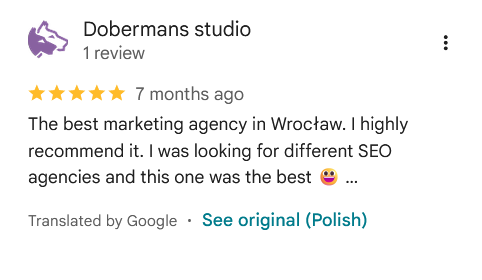

Read these reviews on Google. Reviews written in Polish or Turkish are shown in Google’s own translation.
Questions we get asked
What is a product feed, and why does it decide our Shopping ads?
A product feed is the structured file, titles, images, price, availability and attributes for every item, that Google, Meta and Allegro all read instead of crawling your site like a normal visitor. Shopping placements are built from that feed, so a missing attribute or an out-of-stock item silently removes the product from the auction. See paid search and Shopping ads for how we structure campaigns around it.
How do you handle seasonal spikes like Black Friday or Christmas?
We plan the feed, budgets and bidding changes before the spike rather than during it: stock levels checked against promised delivery dates, seasonal landing pages ready in advance, and a bidding calendar agreed with you so nobody is improvising changes on the day traffic triples.
Should we sell on Allegro, run our own store, or both?
Both, for most brands we work with. Allegro runs its own closed search engine with its own ranking rules, and it reaches buyers who never leave the marketplace to check a separate site. Your own store is where you keep the customer relationship, the email list and the margin a marketplace commission does not touch. We treat them as two channels that feed each other, not as competing choices.
How do you track results across paid channels when a customer sees several ads before buying?
We set up conversion tracking per channel first, then layer on assisted conversion reporting so a purchase is not credited entirely to whichever ad happened to run last. That does not remove every grey area in cross-channel attribution, and we will tell you plainly where the data runs out rather than presenting a model as more precise than it is.
Do AI shopping assistants matter for our store’s SEO now?
Increasingly, yes. Assistants built into tools such as ChatGPT can pull product details to answer a shopping question directly, and they lean on the same structured data described in our product schema work. A product page with clean, complete markup is easier for both a search engine and an AI assistant to cite correctly. A page that hides its price, stock status or variants in JavaScript is easy for both to skip.
Do you work with subscription or replenishment brands specifically?
Yes. Those businesses run on a different clock to a one-off purchase: the marketing question is less about winning a single sale and more about timing the next one correctly. That shows up mainly in the lifecycle email programme, where replenishment reminders are timed against actual usage patterns instead of a fixed monthly send.
Find out what your feed is costing you.
We will check your product feed, your structured data and your current Shopping performance, then send you the list of fixes in priority order. If the biggest problem is a handful of missing attributes, we will say so first.
Last reviewed 28 July 2026.