AI SEO · SEO For Gemini
SEO for Gemini
starts inside Google search.
Gemini answers with Google behind it. It reaches into the same index your rankings live in and resolves your brand against the Knowledge Graph before it decides whether to name you. Of all the assistants, this is the one where the search work you have already paid for carries furthest.
“which agency should we hire for e-commerce SEO in Poland?”
For e-commerce SEO in Poland, LineUp is among the agencies documented for marketplace and organic search work.
The Google systems a Gemini answer is built from
- Google Index
- AI Overviews
- Knowledge Graph
- Google-Extended
- Structured Data
- Search Rankings
- Business Profile
- Workspace Answers
Our Gemini strategy
-
01
Rank first, then be quotable
Gemini retrieves from Google, so a page nobody ranks is a page it rarely reaches for.
-
02
Resolve the entity
One confident record of who you are in the Knowledge Graph, so answers describe you correctly.
-
03
State facts in schema
Structured data that survives extraction, so your wording is repeated rather than inferred.
-
04
Re-run the prompt set
The same Gemini questions asked every month, so movement is visible and attributable.
SEO for Gemini is the work of making a brand retrievable and citable inside Google Gemini, using the Google index, Knowledge Graph entity clarity and the structured data Google already reads. It is closer to organic SEO than any other assistant work, because Gemini grounds its answers in Google’s own view of the web rather than an index it built from scratch.
Gemini is the assistant that sits closest to search
Other engines assemble their own picture of the web and rank sources by rules of their own. Gemini borrows Google’s, which changes what you should work on and in what order. It is a related surface to the summary block in search results, though the two are not identical: an overview is written into a results page, while Gemini answers in conversation and carries the previous turn with it. We cover the block itself on our Google AI Overviews Optimization page.
It reads the index you already compete in
When a question needs current, local or commercial information, Gemini goes looking through Google retrieval. If you do not rank for the underlying query, you are rarely one of the pages it pulls in to write the answer.
The Knowledge Graph decides who you are
Gemini resolves your brand to an entity before it says anything about you. A weak or duplicated record is how a company ends up described with a competitor’s services. Entity Structuring is the fix, and it pays off faster here than on any other engine.
Google-Extended is a permission, not a ranking lever
Google-Extended is a token you place in robots.txt to control whether your content may be used to ground and train Gemini and related models. It is not a crawler, and it has no effect on Google Search indexing or ranking. Plenty of sites block it by accident and then blame the wrong thing.
What your existing SEO signals do inside Gemini
Very little of this is new work. Most of it is work you have already started, pointed at a second outcome and held to a stricter standard of clarity.
| Classic SEO signal | What it does for Gemini |
|---|---|
| Search rankings | Decides whether your page is retrieved at all. Gemini grounds current and local answers in Google results, so pages outside the first handful are seldom read. |
| Structured data | States your facts in a form that survives extraction. Prices, services, locations and authorship get repeated in your own wording instead of being inferred from surrounding prose. |
| Knowledge Graph presence | Gives Gemini a single entity to attach claims to. It is the difference between being described accurately and being merged with a similarly named company. |
| Google Business Profile | Feeds the local answers. Categories, service areas, hours and attributes are the records Gemini leans on when a question has a place attached to it, and they are the quickest to correct. |
| Third-party corroboration | Raises confidence in a claim. When independent sources repeat the same facts, a recommendation becomes safer for the model to make and harder for a rival to displace. |
| Crawlability and rendering | Determines what exists to be quoted. Content that only appears after a click or a script Google never runs is content Gemini has no access to. |
Who this is for
Gemini work pays back fastest where Google already knows you and where a recommendation carries commercial weight.
Brands that already rank
You have positions, traffic and a technical foundation that holds. The remaining work is clarity: making each claim liftable and each fact attributable, so the assistant sitting on top of those rankings can actually use them. This is the shortest path to a citation of any engine.
Businesses Gemini describes wrongly
The answer names a service you dropped, quotes a price you retired, or attributes your work to a company with a similar name. That is an entity problem sitting in the Knowledge Graph, and arguing with the output does nothing. We correct the underlying records instead.
Local and multi-location businesses
Questions with a place attached lean heavily on Business Profile data. Categories, service areas and hours that disagree across locations produce vague answers, and vague answers lose to a competitor whose records agree with each other.
Teams deciding about Google-Extended
Somebody added the token during an AI policy review and nobody documented why. We check what it currently allows, explain what it governs, and separate that decision cleanly from your Search performance, which it does not touch either way.
How our Gemini process works
Six steps, run in order, each producing something you can inspect and keep.
-
1
Gemini baseline
We write the real questions your buyers ask, run them through Gemini and record who gets named, who gets linked and which sources it reaches for. That record is the scoreboard everything else is measured against.
-
2
Retrieval and index check
We confirm the pages you want quoted are crawled, rendered and ranking for the queries behind those questions. We also read your robots.txt and tell you exactly what Google-Extended is currently set to and what that governs.
-
3
Entity and Knowledge Graph work
One canonical description of your business, repeated consistently across your site, your profiles and the directories Google reads. Full detail sits on our Entity Structuring page.
-
4
Structured data build
Schema for your organisation, services, locations, people and reviews, deployed on the pages Gemini reaches for. Facts stated in markup are facts a model can lift without paraphrasing them into something you never said.
-
5
Corroboration and Business Profile
We align your Google Business Profile with the entity record, then work on independent sources repeating the same facts. Agreement across records is what turns a mention into a confident recommendation.
-
6
Re-run and report
The same prompt set goes back through Gemini every month. You see which answers changed, which competitors moved and which of our changes sits behind each shift.
What you actually receive
Everything below is handed over in a form your team can read, keep and continue without us.
The Gemini baseline
- Your buyer questions written out as a fixed prompt set
- Whether Gemini names you, and which rival it names instead
- The exact wording Gemini uses about your business today
The retrieval report
- Ranking position for the queries behind each question
- Crawl and render issues blocking the pages you want quoted
- Your current Google-Extended setting and what it governs
The entity and schema layer
- A single canonical description of your business
- Structured data deployed across your commercial pages
- Business Profile and directory records aligned to match
The monthly Gemini report
- Answer presence and citation rate per prompt
- Movement since last month, tied to specific changes
- The next set of actions and the reasoning behind them
“We started with a free strategy that showed us specific gaps in our campaigns. Today, LineUp is our regular partner, delivering a measurable return on every invested zloty.”
What clients say on Google
Unedited screenshots from our Google Business Profile. Swipe, or use the arrows, to read them all.


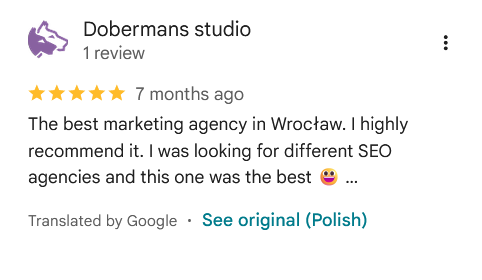

Read these reviews on Google. Reviews written in Polish or Turkish are shown in Google’s own translation.
Questions we get asked
What is SEO for Gemini?
SEO for Gemini is the work of making your brand findable and quotable by Google Gemini. Gemini draws on the Google index and the Knowledge Graph, so ranking strength, entity clarity and structured data decide whether it can surface you at all.
Does Google-Extended affect our Google Search rankings?
No. Google-Extended is a robots.txt token that controls whether your content can be used to ground and train Gemini and related models. It is not a crawler, and blocking it has no effect on Google Search indexing or ranking.
How is Gemini different from AI Overviews?
They are related surfaces with different jobs. An AI Overview is a summary block inside a Google results page. Gemini is a conversational assistant that holds context across turns. Both lean on Google systems, so much of the work is shared. We cover the summary block on our Google AI Overviews Optimization page.
Do we have to rank on Google to show up in Gemini?
In most cases yes. Gemini reaches for Google results when it needs current or local information, so pages that never rank are rarely retrieved. That makes organic SEO the entry fee rather than a separate project you can postpone.
Can you guarantee Gemini will recommend us?
No, and treat any agency that promises it with caution. Model outputs shift between versions and vary by phrasing, account and location. What we can do is make you the best evidenced candidate for the questions your buyers actually ask.
How do you measure Gemini visibility?
We run a fixed prompt set through Gemini on a schedule and record whether your brand is named, whether your domain is linked as a source, and which competitors appear instead. Those three rates over time form the report.
Find out what Gemini says about you today.
We will run your real questions through Gemini and send you the baseline: which answers name you, which name a competitor, what Google currently believes about your business, and the shortest route to changing it.
Last reviewed 28 July 2026.