
The short version
- Market a Manchester aesthetic clinic through local search, factual treatment pages and ads for consultations or non-prescription treatments.
- Botox and other botulinum toxin products are prescription-only, so CAP Code rule 12.12 bans advertising them to the public, including hashtags and offers.
- You can advertise dermal fillers, but drop countdown offers, retouched before-and-after photos and any targeting of under-18s.
- Complete your Google Business Profile and ask every patient for a review, but never offer a reward for one.
- Track booked consultations in Google Analytics 4 and judge each channel on bookings, not clicks or followers.
How do you market an aesthetic clinic in Manchester?
You market an aesthetic clinic in Manchester by making it easy to find on Google Maps and in local search, publishing factual pages about the concerns and treatments you offer, and advertising consultations and non-prescription treatments rather than prescription-only medicines. Everything you publish, including your own website and social posts, has to follow the CAP Code, which the Advertising Standards Authority (ASA) enforces. That rules out ads for Botox and other botulinum toxin products, misleading before-and-after photos, pressure tactics and ads aimed at under-18s.
This guide covers the rules first, then local SEO, content, social media, paid ads and a 90-day plan. For the national picture, read our guide to aesthetic clinic marketing in the UK, or see how we handle marketing for private clinics.
What are the advertising rules for aesthetic clinics?
Fix compliance before you spend money on visibility. More traffic to a non-compliant page only spreads the problem.
Prescription-only medicines
CAP Code rule 12.12 says prescription-only medicines or prescription-only medical treatments may not be advertised to the public. The law says the same thing: regulation 284 of the Human Medicines Regulations 2012 bans publishing an advertisement “likely to lead to the use of a prescription only medicine”.
A joint CAP and MHRA enforcement notice names Botox, Vistabel, Dysport, Bocouture and Azzalure as prescription-only medicines (POMs). The ban applies even when a registered medical professional injects, and covers hashtags, images, prizes and indirect phrases such as “wrinkle relaxing injections”.
Your website gets some leeway. The ASA’s advice on botulinum toxin products says a clinic website may give balanced, factual information about a POM as a possible treatment option after a consultation. The POM still must not appear in sponsored ads, on your homepage, in your logo or in testimonials.
This is enforced. In 2024 the ASA upheld a complaint about a booking-platform listing that showed “Anti Wrinkle/Botulinium Toxin” with a price.
What you can advertise instead
| Avoid | Use instead | Why |
|---|---|---|
| “Botox Manchester” ads or keywords | “A consultation for the treatment of lines and wrinkles” | CAP gives this consultation wording as an example that may be acceptable |
| “Wrinkle relaxing injections” or “#botox” | The consultation, the practitioner and the clinic | Indirect references to a POM count as POM ads |
| “Anti-wrinkle injections and dermal fillers” | “Dermal fillers” or “cosmetic fillers” on their own | Fillers are not POMs, but pairing them with “injections” implies a POM |
| Botox special offers or price promotions | Treatments that are not prescription-only, such as fillers, chemical peels or laser hair removal, with factual price guidance | Only non-POM treatments may be promoted to the public |
Before-and-after photos
The ASA’s cosmetic interventions guidance warns against exaggerated or unrealistic claims, including those made through before-and-after images. Use the same lighting, angle and distance in both photos. Don’t retouch or filter them. Show a typical result and say how long after treatment the photo was taken. Keep written consent for every image, and never use a before-and-after pair to promote a POM.
Time-limited offers and pressure
CAP’s advice on cosmetic interventions and social responsibility says people must not be put under undue pressure to buy. It says countdown clocks and lines like “Hurry, offer must end Friday” should not be used. It also warns against presenting a procedure as a casual decision or exploiting insecurities about appearance.
In 2025 the ASA upheld complaints about a “Black Friday” offer for injected filler procedures, because its deadline created “a sense of undue urgency”. In March 2026 the ASA reported that time-limited claims kept coming up in its monitoring of cosmetic procedure ads. If you promote a lawful treatment, give people time to think and drop the countdown.
Under-18s
CAP Code rule 12.25 says ads for cosmetic interventions must not be directed at under-18s through the media or context they appear in. Set every paid campaign to 18+ and avoid youth-focused placements. Separately, the Botulinum Toxin and Cosmetic Fillers (Children) Act 2021 makes it an offence in England to give botulinum toxin or cosmetic filler injections to anyone under 18, or to arrange them, except in limited cases set out in the Act.
Titles, qualifications and registration
Claims about who treats patients must be accurate. In the 2024 booking-listing ruling above, the ASA found a clinic name using “Dr” misleading because it implied a medical qualification the business could not show.
Registration with the Care Quality Commission (CQC) depends on what you do. CQC’s scope guidance on surgical procedures includes cosmetic surgery by a healthcare professional where instruments go into the body, such as liposuction. It excludes subcutaneous injections to enhance appearance. If you offer surgery or treat medical conditions, check the guidance.
The government has also said it plans to license non-surgical cosmetic procedures in England. Under the plans, the highest-risk procedures would be limited to regulated healthcare professionals working for CQC-registered providers. Check the current status before making licensing claims.
Marketing for clinics and dentists
Google Maps, clear treatment pages, patient reviews and ads that follow the rules. Start with a free audit.
Why your clinic may not show up on Google
When someone in Manchester searches “lip fillers near me”, Google decides which clinics appear in the map results. Google says its local results are based on relevance, distance and prominence, and that you can’t pay for a better local ranking. Prominence includes how many reviews you have and how many sites link to you.

| Factor | What it means | Common gaps |
|---|---|---|
| Relevance | How well your profile and pages match the search | Generic copy, no page for each treatment you offer |
| Distance | How far you are from the person searching | Missing or wrong address on the profile and in directories |
| Prominence | How well known and trusted you are | Few reviews, few links from local sites, thin profile |
Local SEO for a Manchester aesthetic clinic
Complete your Google Business Profile
Choose the closest primary category, such as “Skin care clinic” or “Medical spa”. Fill in your opening hours, booking link and a plain description of what you do. List your lawful treatments as services, and leave POM product names out of service names, posts and photo captions. Add real photos of your premises, treatment rooms and team. Use a real address where patients are seen, not a virtual office.
Post updates that inform
Use profile posts for practitioner introductions, new non-POM treatments, consultation availability and aftercare tips. Skip countdown offers and POM names. End each post with one clear action.
Ask for reviews and reply to them
Google says more reviews and positive ratings can help your local ranking. Send every patient a review link after their appointment, and reply to every review, positive or negative. Don’t write, buy or swap reviews, and never offer a discount, gift or other reward for leaving one: Google’s review guidance prohibits incentives for reviews. The CMA’s fake reviews guidance explains the rules introduced in April 2025. Never confirm a patient’s treatment or medical details in a public reply.
Build pages for areas you really serve
Patients search by neighbourhood as well as by city. If you have a clinic in Didsbury or regularly see patients from Altrincham, a location page can help. Give it real detail: directions, parking, practitioners and treatments. Name lawful treatments, such as “dermal fillers in Didsbury”, not POMs. Skip near-identical pages for areas you don’t serve.
Content that explains treatments factually
Patients research for a while before they book. Search content that answers their questions earns visibility without breaking the rules, as long as it informs rather than sells. Good topics include:
- Concerns: lines and wrinkles, volume loss, pigmentation and scarring, and the options a consultation might cover.
- The consultation: what happens and why a treatment might not be suitable.
- Non-POM treatments: how dermal fillers, peels, microneedling or laser treatments work, typical downtime, risks and aftercare.
- Practitioners: profession, registration, training and treatments carried out.
- Price guidance: clear starting prices for non-POM treatments, with what is included.
Where your site mentions a POM, keep it balanced and factual, present it as one option a prescriber may discuss at consultation, and keep claims within the product’s patient information leaflet.
Social media without breaking the rules
Promotional social posts count as ads under the CAP Code, including unpaid posts and influencer content. Judge each channel by booked consultations, not followers.

| Platform | Useful for | Check before posting |
|---|---|---|
| Practitioner videos, clinic tours, treatment explainers | No POM names in captions, hashtags or on-screen text | |
| TikTok | Short educational videos | Audience age; rule 12.25 bars targeting under-18s |
| Local community, reviews, event news | No countdowns or “limited slots” pressure |
Point your link in bio at a page with your practitioners, the consultation process and a booking button, not your homepage.
The patient journey from search to repeat visit
People research and compare before booking. Our article on the private patient funnel covers this in more depth.
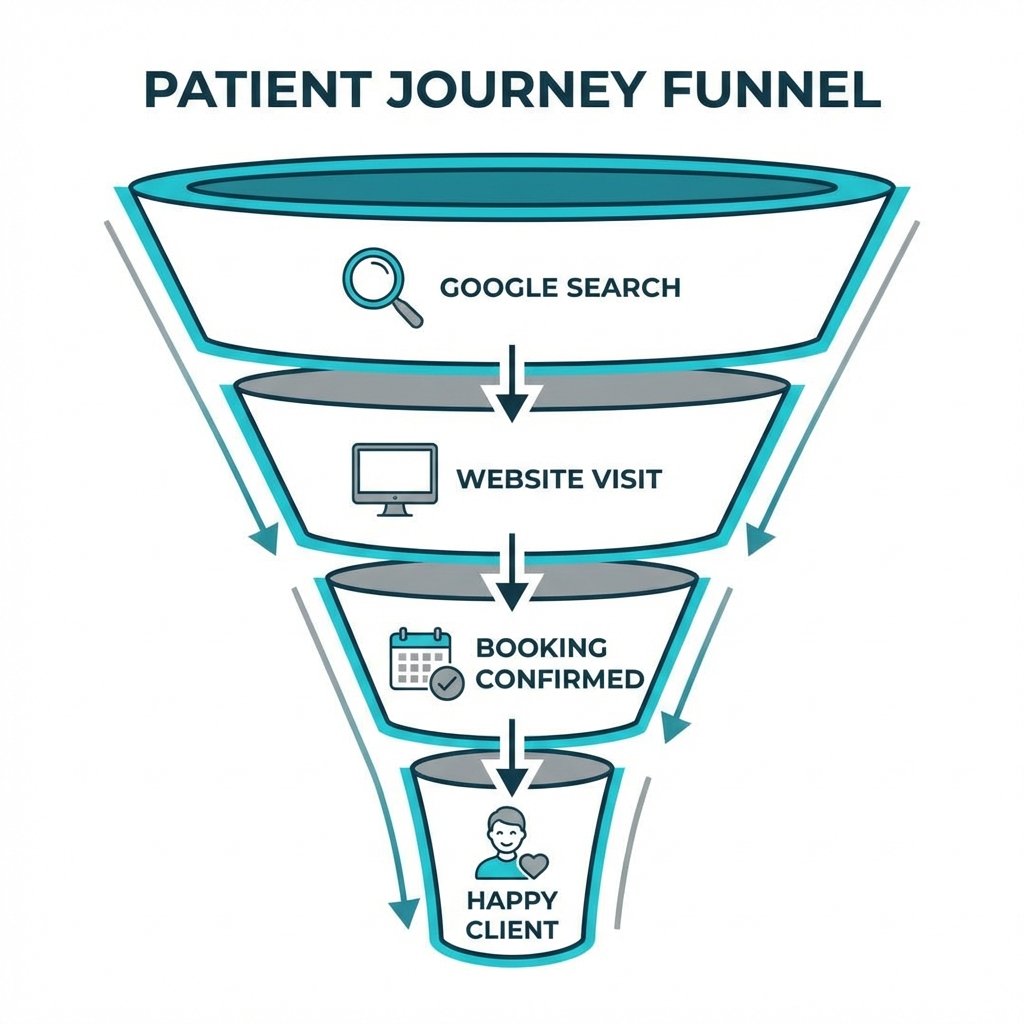
- Research: people search concerns and questions, such as “how long do lip fillers last”. Factual pages meet them here.
- Comparison: they compare reviews, practitioner credentials and realistic results. Make all three easy to find.
- Booking: a simple form, a clear consultation offer and a quick reply decide it. Name one person to answer calls, forms and messages.
- Return visits: aftercare emails and review-appointment reminders, sent only to patients who agreed to hear from you and free of POM promotion.
Paid advertising that stays within the rules
Google Ads
Search ads reach people already looking for a treatment. Google’s healthcare and medicines policy restricts prescription drug terms in ads, keywords and landing pages, on top of the UK rules. Bid on lawful, local terms such as “dermal fillers Manchester” or “laser hair removal Altrincham”. For lines and wrinkles, advertise a consultation without naming a POM. Send each campaign to a landing page with the practitioner, the process, price guidance and a booking form. Orthodontic practices face similar questions, as our guide to acquiring Invisalign patients with Google Ads shows.
Meta ads
Facebook and Instagram ads suit awareness and retargeting site visitors who did not book. The same rules apply: 18+ targeting, no POM names in copy or images, and no deadlines.
Track forms, calls and booked consultations as conversions in Google Analytics 4, and judge each campaign on bookings, not clicks.
Your 90-day plan

Days 1 to 30: compliance and foundations
- Search your website, booking listings and social profiles for POM names, “wrinkle relaxing” wording and countdown offers, and remove them
- Check every before-and-after image for consent, matching conditions and no retouching
- Complete your Google Business Profile
- Set up a review request after each appointment
- Set up Google Analytics 4 conversion tracking
Days 31 to 60: pages and campaigns
- Build or rewrite pages for your main lawful treatments and for the consultation
- Add practitioner profiles with registration and training
- Launch Google Ads on local, lawful terms with 18+ settings where available
- Publish factual articles that answer common patient questions
Days 61 to 90: review and improve
- Check which search terms and pages produced booked consultations
- Cut spend on terms that bring clicks but no bookings
- Start Meta retargeting with 18+ targeting
- Film short practitioner videos about consultations and aftercare
Want help with this? We help private clinics with search and advertising. We start with a free audit, and a fixed written price follows within 48 hours.
Sources
Rules and facts in this guide link to the pages that state them:
- ASA: CAP Code section 12, medicines, medical devices, health-related products and beauty products
- legislation.gov.uk: Human Medicines Regulations 2012, regulation 284
- CAP and MHRA: Enforcement notice on advertising Botox and other botulinum toxin injections (PDF)
- ASA: Beauty and cosmetics, botulinum toxin products
- ASA: Cosmetic interventions
- ASA: Cosmetic interventions, social responsibility
- ASA ruling: Dr Bunny Aesthetics (2024)
- ASA ruling: Bomb Doll Aesthetics (2025)
- ASA: Reports on ads for non-surgical liquid BBLs and cosmetic surgery abroad (2026)
- legislation.gov.uk: Botulinum Toxin and Cosmetic Fillers (Children) Act 2021
- CQC: Scope of registration, surgical procedures
- GOV.UK: Licensing of non-surgical cosmetic procedures
- MHRA: The Blue Guide, advertising and promoting medicines
- CMA: Fake reviews guidance
- Google: Tips to improve your local ranking
- Google: Tips to get more reviews
- Google Ads: Healthcare and medicines policy
Frequently asked questions
No. Botox and other botulinum toxin products are prescription-only medicines, and CAP Code rule 12.12 and the Human Medicines Regulations 2012 ban advertising them to the public anywhere in the UK. That covers Google Ads, social posts, hashtags, booking listings and offers. You can promote a consultation for lines and wrinkles without naming the product.
Yes. Dermal fillers are not prescription-only medicines, so you can advertise them if the ad doesn’t imply that a POM is also available. Call them “dermal fillers” or “cosmetic fillers”, and avoid phrases like “anti-wrinkle injections and dermal fillers”. The rules on under-18s, pressure and before-and-after images still apply.
It depends on how many treatments you promote, local competition and whether your website needs work. Start with the free parts: your Google Business Profile and reviews. Our private medical clinic marketing costs breakdown shows how to plan a budget.
Search ads can bring enquiries soon after launch. Local SEO, content and reviews build over months, so judge organic growth after a quarter, using booked consultations as the measure.
They matter for ranking and for patient trust. Google says more reviews and positive ratings can help your local ranking. Ask every patient, reply without disclosing medical details, and never buy, fake or reward reviews.
It depends on your services. CQC’s scope covers cosmetic surgery where instruments go into the body but excludes subcutaneous injections to enhance appearance. Check each service, and watch for the planned licensing scheme in England.

Co-Founder, LineUp Agency
Ekrem Abdulkerim is the co-founder of LineUp. He leads the performance side: analytics and tracking, technical SEO and Google Search Console. Search, ads and video for businesses that want more customers. Every guide is based on what we see in client accounts. See our services