Google Ads for Property Developers UK (2026 Guide)

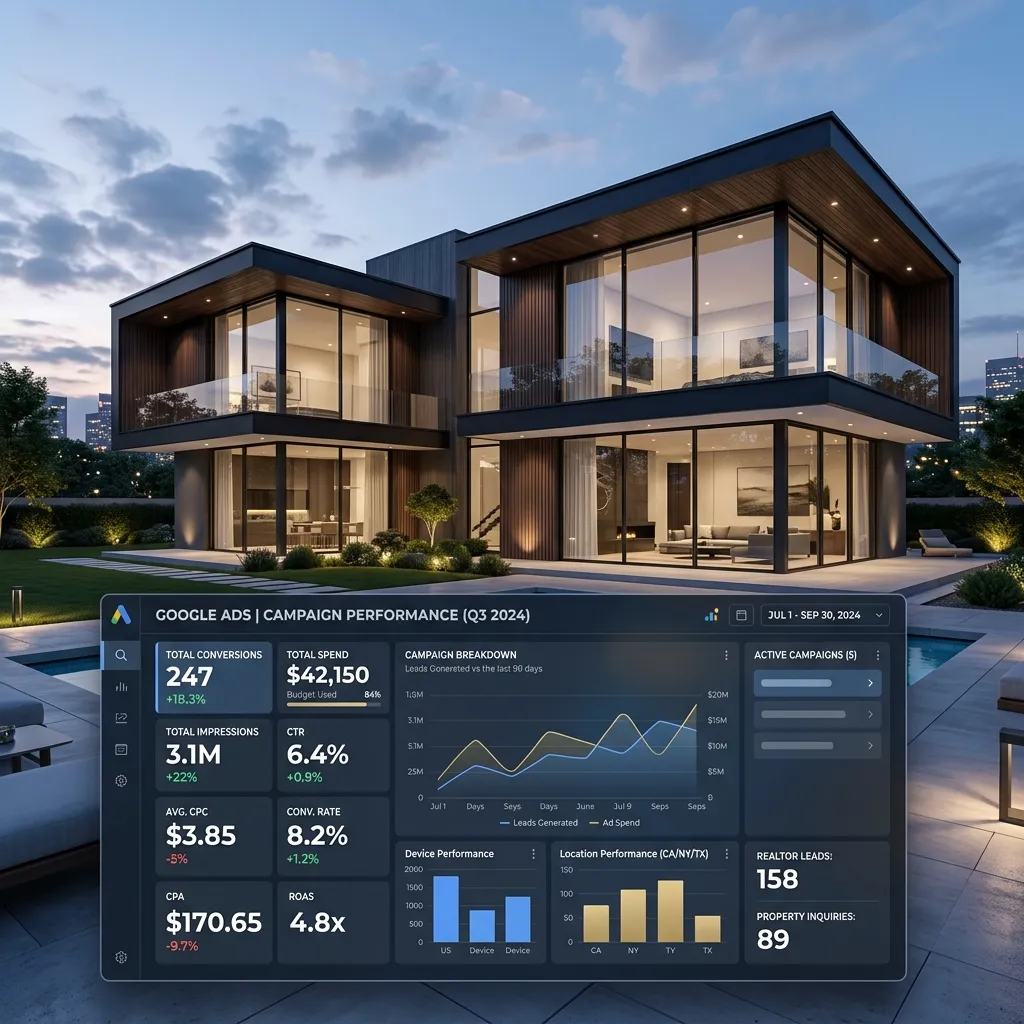
Google Ads for UK Property Developers is the strategic deployment of Pay-Per-Click (PPC) advertising to generate high-intent buyer leads for new-build developments. To maximize Return on Ad Spend (ROAS) in 2026, developers must utilize highly segmented Search Campaigns bidding on specific localized queries (e.g., “4 bed new builds in Manchester”), deploy Performance Max for aggressive remarketing, build frictionless Landing Pages for capturing off-plan brochure downloads, and integrate data directly into a Property CRM for immediate sales team follow-up.
Marketing a £50 million new-build development in the UK is an entirely different discipline from marketing a single second-hand property. An independent estate agent is trying to win a £4,000 instruction fee. A property developer is trying to secure a £500,000 transaction.
For a developer, the stakes are astronomically higher. You have holding costs, bridging finance interest, and strict timelines. If a 40-unit site sits empty for six months after completion, the financial hemorrhage can wipe out the profit margin. You cannot afford to simply list the development on Rightmove and hope for the best. You must aggressively drive high-intent, targeted traffic directly to your own assets.
In this guide, we break down the definitive 2026 Google Ads playbook for UK property developers, designed to sell out phases entirely off-plan.
1. The £500,000 Click: Why Developers Must Master PPC
When a user types “new build homes near me” into Google, they have commercial intent. They are actively in the market to buy a house. If your development does not appear at the very top of the search results page, they will click on a competitor’s ad (or a portal like Rightmove) and you have lost the opportunity to capture them directly.
Relying solely on property portals is dangerous for developers. When a buyer clicks your listing on Rightmove, Rightmove immediately shows them “Similar Properties” from your competitors. When a buyer clicks your Google Ad, they are taken to your dedicated landing page, where there are zero distractions and zero competitors.
2. Search vs. Display: The Property Developer Strategy
In Google Ads, Search Campaigns target active intent (users typing queries into Google), while Display/Performance Max Campaigns target passive intent (users browsing other websites or watching YouTube). For property developers, 80% of the initial budget should be allocated to Search Campaigns to capture high-intent buyers, with the remaining 20% allocated to Display for aggressive retargeting of users who have already visited the development website.
You do not want to use Display ads to find “cold” buyers; it is incredibly inefficient. You use Display ads to stalk the buyers who looked at your 4-bed detached floorplan but didn’t fill out the enquiry form.
3. “Off-Plan” Campaigns: Selling the Dream Before the Brick
The most profitable phase of any development is the off-plan phase. Securing reservations before ground is broken mitigates massive financial risk.
However, you cannot run standard Google Ads for an off-plan site. You must pivot the Call To Action (CTA). Since the buyer cannot book a physical viewing, the CTA must be a low-friction value exchange:
- “Download the Phase 1 Brochure & Floorplans.”
- “Register for the VIP Off-Plan Launch Event.”
- “Secure Early Bird Pricing – Enquire Today.”
The ad copy must clearly state: “Completing Q3 2027. Register now to secure priority plot selection.”
4. Structuring a Development Campaign by House Type
A fatal mistake developers make is running one generic campaign for the entire development. If a buyer searches “2 bed luxury apartment Leeds,” and your ad takes them to a generic homepage that prominently features a 5-bed detached family home, they will bounce.
Your Google Ads account must be structured symmetrically to your development phases:
The Symmetrical Account Structure
- Campaign 1: First-Time Buyers / Apartments. Target keywords like “Help to buy apartments,” “1 bed flat new build.” Ads highlight low deposits and commuter links.
- Campaign 2: Family Homes. Target keywords like “4 bed new builds,” “new homes near [Specific School].” Ads highlight garden size and school catchments.
- Campaign 3: Downsizers. Target keywords like “luxury bungalows,” “ground floor apartments.” Ads highlight low maintenance and community.
5. Negative Keywords: Filtering Out Tyre-Kickers
Property keywords are expensive, often costing £3 to £8 per click. If you are not aggressively filtering out irrelevant traffic, you will burn through a £5,000 monthly budget in days with zero leads.
Before launching a campaign, you must add an extensive Negative Keyword List. This ensures your ads do not show for:
- “Rent”, “To Let”, “DSS”, “Social Housing” (You only want buyers).
- “Jobs”, “Careers”, “Apprenticeships” (You do not want people looking for construction work on your site).
- “Rightmove”, “Zoopla” (Do not pay to compete with portal navigational searches).
6. The Perfect Property Landing Page
If you take nothing else from this guide, take this: Never send Google Ads traffic to your corporate homepage.
Your homepage has too many distractions. Paid traffic must be routed to a dedicated, standalone Landing Page built specifically for the campaign. The page should have:
- No Navigation Bar: The user should not be able to click away to your “About Us” page. They have two options: fill out the form, or close the tab.
- Hero Image/CGI: A stunning, high-resolution CGI render of the specific house type they searched for.
- Frictionless Form: Ask for First Name, Phone Number, and Email. Do not ask for their life history.
- Trust Signals: Display your NHBC/Buildmark warranty logos prominently.
7. Retargeting (Remarketing): The 90-Day Conversion Window
Buying a new build is a 3 to 6-month decision process. The user will click your ad, look at the CGI renders, and then leave to talk to their partner or their mortgage broker.
You must have a Google Ads Retargeting tag installed. When that user leaves, you use Performance Max or Display campaigns to follow them around the internet. While they are reading the BBC News or watching YouTube, they should see banner ads featuring the exact property type they viewed, with messaging like: “Only 3 Plots Remaining in Phase 1. Book Your Show Home Tour Today.”
8. Local Inventory Ads and the Map Pack
For developers with a physical sales suite on-site, Local Search is vital. You must create a Google Business Profile specifically for the Development, not just your corporate headquarters.
When a local user searches “new homes near me”, Google will prioritize the Map Pack. By linking your Google Business Profile to your Google Ads account, you can run Local Campaigns that specifically push your sales suite to the top of the map results, driving physical foot traffic on weekends.
9. Integrating Google Ads with CRM Software
A lead is worthless if the sales team does not call them while the intent is hot. Your Google Ads landing page must be directly integrated (via webhook or Zapier) into your sales CRM (e.g., ContactBuilder, Salesforce, or HubSpot).
Furthermore, you must implement Offline Conversion Tracking (OCT). When a lead from Google Ads eventually pays their £1,000 reservation fee three months later, your CRM must send a signal back to Google Ads saying, “That specific click resulted in a £500,000 sale.” This trains Google’s AI to find more buyers with the exact same data profile.
10. Managing Budget: CPL vs. CPI for Developers
Property developers must measure success through two metrics: Cost Per Lead (CPL) and Cost Per Reservation (CPR).
If you spend £10,000 on Google Ads and generate 250 leads, your CPL is £40. If your sales team converts 5% of those leads into reservations (12.5 reservations), your Cost Per Reservation is £800.
Spending £800 to secure a £500,000 transaction is an exceptional Return on Investment (ROI). This mathematical clarity allows you to scale your budget infinitely as long as the CPR remains profitable.
11. Bidding Strategies in 2026: Manual vs. AI
In the past, PPC managers manually adjusted bids by the penny. In 2026, Google’s Smart Bidding algorithms are vastly superior. However, you must feed the AI the right data.
Start a new development campaign on Maximize Clicks to generate initial traffic and data. Once you have generated 30 conversion events (brochure downloads), switch the campaign to Target CPA (Cost Per Acquisition). Tell Google: “I am willing to pay £50 for a brochure download,” and the AI will automatically adjust bids based on the user’s device, location, and time of day to hit that target.
12. Creating a Sense of Scarcity on Landing Pages
Scarcity drives urgency in off-plan sales. If a buyer believes they have six months to make a decision, they will delay. Your landing pages and ad copy must inject genuine scarcity into the funnel.
Do not use fake countdown timers; buyers see right through them. Instead, use real development data: “Phase 1 is now 80% reserved,” or “Only two 4-bedroom ‘Oak’ housetypes remaining.” By combining highly targeted Google Ads traffic with landing pages that communicate diminishing availability, you force high-intent buyers to submit their details immediately rather than bookmarking the page for later.
13. Tracking the User Journey: GA4 for Developers
Understanding the multi-touchpoint user journey is crucial for a product that costs half a million pounds. A buyer will almost never click a Google Ad and immediately reserve a house. They will click an ad, leave, Google your development name organically a week later, click a retargeting ad on YouTube, and finally fill out a contact form.
Google Analytics 4 (GA4) uses data-driven attribution to model this exact path. By setting up custom Events for “Brochure Downloads”, “Video Tour Views”, and “Reservation Form Submissions”, you can see exactly which Google Ads campaigns are initiating the journey (first-click) and which are closing the journey (last-click). Without GA4, developers often pause top-of-funnel campaigns because they don’t appear to drive direct conversions, unwittingly destroying their pipeline.
14. A/B Testing Your CTA
Never assume you know what will convert a buyer. Always run an A/B test on your landing page Call to Action. For example, direct 50% of your Google Ads traffic to a button that says “Download Brochure” and 50% to a button that says “View Floorplans and Pricing”. In our experience, pricing transparency often yields a 20% higher conversion rate, but you must test this rigorously against your specific local demographic.
Scale Your Off-Plan Sales
At LineUp Agency, we manage high-budget Google Ads campaigns specifically for UK property developers. Stop relying on passive portals. We build the PPC architecture required to drive high-intent buyers directly to your sales suites and secure reservations faster.
15. Sources & References
The campaign structures and financial benchmarks in this guide are validated against the following property marketing resources:
- Google Ads Real Estate Policies — Strict guidelines regarding location-based targeting and demographic restrictions for housing advertisements. support.google.com ↗
- Home Builders Federation (HBF) — Data trends on off-plan consumer behavior and new-build acquisition timelines in the UK.
- ContactBuilder Benchmarks — Statistical analysis on lead-to-reservation conversion rates across the UK new homes sector.
Ekrem Abdulkerim
SEO Strategist and Founder of LineUp. I help brands dominate search through technical precision and measurable growth.
Ready to Grow Your Property Business?
Discover how Lineup helps UK estate agents and property developers dominate search and acquire more instructions.
Book a Free Audit →