
Google Maps Ranking for European Businesses: The Complete Guide (2026)
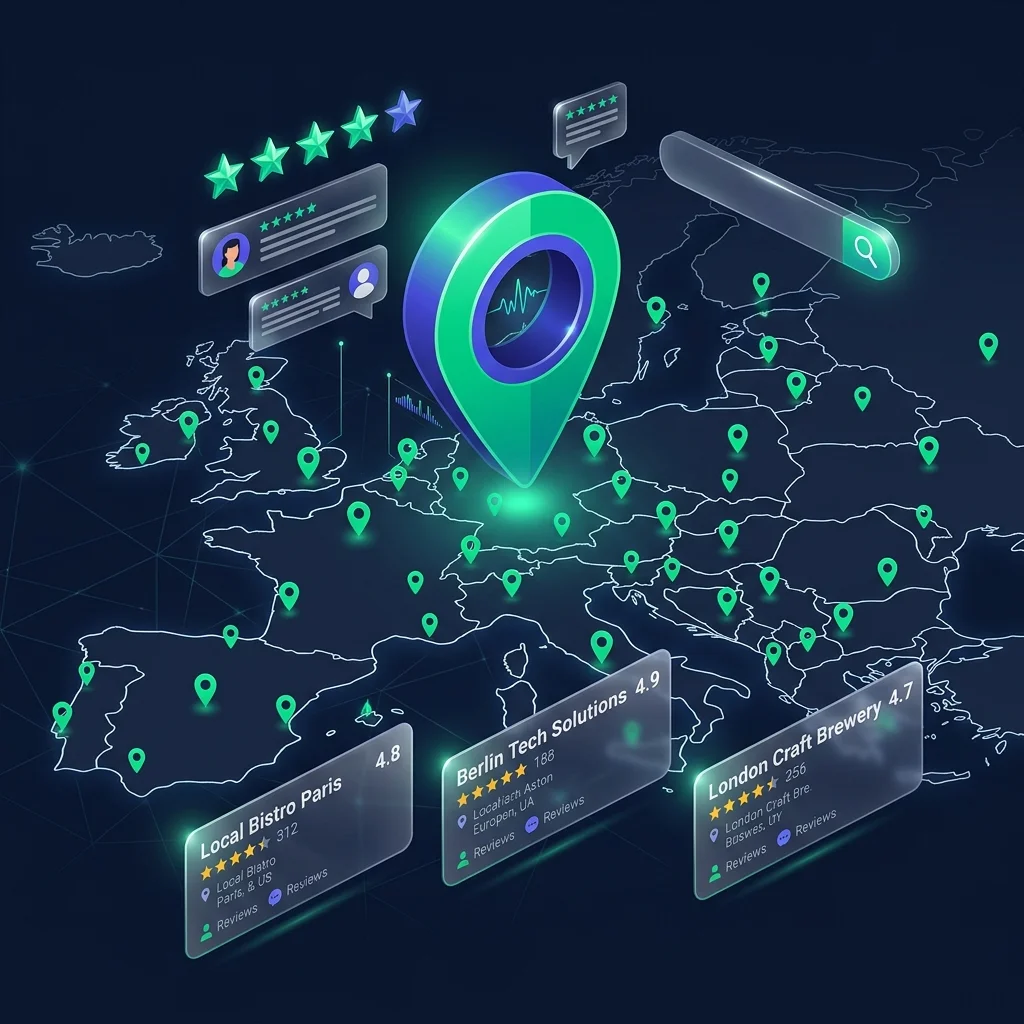
Google Maps ranking for European businesses depends on three core factors: relevance (how well your Google Business Profile matches the search query), distance (how close your business is to the searcher), and prominence (your review count, rating, citation consistency, and online authority). To rank in the Local Pack across European markets in 2026, businesses must fully complete their Google Business Profile with accurate NAP (Name, Address, Phone) data, gather consistent reviews, build local citations on country-specific directories, and implement LocalBusiness schema markup on their website.
When a potential customer in Milan searches “dentista vicino a me” or a user in Warsaw types “fryzjer w centrum,” Google’s Local Pack — the 3-business map widget that appears above organic results — determines which businesses get the call. According to Google’s own data, 76% of local mobile searches result in a same-day visit. In Europe, where service economies dominate GDP, Google Maps visibility is not a marketing channel — it is the primary customer acquisition mechanism for millions of businesses.
This guide covers everything European businesses need to know about ranking in Google Maps in 2026, including the EU-specific factors that many US-focused SEO guides completely ignore.
1. The 3 Pillars of Google Maps Ranking
Google Maps rankings are determined by three factors: Relevance (how well your profile matches the search query), Distance (how close your business is to the searcher’s location), and Prominence (how well-known and trusted your business is, based on reviews, citations, and web authority). You can directly influence Relevance and Prominence; Distance is fixed by your physical location.
| Pillar | What It Measures | Can You Control It? | How to Optimise |
|---|---|---|---|
| Relevance | How well your profile matches the search query | ✅ Yes — fully | Precise primary category, complete services list, keyword-rich business description |
| Distance | Physical proximity to the searcher | ⚠️ Partially — service area settings help | Set accurate service areas; create location-specific landing pages |
| Prominence | Authority, trust, and recognition | ✅ Yes — requires sustained effort | Consistent reviews, local citations, website authority, GBP activity |
The ranking hierarchy in 2026: For branded searches (e.g., “LineUp Agency Wrocław”), Relevance dominates — Google matches the exact name. For generic category searches (e.g., “marketing agency near me”), Distance weighs heaviest within a 5km radius, then Prominence determines which of the nearby businesses appears in the 3-pack. For broader area searches (e.g., “best marketing agency Wrocław”), Prominence becomes the dominant factor because Distance applies to an entire city.
2. Google Business Profile: The Complete Setup Checklist
A fully optimised Google Business Profile is the single most important factor for Google Maps ranking. Businesses with complete profiles are 70% more likely to attract location visits and 50% more likely to lead to a purchase, according to Google’s own data. Every field in the profile is a ranking signal — completeness is not optional, it is foundational.
The European GBP Optimisation Checklist
- Business name: Exact legal trading name. Do not stuff keywords into the business name — “Best Pizza London” as a business name violates Google’s guidelines and risks suspension.
- Primary category: This is the single most important ranking field. Choose the most specific category available (e.g., “Orthodontist” not “Dentist,” “Estate Agent” not “Real Estate Agency”). Google has over 4,000 categories — find the most precise match.
- Secondary categories: Add 3–5 additional categories that accurately describe your services. A dental practice might add “Cosmetic Dentist,” “Emergency Dental Service,” and “Teeth Whitening Service.”
- Address (NAP): Must exactly match your website and all directories. In Europe, pay special attention to address formatting — Polish addresses use a different format (ul. Rynek 13/2, 50-101 Wrocław) than UK (13 Market Street, London EC1A 1AA) or German (Marktstraße 13, 10117 Berlin). Consistency in format matters.
- Service area: If you serve customers at their location (plumber, mobile hairdresser), define your service area by city, region, or radius. Do not set both a physical address and a service area unless you genuinely operate both ways.
- Business hours: Include regular hours, holiday hours, and special hours. European businesses must account for country-specific public holidays — Polish businesses have different holidays than UK businesses.
- Business description: 750 characters maximum. Include your primary service, location, and unique value proposition. Write naturally — keyword stuffing is penalised.
- Services and products: List every individual service with a description and price where applicable. Google uses these to match specific search queries.
- Photos: Upload at minimum: exterior shot, interior shot, team photo, and 3–5 work examples. Add geo-tagged photos weekly. Businesses with 100+ photos receive 520% more calls than the average, according to BrightLocal’s 2026 study.
- Q&A section: Pre-populate with your 5 most common customer questions and answers. This feeds Google’s “Ask Maps” feature and AI Overviews.
⚠️ European Address Formatting Matters
NAP inconsistency is the #1 cause of Google Maps ranking suppression. European addresses are formatted differently across countries. If your Google Business Profile says “ul. Rynek 13” but your website says “Rynek Street 13,” Google treats these as potentially different businesses. Standardise all addresses to the native format for each country, and ensure it matches exactly across your website, GBP, social profiles, and directory listings.
3. Review Strategy That Drives Rankings (Not Just Stars)
Google reviews directly influence Maps rankings through three signals: review count (volume), review recency (velocity), and review content (keyword relevance). Businesses that receive a steady stream of 4–5 star reviews with service-specific and location-specific keywords in the review text rank significantly higher than businesses with the same star rating but fewer or less descriptive reviews.
The European Review Playbook
- Velocity over volume: 3 reviews per week consistently outranks 50 reviews in one month followed by silence. Google measures review velocity as a freshness signal.
- Keyword-rich reviews: Encourage customers to mention the specific service and location naturally. “Best haircut I’ve had in Kraków” is more valuable to your Maps ranking than “Great service, highly recommend!” because it contains both the service keyword (“haircut”) and the location (“Kraków”).
- Respond to every review: Every. Single. One. Positive responses build trust. Negative responses — handled professionally — actually improve your perceived trustworthiness. In your response, naturally mention your service and location: “Thank you for visiting our dental clinic in Bristol — we’re glad the teeth whitening treatment exceeded your expectations.”
- Multi-language reviews: In multilingual European markets, reviews in the local language carry more weight for local-language searches. A review in Polish about your Wrocław restaurant will help your Maps ranking for Polish-language searches more than an English review will.
| Market | Avg. Reviews for 3-Pack | Minimum Star Rating | Review Response Rate |
|---|---|---|---|
| 🇬🇧 UK (competitive cities) | 80–200+ | 4.2+ | 85%+ expected |
| 🇩🇪 Germany | 50–150 | 4.0+ | 70%+ expected |
| 🇫🇷 France | 40–120 | 4.0+ | 60%+ expected |
| 🇵🇱 Poland | 30–80 | 4.0+ | 50%+ expected |
| 🇨🇿 Czech Republic | 20–60 | 4.0+ | 45%+ expected |
| 🇮🇹 Italy | 30–100 | 4.0+ | 55%+ expected |
| 🇪🇸 Spain | 25–80 | 4.0+ | 50%+ expected |
4. Local Citations: Country-Specific Directories That Matter
Local citations — mentions of your business name, address, and phone number on external directories — are a key Prominence signal for Google Maps. In Europe, each country has its own high-authority directories that carry more weight than global platforms. Submitting to country-specific directories with consistent NAP information is essential for ranking in each national market.
| Country | Must-Have Directories | Industry-Specific |
|---|---|---|
| 🇬🇧 UK | Yell.com, Thomson Local, FreeIndex, Yelp UK, Scoot | Checkatrade (trades), Doctify (healthcare), TrustATrader |
| 🇩🇪 Germany | Das Örtliche, Gelbe Seiten, GoLocal, 11880, Meinestadt | Jameda (healthcare), Anwalt.de (legal), WerKenntDenBesten |
| 🇫🇷 France | Pages Jaunes, 118712, Justacote, Yelp France | Doctolib (healthcare), MeilleurArtisan (trades) |
| 🇵🇱 Poland | Panorama Firm, PKT.pl, Firmy.net, Oferteo, Aleo | ZnanyLekarz (healthcare), Oferteo (services) |
| 🇨🇿 Czech Republic | Firmy.cz, Zlaté Stránky, Najisto.cz | Znamylekar.cz (healthcare), Heureka.cz (e-commerce) |
| 🇮🇹 Italy | Pagine Gialle, Virgilio, TuttoCittà, Yelp Italia | MioDottore (healthcare), ProntoPro (services) |
| 🇪🇸 Spain | Páginas Amarillas, QDQ, 11870, Yelp España | Doctoralia (healthcare), Habitissimo (home services) |
The golden rule: Submit to 15–25 directories per country with perfectly consistent NAP data. Do not mass-submit to 500 directories — Google treats sudden citation spikes as manipulation. Build citations over 4–8 weeks at a natural pace.
5. LocalBusiness Schema for European Businesses
LocalBusiness schema markup helps Google’s Knowledge Graph verify your business entity against your Google Business Profile. Implementing JSON-LD structured data with your exact NAP information, opening hours, and service area creates a confirmation signal that strengthens both your organic and Maps rankings. Every European business with a physical location should implement LocalBusiness schema.
The correct implementation uses JSON-LD format in your website’s <head> section. Here is the recommended structure for a European business:
{
  "@context": "https://schema.org",
  "@type": "ProfessionalService",
  "name": "Your Business Name",
  "image": "https://yourdomain.com/images/storefront.webp",
  "url": "https://yourdomain.com/",
  "telephone": "+48-71-123-4567",
  "address": {
    "@type": "PostalAddress",
    "streetAddress": "ul. Rynek 13/2",
    "addressLocality": "Wrocław",
    "postalCode": "50-101",
    "addressCountry": "PL"
  },
  "geo": {
    "@type": "GeoCoordinates",
    "latitude": 51.1079,
    "longitude": 17.0385
  },
  "openingHoursSpecification": [
    {
      "@type": "OpeningHoursSpecification",
      "dayOfWeek": ["Monday","Tuesday","Wednesday","Thursday","Friday"],
      "opens": "09:00",
      "closes": "17:00"
    }
  ],
  "sameAs": [
    "https://www.facebook.com/yourbusiness",
    "https://www.linkedin.com/company/yourbusiness"
  ],
  "priceRange": "€€"
}
European-specific schema considerations:
- Use the ISO 3166-1 alpha-2 country code in
addressCountry(e.g., “PL” for Poland, “GB” for UK, “CZ” for Czech Republic). - Format phone numbers with the international prefix (+48 for Poland, +44 for UK, +420 for Czech Republic).
- Include
geocoordinates — these directly map to your Google Maps pin location. - Use the most specific
@typeavailable (e.g., “Dentist” instead of “LocalBusiness,” “LegalService” instead of “ProfessionalService”).
6. Multi-Location and Multi-Country Strategies
European businesses operating across multiple locations or countries need separate Google Business Profiles for each physical location, location-specific landing pages on their website, and consistent branding tied together through an Organisation schema with department or subOrganization properties. Each country requires its own citation strategy, review generation process, and locally formatted NAP data.
The Multi-Country Architecture
- One GBP per physical location: If you have offices in London and Wrocław, create two separate Google Business Profiles with their respective local details.
- Dedicated landing pages: Each location needs its own URL on your website (e.g.,
/locations/wroclaw/and/locations/london/) with unique content, local testimonials, and embedded Google Maps. - Hreflang implementation: If your website serves content in multiple languages, implement hreflang tags to tell Google which version to show users in each country.
- Country-specific content: Do not simply translate your London page into Polish for your Wrocław page. Each location page should reference local landmarks, local industry context, and local customer success stories.
- Separate review strategies: Reviews for your London location should be in English and reference London-specific details. Reviews for Wrocław should be in Polish and reference local context.
⚠️ Do Not Create Fake Locations
Creating GBPs for locations where you do not have a staffed physical presence is a Google Guidelines violation. Google’s verification process in Europe increasingly uses video verification — you may be asked to live-video-walk through your office to prove it exists. Virtual office addresses are explicitly prohibited for most business categories.
7. EU-Specific Factors: DMA, GDPR, and Google’s Response
The EU Digital Markets Act (DMA), which became fully enforceable in 2024, designates Google as a “gatekeeper” and requires changes to how search results and Maps results are displayed in EU member states. Key impacts for European businesses include: increased visibility for alternative map providers, potential changes to how Google displays its own services (Maps, Shopping), and stricter requirements around data collection in local search.
For European businesses, the DMA creates both risks and opportunities:
- Opportunity — More diverse local results: Google has been required to show results from alternative mapping services alongside Google Maps in EU countries. This means your business may appear in additional surfaces beyond the traditional Maps 3-pack.
- Risk — Layout changes: Google’s response to DMA compliance has included UI changes in European SERPs. The Maps widget position and size may shift, potentially reducing visibility for lower-ranked listings.
- GDPR and reviews: European businesses must be careful about how they solicit reviews. Sending unsolicited emails asking for reviews may violate GDPR if the customer has not consented to marketing communications. Use transactional touchpoints (post-service SMS, in-app prompts) rather than cold email outreach.
- Data portability: Under DMA, businesses have the right to export their Google Business Profile data. Use this to maintain backups of your review history, Q&A, and performance metrics.
8. AI Overviews and the Future of Local Search in Europe
Google’s AI Overviews are increasingly appearing for local queries in European markets, pulling information directly from Google Business Profiles, reviews, and local web content. In 2026, the “Ask Maps” feature allows users to ask natural-language questions about businesses (e.g., “Does this restaurant have outdoor seating?”), and Google answers using GBP data, Q&A sections, and review sentiment analysis. Businesses that populate their GBP thoroughly are the ones being cited in these AI-generated answers.
What this means for your strategy in 2026:
- Your Q&A section is now an AI data source: Google’s AI uses your pre-populated Q&A answers to respond to voice and text queries about your business. If a user asks “Does the restaurant serve vegan food?” and you have answered this in your Q&A, your business is more likely to be recommended.
- Review sentiment feeds AI summaries: Google now generates AI-powered review summaries (e.g., “Customers frequently praise the fast service and parking availability”). This means the content of your reviews directly shapes how Google presents your business.
- GBP Posts feed topical relevance: Weekly Google Posts are indexed and used as freshness signals. A restaurant posting about its new summer menu will rank higher for “summer dining” queries than one that has not posted in 6 months.
9. The 30-Minute Weekly Google Maps Maintenance Routine
Consistent weekly maintenance of your Google Business Profile signals to Google that your business is active, relevant, and trustworthy. The most effective routine takes 30 minutes per week and covers photo uploads, review responses, Google Posts, and Q&A monitoring — these four actions alone account for over 80% of the controllable ranking signals in Google Maps.
| Task | Time | Impact on Rankings | How To |
|---|---|---|---|
| Respond to all new reviews | 5–10 min | 🔴 High — affects Prominence | Reply to every review. Mention your service and city naturally. |
| Upload 2–3 new photos | 5 min | 🔴 High — freshness signal | Photo of recent work, team, or premises. Geo-tag before uploading. |
| Publish 1 Google Post | 10 min | ⚠️ Medium — topical relevance | Share a news update, offer, event, or service highlight. Include a CTA. |
| Check and answer new Q&A | 3 min | ⚠️ Medium — AI Overview signal | Answer all user questions. Proactively add 1 new Q&A per week. |
| Review GBP Insights | 5 min | ℹ️ Monitoring only | Check direction requests, calls, and search queries. Note trends. |
Need Local SEO Across Multiple European Markets?
LineUp Agency manages Google Maps optimisation for businesses across Europe. From single-location local SEO to multi-country GBP management, we handle the entire local search ecosystem.
Get a Free Local SEO Audit →10. Frequently Asked Questions
Can I rank in Google Maps in a city where I do not have a physical office?
If you serve customers at their location (e.g., plumber, mobile hairdresser, cleaning service), you can set a service area in Google Business Profile without listing a physical address for that city. However, you cannot create a GBP listing for a city where you have no physical presence and do not serve customers there. Using virtual office addresses violates Google’s guidelines and risks profile suspension. The legitimate alternative is to create a service area business listing from your actual location.
How do I rank in Google Maps across multiple European countries?
To rank across multiple European countries, create separate Google Business Profiles for each physical location with locally formatted NAP data. Build your website with country-specific landing pages (e.g., /de/ for Germany, /pl/ for Poland) connected by hreflang tags. Build citations on each country’s major local directories. Generate reviews from customers in each market in their local language. This multi-country local SEO approach requires sustained effort per market — there is no shortcut to appearing in multiple countries’ Map Packs simultaneously.
Does the EU Digital Markets Act affect Google Maps rankings?
The Digital Markets Act (DMA) does not directly change Google’s ranking algorithm for Maps, but it affects how Maps results are displayed in EU member states. Google has been required to show alternative mapping and local business services alongside its own Maps results, which creates additional visibility opportunities for businesses listed on multiple platforms. The DMA also gives businesses more control over their data, including the right to export Google Business Profile information.
How long does it take to rank in Google Maps?
New Google Business Profiles typically take 2–4 weeks to begin appearing in Maps results after verification. Reaching the Local Pack (top 3) for competitive queries takes 3–6 months of consistent optimisation: building citations, generating reviews, posting regularly, and maintaining an optimised website with LocalBusiness schema. In less competitive European markets (smaller cities, niche services), Local Pack positioning can be achieved in 4–8 weeks.
What is the most important factor for Google Maps ranking in 2026?
In 2026, the single most impactful factor for Google Maps ranking is a fully completed Google Business Profile with consistent review generation. While all three pillars (Relevance, Distance, Prominence) matter, Prominence — driven by reviews, citations, and GBP activity — is the only pillar that continuously compounds over time. Businesses that maintain a weekly GBP posting schedule and generate 3+ reviews per week consistently outrank competitors with higher domain authority but inactive profiles.
11. Sources & References
- Google Search Central — How Local Results Work — Official documentation on Google Maps ranking factors: relevance, distance, and prominence. support.google.com ↗
- BrightLocal — Local Consumer Review Survey 2026 — Data on consumer review behaviour, review impact on conversions, and photo engagement metrics. brightlocal.com ↗
- European Commission — Digital Markets Act (DMA) Enforcement — Official guidance on DMA compliance requirements for gatekeeper platforms including Google. digital-markets-act.ec.europa.eu ↗
- Schema.org — LocalBusiness Type Documentation — Structured data specifications for local business entities. schema.org ↗