Dental Marketing Costs UK (2026): What £500–£5K/Month Gets You


TL;DR – Key Takeaways
- Average dental marketing costs UK range from £500 to £5,000+ monthly depending on
practice size and goals - SEO services typically cost £750-£2,500/month with ROI showing within 6-12 months
- PPC campaigns require £1,000-£3,000/month budgets for competitive dental keywords
- Full-service dental practice marketing packages average £2,000-£4,500 monthly
across the UK - ROI expectations: £3-£8 return for every £1 spent on strategic dental marketing
Table of Contents
- Understanding Your Dental Marketing Investment
- UK Dental Marketing Pricing Breakdown by Service
- How to Allocate Your Dental Practice Marketing Budget
- Local SEO Costs for Dental Practices
- PPC and Google Ads Investment for Dentists
- Dental Marketing Service Packages Explained
- Calculating Your Dental Marketing ROI
- Red Flags: When You’re Paying Too Much
- Frequently Asked Questions
If you’re a dental practice owner in the UK, you’ve likely asked yourself: “How much should I actually be
spending on marketing? or What are dental marketing costs in the UK?” The answer isn’t straightforward, and the lack of transparency in the industry often
leaves practice owners feeling confused or, worse, overcharged.
According to the British Dental
Association, over 68% of dental practices report uncertainty about their marketing budgets, and
nearly 43% believe they’re not getting adequate value for their investment. This comprehensive guide cuts
through the confusion to reveal the real dental marketing costs UK practices should expect in 2025.
Understanding Your Dental Marketing Investment
Dental marketing costs UK vary significantly based on multiple factors including location, practice size,
competition, and your specific growth objectives. Understanding what influences these costs helps you make
informed decisions about your dental practice marketing budget.
What Influences Dental Marketing Prices?
Several key factors determine the cost of dental advertising and marketing services across the UK:
- Geographic location: London and Southeast practices typically face 30-50% higher
marketing costs compared to practices in Scotland, Wales, or Northern England - Market competition: Areas with high dental practice density require more aggressive
marketing strategies and larger budgets - Practice size and revenue: Multi-chair practices with higher turnover can justify and
benefit from larger marketing investments - Service specialization: Cosmetic dentistry and implant practices often require premium
marketing approaches with higher associated costs - Current digital presence: Practices starting from scratch face higher initial
investment than those optimizing existing assets
Industry Benchmarks for Dental Practice Marketing Budget
Research from Medical Group Management
Association suggests that successful dental practices allocate between 5-10% of their gross revenue
to marketing activities. For a practice generating £500,000 annually, this translates to £25,000-£50,000 per
year, or approximately £2,100-£4,200 monthly.
💡 Industry Insight
High-performing dental practices in competitive UK markets often invest 8-12% of gross revenue into
marketing, significantly above the industry average. This higher investment correlates with 25-40%
faster patient acquisition rates according to Dental Economics research.
NHS vs Private: Entirely Different Budget Logics
This is where most generic dental marketing guides fall flat — they treat all practices the same. The economics of NHS and private marketing are fundamentally different.
NHS Practice Marketing
If your practice is predominantly NHS-contracted, your marketing challenge is not patient acquisition — it’s managing demand and selectively growing your private offering. Over-investing in patient acquisition when you’re already at capacity on NHS is wasteful.
For NHS-heavy practices, marketing budget should focus on:
- Google Business Profile management and review generation (essential for local trust)
- A clean, fast website that converts the private enquiries you do get
- Email marketing to existing patients to upsell private treatments (whitening, Invisalign)
- Reputation management — NHS patients review you publicly regardless of whether you market to them
Budget recommendation for NHS-heavy: £2,000–£6,000/year, focused entirely on retention and private upsell.
We also have prepared a local SEO guide for dentists, it is a nice start before working with a full agency and teaches you the fundamentals so you can get the basics.
Private Practice Marketing
Private practices are in a direct competition market. You are competing against every other private and mixed practice within a realistic travel radius — and that radius is shrinking as Google Maps becomes the primary discovery channel.
Private practices need to invest more aggressively because:
- You have no NHS contract to guarantee a baseline patient flow
- Your higher treatment values mean a single conversion pays for significant ad spend
- Patient acquisition is your primary business risk — an empty diary is an existential problem
Budget recommendation for private: 6–10% of turnover, with heavy weighting to Google Ads and local SEO.
Mixed Practices Converting from NHS to Private
This is the trickiest scenario — and the most common one we work with. You’re simultaneously managing existing NHS demand while trying to grow private revenue. The temptation is to underspend because “we’re already busy”.
The correct approach is to treat private marketing as a separate business unit and budget accordingly. What percentage of your revenue do you want to be private in 24 months? Work backwards from that number to define your acquisition targets, then set your marketing budget to hit them.
Dental Marketing Budget UK Benchmarks: The Real Numbers
Based on industry data from NHS Digital, the British Dental Association (BDA), and performance data across UK dental marketing campaigns, here are realistic benchmarks for 2026:
By Practice Type
| Practice Type | Turnover Range | Recommended Budget | Annual Spend Range |
| NHS-heavy (70%+ NHS) | £200k–£400k | 1–3% of turnover | £2,000–£12,000 |
| Mixed (30–70% private) | £300k–£700k | 3–6% of turnover | £9,000–£42,000 |
| Private-only (small) | £250k–£500k | 5–8% of turnover | £12,500–£40,000 |
| Private-only (growth) | £500k–£1.5m | 6–10% of turnover | £30,000–£150,000 |
| Dental group / DSO | £1m+ | 4–8% of turnover | £40,000–£400,000+ |
By Growth Stage
| Stage | Goal | Budget % of Revenue | Primary Channels |
| Launch (0–2 years) | Build awareness, fill book | 8–15% | Google Ads, local SEO, social |
| Growth (2–5 years) | Increase private mix | 5–10% | SEO, Google Ads, email, referrals |
| Established (5+ years) | Retain & upsell | 3–6% | SEO, email, social, reviews |
| Scale / multi-site | Replicate model | 4–8% | All channels with tracking |
| Key Insight |
|---|
| The biggest budgeting mistake we see is treating marketing as a fixed cost rather than a variable investment. Your budget should flex with your growth ambitions — not be locked to last year’s turnover |
UK Dental Marketing Pricing Breakdown by Service
Let’s examine the specific dental marketing costs UK practices encounter across different service categories.
These figures represent 2025 market rates from reputable agencies serving dental clients.
| Service Type | Monthly Cost Range | One-Time Setup | Expected Timeline for Results |
|---|---|---|---|
| Local SEO | £750 – £2,500 | £1,500 – £3,500 | 3-6 months |
| PPC/Google Ads | £1,000 – £3,000 | £500 – £1,200 | Immediate (with optimization) |
| Social Media Management | £400 – £1,500 | £300 – £800 | 2-4 months |
| Website Design/Redesign | N/A | £2,500 – £8,000 | Ongoing benefit |
| Content Marketing | £500 – £1,800 | £400 – £1,000 | 4-8 months |
| Email Marketing | £200 – £800 | £300 – £600 | 1-3 months |
| Reputation Management | £300 – £1,000 | £200 – £500 | Ongoing |
What’s Included in These Costs?
Understanding what you’re actually paying for helps evaluate whether UK dental marketing prices represent
fair value. Here’s what professional dental marketing costs UK typically include:
Local SEO Services (£750-£2,500/month)
- Google Business Profile optimization and management
- Local citation building across 50+ directories
- On-page SEO optimization for dental-specific keywords
- Monthly content creation (blog posts, service pages)
- Technical SEO audits and improvements
- Local link building campaigns
- Monthly ranking reports and analytics
Effective local SEO strategies for
dentists require consistent effort and expertise. Practices that invest in comprehensive local SEO
see an average 156% increase in organic traffic within 12 months, according to Moz’s local search study.
PPC and Google Ads Management (£1,000-£3,000/month)
- Campaign strategy and keyword research
- Ad copy creation and A/B testing
- Landing page optimization
- Bid management and budget optimization
- Conversion tracking setup
- Monthly performance reports
- Remarketing campaign management
The cost of dental advertising through PPC includes both the management fee (typically 15-20% of ad spend)
and the actual ad budget. For competitive dental keywords in major UK cities, expect cost-per-click rates of
£3-£12 for general dentistry and £8-£25 for cosmetic procedures.
⚠️ Budget Reality Check
Many dental practices underestimate PPC costs. To achieve meaningful results in competitive markets, your
total monthly investment (management + ad spend) should typically exceed £1,500. Budgets below £1,000
monthly often fail to generate sufficient leads to justify the investment.
3. 2026 UK Benchmarks: Cost Per Acquisition (CPA) by Treatment
Your budget shouldn’t just be an arbitrary lump sum thrown at a dental marketing agency. It needs to be carefully reverse-engineered based on the exact treatments you want to perform. The single most important metric in this calculation is your Cost Per Acquisition (CPA).
CPA is simply the answer to the question: “How much marketing spend does it take to get one new patient sitting in the dental chair for a specific treatment?”
CPA varies wildly depending on the treatment type, the competitiveness of your local area, and the effectiveness of your internal sales and front desk teams. It costs significantly more to convince someone to trust you with a £15,000 full-arch implant case than it does to convince them to book a £60 routine exam.
Based on comprehensive data analyzed across successful UK practices through 2025 and into 2026, here are the realistic CPA benchmarks you should build your budget around.
Styled Table
| Treatment Category | Avg. 2026 UK CPA (£) | Average Treatment Value (£) | Notes & Complexity |
|---|---|---|---|
| Invisalign / Clear Aligners | £150 – £350 | £3,000 – £4,500 | Highly competitive. Requires excellent lead nurturing and open days. |
| Single Dental Implant | £250 – £450 | £2,500 – £3,500 | Long consideration phase. High trust requirement. E-E-A-T is vital. |
| Full Arch / All-on-4 Implants | £600 – £1,500+ | £12,000 – £25,000+ | Very long sales cycle. Often requires financing options heavily advertised. |
| Composite Bonding (Smile Makeover) | £80 – £180 | £1,500 – £3,000 | Driven largely by visual platforms (Instagram/TikTok). High conversion rate. |
| Teeth Whitening | £40 – £90 | £250 – £500 | Used primarily as a loss-leader or entry point for larger cosmetic work. |
| General Checkup / New Patient Exam | £30 – £80 | £50 – £150 (initial) | Relies on strong local SEO. True value is realized over years of retention. |
A Crucial Caveat: These figures assume a healthy dental website conversion rate. If your website is slow, confusing, or lacks clear calls-to-action, you might generate leads at these prices, but fail to convert them into seated patients. If your front desk fails to answer the phone or follows up with leads three days late, your CPA will skyrocket. If your CPA is drastically higher than the higher-end benchmarks listed above, you likely have an internal conversion problem, not a marketing budget problem.
How to Allocate Your Dental Practice Marketing Budget
Smart budget allocation maximizes your dental marketing ROI. Based on analysis of successful UK dental
practices, here’s a recommended breakdown for a £3,000 monthly dental practice marketing budget:
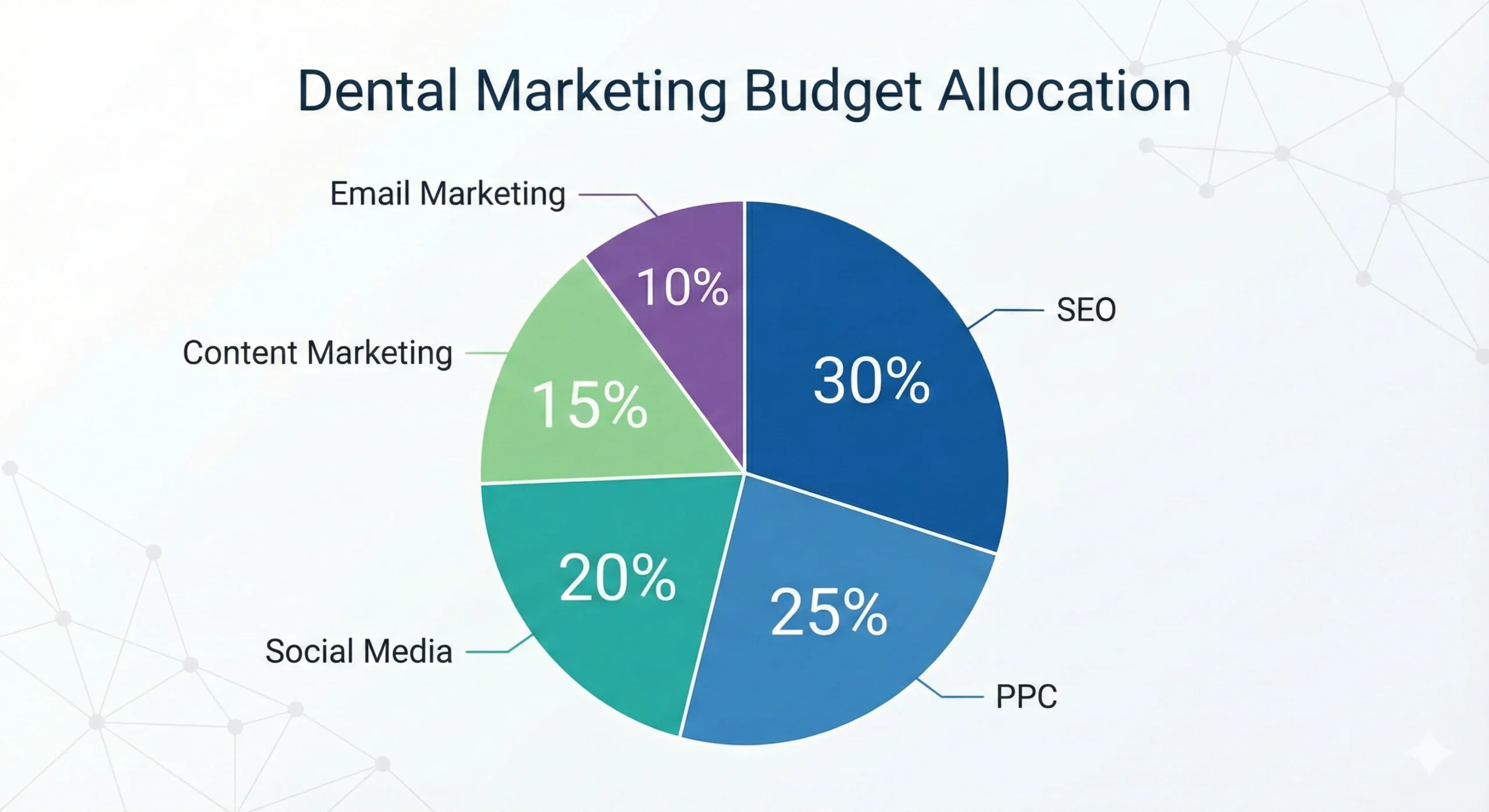
Foundation: Website & Local SEO (40% – £1,200)
Your website and local search presence form the foundation of all digital marketing efforts. This
allocation covers ongoing SEO optimization, content creation, and technical maintenance.
Understanding what is local
SEO helps you appreciate why this foundation deserves substantial investment.
Patient Acquisition: PPC Campaigns (35% – £1,050)
Pay-per-click advertising delivers immediate visibility and patient bookings. This budget covers both
ad spend and management fees for Google Ads and potentially Facebook advertising campaigns targeting
high-value treatments.
Engagement: Social Media & Content (15% – £450)
Regular social media posting and content marketing build brand awareness and patient trust. This
allocation supports consistent posting, community management, and engagement activities across
platforms like Instagram and Facebook.
Retention: Email Marketing & Reputation (10% – £300)
Patient retention marketing often delivers better ROI than acquisition. This budget supports
automated email campaigns for appointment reminders, educational content, and review generation
activities.
Adjusting Your Budget Based on Practice Goals
Your ideal budget allocation should reflect your specific practice objectives:
- New practice launch: Allocate 50% to PPC for immediate visibility, 30% to SEO
foundation, 20% to social proof and reputation building - Established practice growth: Balance 40% SEO, 35% PPC, 15% content marketing, 10%
retention activities - Specialist/cosmetic focus: Invest 35% in high-quality content marketing, 35% PPC for
premium services, 30% SEO optimization - Multi-location expansion: Distribute 45% across location-specific SEO, 30% centralized
PPC, 25% unified brand marketing

Local SEO Costs for Dental Practices
Local SEO represents one of the highest-ROI investments in dental marketing costs UK. When patients search
“dentist near me” or “emergency dentist [city],” ranking in the top three positions can transform your
practice’s patient acquisition.
What Makes Dental SEO Worth the Investment?
Research from BrightLocal’s consumer
review survey reveals that 87% of UK consumers read online reviews for local businesses, and 93% of
patients find their dentist through online search. The visibility SEO provides directly impacts your
practice’s growth potential.
💰 Cost-Saving Tip
Before hiring an expensive agency, leverage free SEO tools to audit your
current position and identify obvious optimization opportunities. Tools like Google Business Profile,
Google Search Console, and Ubersuggest provide valuable insights at zero cost.
DIY vs. Professional SEO: The Real Cost Comparison
Many practice owners consider handling SEO internally to save on dental marketing costs UK. Here’s an honest
comparison:
| Approach | Monthly Cost | Time Investment | Expected Results |
|---|---|---|---|
| Complete DIY | £50-£200 (tools only) | 15-25 hours/month | Modest improvements over 12+ months |
| Hybrid (DIY + tools) | £300-£600 | 8-15 hours/month | Moderate results within 6-9 months |
| Budget Agency | £400-£750 | 2-4 hours/month | Basic optimization, limited growth |
| Professional Agency | £1,200-£2,500 | 1-2 hours/month | Significant growth within 4-6 months |
The hidden cost in DIY approaches is opportunity cost. The 15-25 hours monthly you spend on SEO activities
represents significant chair time and revenue potential. For most practices, professional management
provides superior ROI when you factor in the value of the practice owner’s time.
PPC and Google Ads Investment for Dentists
Pay-per-click advertising offers immediate visibility but requires careful budget management to achieve
positive dental marketing ROI. Understanding the true cost of dental advertising through PPC helps you set
realistic expectations and budgets.
Understanding PPC Cost Structures
PPC costs for dental practices in the UK consist of three components:
- Ad spend: The amount paid directly to Google for clicks (£500-£2,500+ monthly)
- Management fees: Agency or consultant fees for campaign optimization (15-20% of ad
spend or £300-£800 flat fee) - Landing page costs: Conversion-optimized pages for your campaigns (£500-£2,000 one-time
or included in service)
UK Dental Keyword Cost Examples (2025)
According to WordStream’s industry
benchmark data, here are average cost-per-click rates for common dental keywords in UK markets:
- “Emergency dentist [city]” – £8.50-£15.00 per click
- “Dental implants [city]” – £12.00-£25.00 per click
- “Invisalign [city]” – £10.00-£20.00 per click
- “Teeth whitening [city]” – £6.00-£12.00 per click
- “Private dentist [city]” – £5.50-£10.00 per click
- “Dentist near me” – £4.00-£8.00 per click
With these CPCs, a £1,500 monthly PPC budget might generate 100-375 website clicks, depending on your keyword
strategy and campaign optimization.
Calculating Required PPC Investment
To determine your appropriate PPC budget, work backward from your patient acquisition goals:
PPC Budget Calculation Formula
Required Monthly Budget = (New Patients Needed × CPC) ÷ Conversion Rate
Example: If you need 15 new patients monthly, your average CPC is £8, and your website
converts at 4%: (15 ÷ 0.04) × £8 = £3,000 minimum monthly budget.
Dental Marketing Service Packages Explained
Many UK agencies offer tiered dental practice marketing packages. Understanding these packages helps you
identify which services deliver the best value for your specific dental marketing costs UK budget.
Starter Package (£800-£1,500/month)
Ideal for new practices or those just beginning their digital marketing journey:
- Basic website optimization (3-5 pages)
- Google Business Profile setup and optimization
- Monthly blog content (1-2 posts)
- Social media posting (2-3 times weekly)
- Basic SEO monitoring and reporting
- Email marketing setup
Best for: Single-chair practices, new practice launches, or practices in less competitive
areas with limited initial budgets.
Growth Package (£1,800-£3,200/month)
Designed for established practices seeking consistent patient acquisition:
- Comprehensive local SEO optimization
- PPC campaign management (£500-£1,000 ad spend included)
- Weekly content creation and blog posts
- Daily social media management
- Review generation and reputation management
- Monthly performance analytics
- Email marketing automation
Best for: Multi-chair practices in moderate competition areas targeting steady 10-20 new
patient growth monthly.
Premium Package (£3,500-£6,000/month)
Comprehensive dental practice marketing for aggressive growth:
- Advanced SEO with competitive keyword targeting
- Multi-channel PPC campaigns (£1,500-£3,000 ad spend)
- Professional content marketing and video production
- Full social media management across platforms
- Advanced reputation management
- Conversion rate optimization
- Dedicated account manager
- Custom reporting dashboards
Best for: Multi-location practices, specialist/cosmetic-focused practices, or practices in
| Deliverable Feature | Starter Package (£800 – £1,500/mo) | Growth Package (£1,800 – £3,200/mo) | Premium Package (£3,500 – £6,000+/mo) |
|---|---|---|---|
| Google Maps Local SEO | Basic GBP optimization & citations | Advanced rank tracking, local backlinks | Multi-location mapping & authority campaigns |
| Google Ads Search PPC | – | Up to £2,500 spend management | Unlimited spend, patient intent keywords |
| Meta Social Ads | – | Standard clear-aligner campaigns | Dynamic video loops, high-value cosmetic funnels |
| High-Converting Landing Pages | – | 2 specialized landing pages | Unlimited custom-designed landing pages |
| CRM API Integrations | – | Standard Dentally / SOE sync | Custom CRM routing (e.g. LeadByte, Zapier) |
| Lead Nurturing Automations | – | Standard email autoresponders | Centralized email, SMS, and WhatsApp sequences |
| Call Tracking Calibration | – | Included (basic call source tracking) | Call tracking, recording, and front-desk training audits |
| Dashboard & Reporting | Monthly static PDF report | Live Looker Studio dashboard | Weekly reviews & custom attribution dashboards |
Calculating Your Dental Marketing ROI
Understanding dental marketing ROI transforms your perspective from viewing marketing as an expense to
recognizing it as an investment. Here’s how to calculate whether your UK dental marketing prices are
generating acceptable returns.
The Simple ROI Formula
Basic marketing ROI calculation: ROI = (Revenue Generated – Marketing Cost) ÷ Marketing Cost ×
100
However, for dental practices, lifetime patient value makes the calculation more sophisticated and favorable.
Calculating Patient Lifetime Value (LTV)
According to American Dental Association
research (applicable to UK markets), the average dental patient lifetime value ranges from
£3,000-£8,000 depending on practice type:
- General dental practice: £3,000-£4,500 LTV
- Family dental practice: £5,000-£7,000 LTV (multiple family members)
- Cosmetic/specialist practice: £6,000-£12,000 LTV
📊 ROI Reality Check
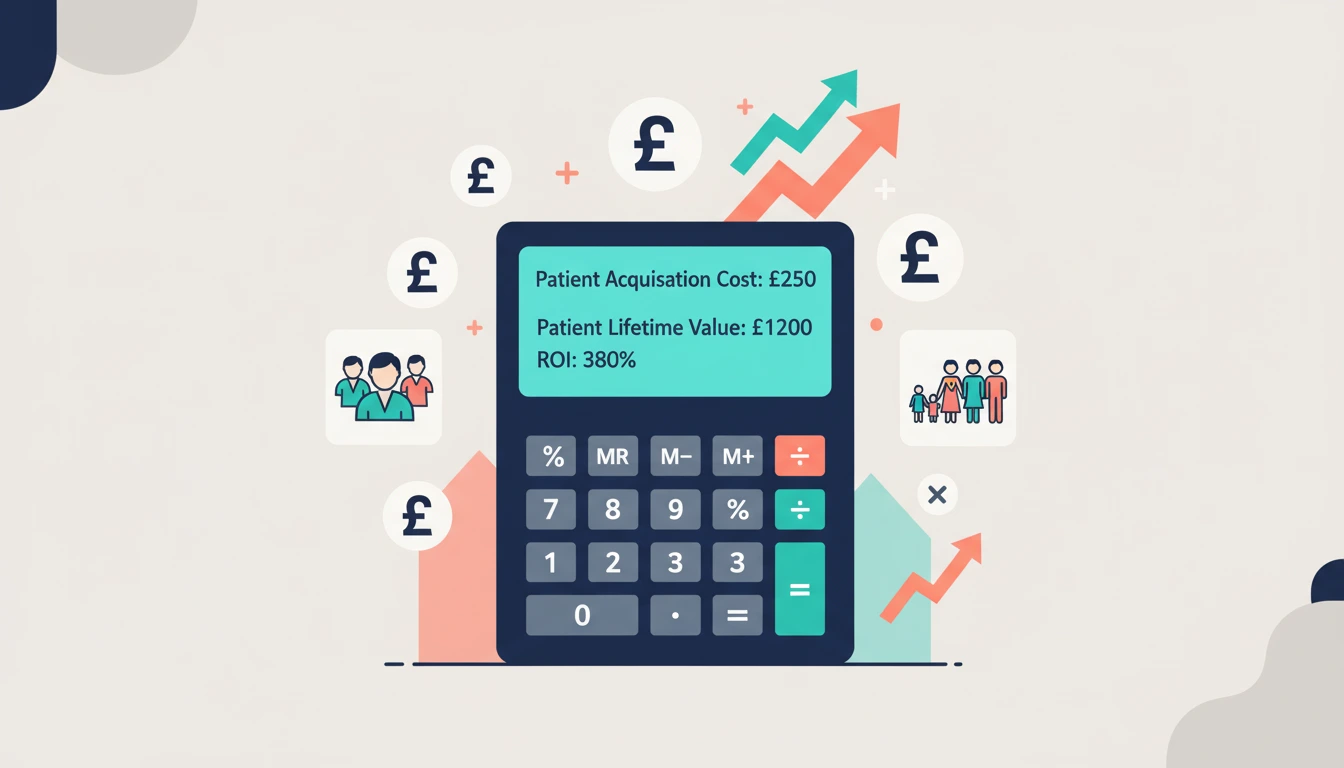
If your dental practice marketing budget is £3,000 monthly and you acquire 12 new patients with an
average LTV of £4,000, your annual ROI is approximately 1,233%. That’s £48,000 in lifetime revenue from
a £36,000 annual investment, generating £12,000 positive return in the first year alone.
Acceptable ROI Benchmarks
Industry research suggests these ROI benchmarks for dental marketing investments:
- Minimum acceptable: 3:1 (£3 return for every £1 spent)
- Good performance: 5:1 (£5 return per £1 spent)
- Excellent performance: 8:1 or higher (£8+ return per £1 spent)
However, these ratios should consider the long-term nature of patient relationships. A patient acquired
through marketing may generate revenue for 5-10+ years, making initial cost of dental advertising far less
significant than immediate ROI suggests.
Tracking the Right Metrics
To accurately assess your dental marketing costs UK and their effectiveness, monitor these key performance
indicators:
- Cost per lead: Marketing spend ÷ leads generated
- Cost per patient acquisition: Marketing spend ÷ new patients booked
- Conversion rate: (New patients ÷ total leads) × 100
- Patient lifetime value: Average revenue per patient over relationship duration
- Marketing ROI: (Revenue – marketing cost) ÷ marketing cost
- Month-over-month growth: Percentage increase in new patient bookings
Red Flags: When You’re Paying Too Much
Not all marketing investments represent good value. Watch for these warning signs that you might be
overpaying for dental marketing services:
⚠️ Price Red Flags
- Unrealistic guarantees: Agencies promising “first page in 30 days” or “guaranteed
50 new patients” are typically unreliable - Opaque pricing: Reluctance to provide clear pricing breakdowns or itemized services
suggests hidden costs - Long-term lock-in contracts: Agencies requiring 12+ month contracts without
performance guarantees may lack confidence in results - Outsourced offshore work: Extremely low prices (under £400/month for “full
service”) often indicate low-quality outsourced labor - No reporting or analytics: If you’re not receiving detailed monthly reports, you
can’t assess whether costs are justified
Questions to Ask Before Committing
Before signing with any dental marketing agency, ask these critical questions to ensure UK dental marketing
prices align with delivered value:
- What specific deliverables are included? Get detailed lists, not vague descriptions
- Who will actually perform the work? In-house teams or subcontractors?
- Can you provide case studies from similar dental practices? Real results from
comparable clients - What are your typical timelines for results? Realistic expectations based on service
type - How do you report on performance? Request sample reports to evaluate transparency
- What happens if results don’t meet expectations? Understanding exit terms protects your
investment - Are there any additional costs beyond the quoted price? Setup fees, tool subscriptions,
or hidden charges
When Premium Pricing is Justified
Higher dental practice marketing costs can be worthwhile when agencies offer:
- Proven track record with verifiable dental client success stories
- Dedicated account management with direct access to strategy teams
- Proprietary tools or methodologies that deliver measurable advantages
- Industry specialization with deep understanding of dental patient behavior
- Comprehensive services eliminating the need for multiple vendors
- Transparent reporting with regular strategy reviews and optimization
💡 Negotiation Tip
Many agencies offer discounts for annual prepayment or bundle pricing when you commit to multiple
services. Don’t hesitate to negotiate, especially if you’re bringing a substantial monthly budget. A
10-15% discount on a £3,000 monthly package saves £3,600-£5,400 annually.
Making the Right Investment Decision
Determining the right dental marketing costs UK for your practice requires balancing budget constraints with
growth ambitions. Here’s a framework for making informed decisions:
Assess Your Current Position
Evaluate your existing digital presence, patient acquisition channels, and competitive landscape.
Practices with weak online presence require larger initial investments to build foundational assets.
Define Clear Objectives
Specify measurable goals: “acquire 15 new patients monthly” or “increase cosmetic consultations by
40%” provides clear targets for budget allocation and success measurement.
Calculate Affordable Investment
Using the 5-10% of gross revenue guideline, determine your sustainable monthly marketing budget.
Remember that higher percentages accelerate growth but require careful ROI monitoring.
Request Multiple Proposals
Obtain detailed proposals from at least three agencies with dental specialization. Compare not just
pricing but deliverables, reporting, and contractual terms.
Start Strategic, Scale Gradually
Begin with core services (SEO + PPC or SEO + social) rather than comprehensive packages. As you
validate ROI, gradually increase investment in proven channels.
Monitor and Optimize Quarterly
Review performance metrics every 90 days. Redirect budget from underperforming channels to those
delivering superior patient acquisition and ROI.
10. Special Considerations for Squat Practices and Startups
If you are opening a “squat” practice (a brand new clinic starting from zero patients), the rules change significantly. You do not have the luxury of natural referrals or an existing patient base to cross-sell to. You are funding your growth entirely through marketing and cash flow.
For squat practices, marketing should not be viewed as an operating expense, but as a critical capital investment necessary to achieve “lift-off velocity.” We frequently see principals secure £500,000 in financing to build a state-of-the-art clinic with three surgeries, CBCT scanners, and bespoke interior design, but fail to allocate sufficient funds to actually acquire the patients needed to fill those chairs.
The Squat Strategy:
- Pre-Opening Budget: You should begin marketing 3-6 months before your doors open. This involves building a robust, SEO-optimized website, creating a “coming soon” landing page to capture emails, and establishing your Google Business Profile.
- Launch Budget: In the first 6-12 months of operation, your marketing budget must be aggressive—often far exceeding the 10-15% benchmark. A strong launch requires heavy investment in localized Google Ads to instantly capture search demand for “dentist near me” while your organic SEO slowly builds momentum.
- Awareness Campaigns: Targeted Meta Ads campaigns offering compelling opening promotions (e.g., discounted new patient exams, free Invisalign consultations) are crucial to rapidly build initial cash flow and get feet through the door.
A squat practice must be prepared to absorb higher CPAs initially as they establish their brand in the community and wait for the flywheel effect of patient referrals to begin turning.
Frequently Asked Questions
What is a reasonable budget for dental marketing in the UK?
A reasonable dental practice marketing budget typically ranges from £1,500 to £4,000 monthly for
established practices, or 5-10% of gross revenue. New practices may need to invest 10-15% initially
to build market presence. Practices generating £500,000 annually should budget £2,500-£4,200 monthly
for comprehensive marketing.
How much should I spend on dental SEO per month?
Professional dental SEO services cost between £750-£2,500 monthly in the UK. Budget agencies charging
under £500 often deliver minimal results, while premium agencies exceeding £3,000 monthly should
demonstrate substantial competitive advantages. For most practices, £1,200-£1,800 monthly provides
comprehensive local SEO with measurable results within 4-6 months.
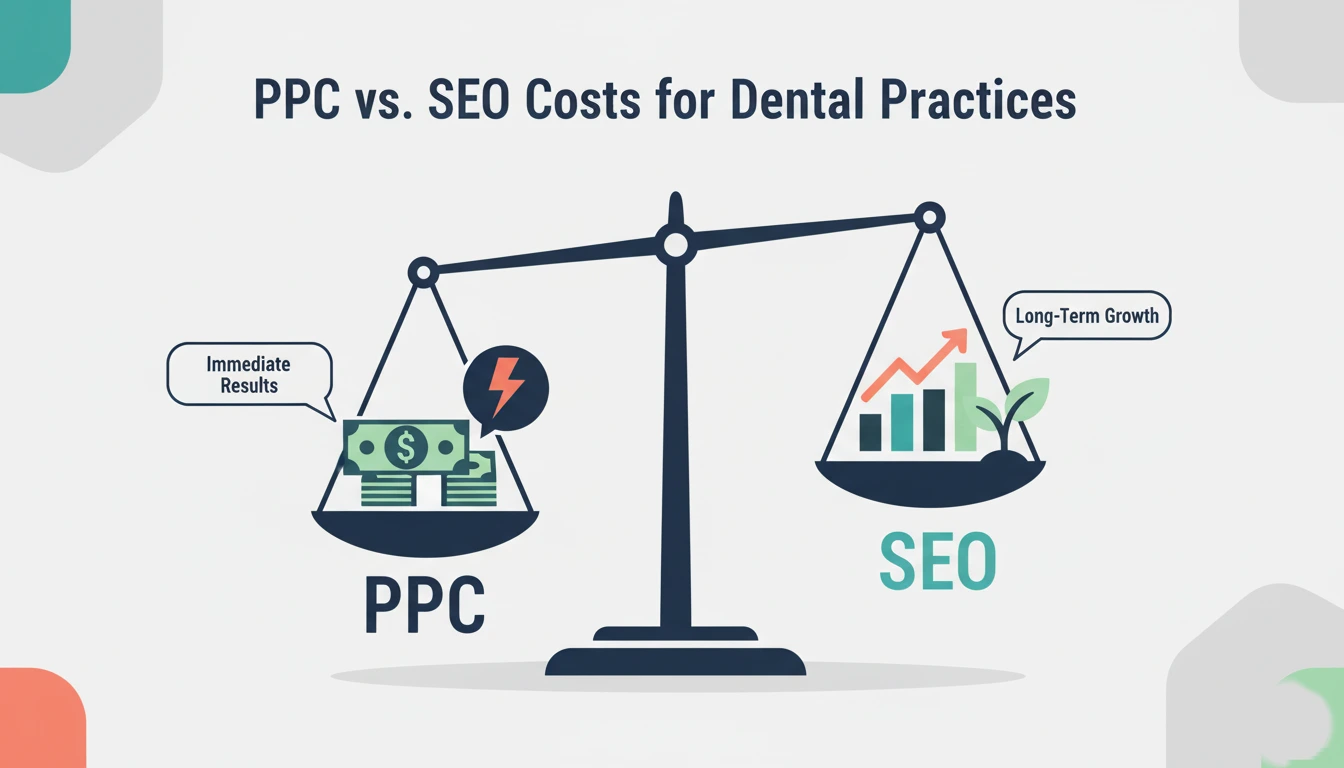
Is PPC or SEO better value for dental practices?
Both deliver value for different objectives. PPC provides immediate visibility and patient bookings,
ideal for new practices or promoting specific services, but requires ongoing ad spend. SEO builds
sustainable long-term traffic with better cost-per-acquisition over time. Most successful practices
invest in both: PPC for immediate results while SEO builds, then gradually shift budget toward SEO
as organic rankings improve.
What ROI should I expect from dental marketing?
Healthy dental marketing ROI ranges from 5:1 to 8:1 (£5-£8 return per £1 invested) when calculated
using patient lifetime value. However, ROI varies by service: PPC typically shows faster returns
(3-6 months) with 4:1-6:1 ratios, while SEO delivers higher long-term ROI (8:1-12:1) but requires
6-12 months to mature. Practices should aim for minimum 3:1 ROI to justify marketing investment.
Should I hire a marketing agency or do it myself?
The decision depends on your available time, expertise, and practice revenue. DIY marketing costs
£200-£400 monthly in tools but requires 15-20 hours of your time—representing significant
opportunity cost for practice owners. Professional agencies cost more (£1,500-£4,000 monthly) but
typically deliver superior results with minimal time investment. Practices generating £300,000+
annually usually benefit from professional management due to opportunity cost of owner time.
How long does it take to see results from dental marketing?
Results timelines vary by channel: PPC advertising delivers immediate traffic and can generate
bookings within days, though optimization requires 2-3 months. Local SEO shows meaningful ranking
improvements in 3-6 months, with substantial patient acquisition by 6-12 months. Social media
marketing builds gradually, requiring 4-6 months for significant audience growth. Content marketing
and email campaigns typically show results within 2-4 months. Most practices see positive ROI within
4-6 months of comprehensive marketing implementation.
What’s included in typical dental marketing packages?
Standard packages include Google Business Profile management, local SEO optimization, content
creation (blogs/social posts), review management, and monthly reporting. Mid-tier packages add PPC
campaign management, advanced social media strategies, and email marketing automation. Premium
packages include video production, advanced conversion optimization, dedicated account management,
and comprehensive multi-channel campaigns. Always request detailed deliverables lists to compare
agency offerings accurately.
Are long-term contracts worth it for dental marketing?
Long-term contracts (12+ months) can secure better pricing (10-20% discounts) but limit flexibility
if results disappoint. Consider 6-month initial contracts with option to extend—this provides
agencies adequate time to deliver results while protecting your investment. Avoid contracts
exceeding 12 months unless the agency has proven performance with your practice. Monthly or
quarterly contracts offer maximum flexibility but typically cost 15-25% more than annual
commitments.
Ready to Invest in Profitable Dental Marketing?
Understanding dental marketing costs UK is the first step toward building a patient acquisition system
that delivers consistent ROI. Whether you’re launching a new practice or optimizing an established one,
strategic marketing investment drives sustainable growth.
Don’t overpay for mediocre results. Armed with this pricing knowledge, you can negotiate confidently,
choose the right services, and build a marketing strategy that transforms your practice.
Final Thoughts on Dental Marketing Investment
The dental marketing landscape in the UK continues evolving, with digital channels becoming increasingly
competitive and sophisticated. While dental marketing costs UK may seem substantial, particularly for new
practices with limited budgets, viewing marketing as an investment rather than an expense transforms your
approach.
Successful dental practices recognize that effective marketing isn’t about finding the cheapest agency—it’s
about identifying partners who deliver measurable patient acquisition at acceptable cost-per-patient rates.
A £4,000 monthly investment generating 20 new patients with £4,000 lifetime value creates £80,000 in future
revenue, representing exceptional ROI even accounting for clinical costs.
The key to maximizing your dental practice marketing budget lies in three critical actions:
- Start with clear measurement: Implement proper tracking from day one so you can
accurately assess which channels and campaigns deliver ROI - Prioritize proven channels: Focus budget on SEO and PPC initially, as these
consistently deliver measurable patient acquisition for dental practices - Scale based on performance: As you validate what works for your specific practice and
market, gradually increase investment in high-performing channels
Remember that dental marketing costs UK represent an investment in your practice’s future. Just as you invest
in clinical equipment, training, and facility improvements, strategic marketing investment builds the
patient base that sustains and grows your practice for years to come.
By understanding realistic pricing, recognizing value versus cost, and demanding transparency from marketing
partners, you can build an effective marketing strategy that delivers consistent patient growth without
overpaying for services. The practices that thrive in increasingly competitive UK markets are those that
view marketing as essential infrastructure rather than optional expense.
Ekrem Abdulkerim
SEO Strategist and Founder of LineUp. I help brands dominate search through technical precision and measurable growth.
Ready to Grow Your Practice?
Discover how Lineup helps UK dental practices dominate search and convert more patients.
Book a Free Audit →