

There is a brutal truth about search engine optimization that most agencies won’t tell you: ranking “on the first page” is no longer enough. In fact, for many businesses, ranking #4 or #5 is practically the same as not ranking at all. The CTR facts we’ll share today reveal a distribution far more brutal than most marketers want to admit.
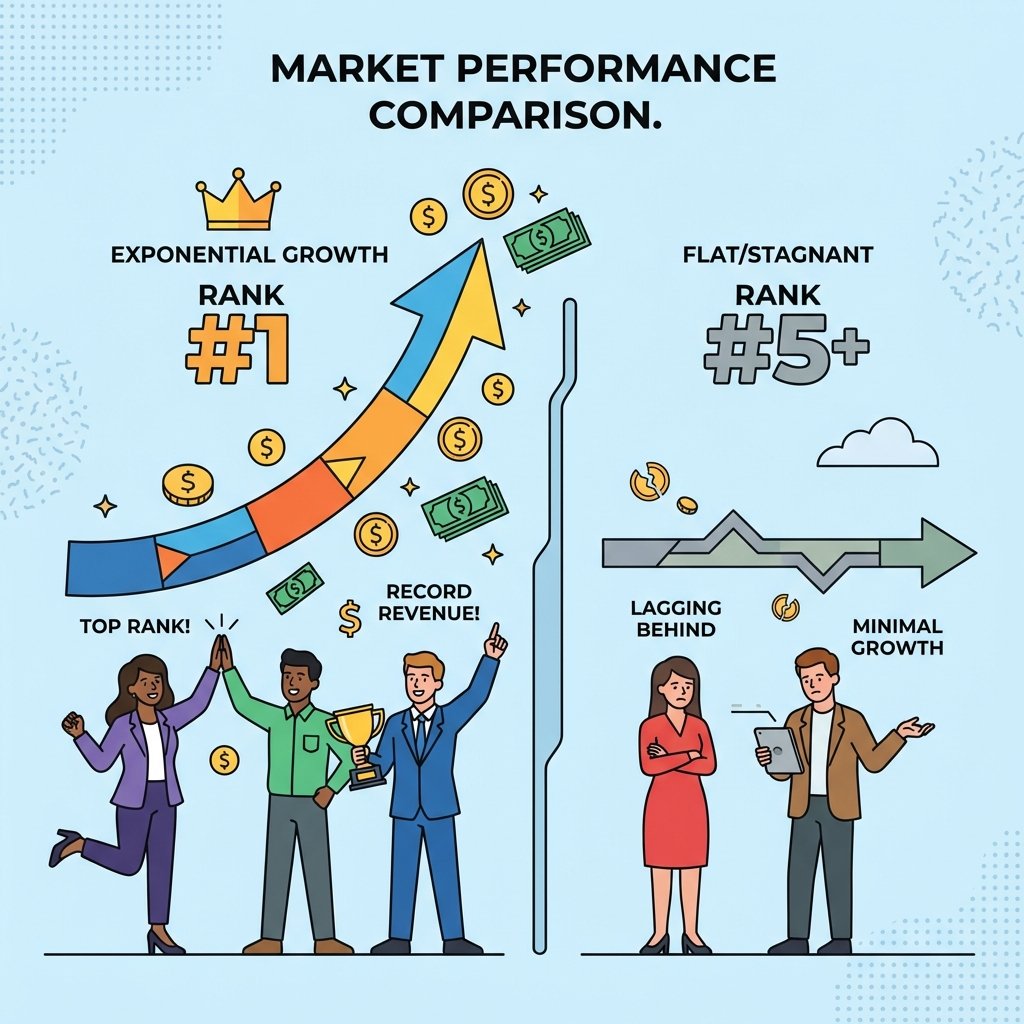
We are witnessing what industry experts call “Google’s Traffic Monopoly”—a phenomenon where the #1 organic result doesn’t just get more clicks; it dominates the entire search landscape. According to comprehensive CTR studies by Backlinko, the top spot captures nearly 40% of all user attention, leaving scraps for everyone else.
These CTR facts have created a winner-takes-all environment. If you’re wondering why your first-page rankings aren’t translating into revenue, the answer lies in the shocking truth about first-page clicks. In this comprehensive deep dive, we’ll reveal the exact stats behind this monopoly and provide actionable strategies to help you claim the top spot.
⚡ TL;DR — Key Takeaways
- The #1 organic result on Google captures 39.6% of all clicks, more than double the second spot.
- These CTR facts show traffic drops precipitously after position #3, with position #10 receiving just ~2%.
- “Banner blindness” is real: users actively scroll past ads to find the first organic result.
- Moving from position #5 to #1 can increase traffic by 10x or more, transforming business ROI.
- The top 3 results collectively control over 75% of all organic traffic for a given query.
The Data: Why #1 is the Only Number That Matters
Let’s examine the cold, hard numbers behind CTR facts distribution. Advanced tracking studies analyzing millions of searches reveal a consistent pattern: the distribution of organic search traffic statistics is overwhelmingly weighted toward the top positions.
Research from Sistrix’s comprehensive 2024/2025 study analyzed over 80 million keywords and billions of search results to paint a definitive picture of how users interact with search results. The findings confirm what many SEO professionals have long suspected: position matters more than ever.
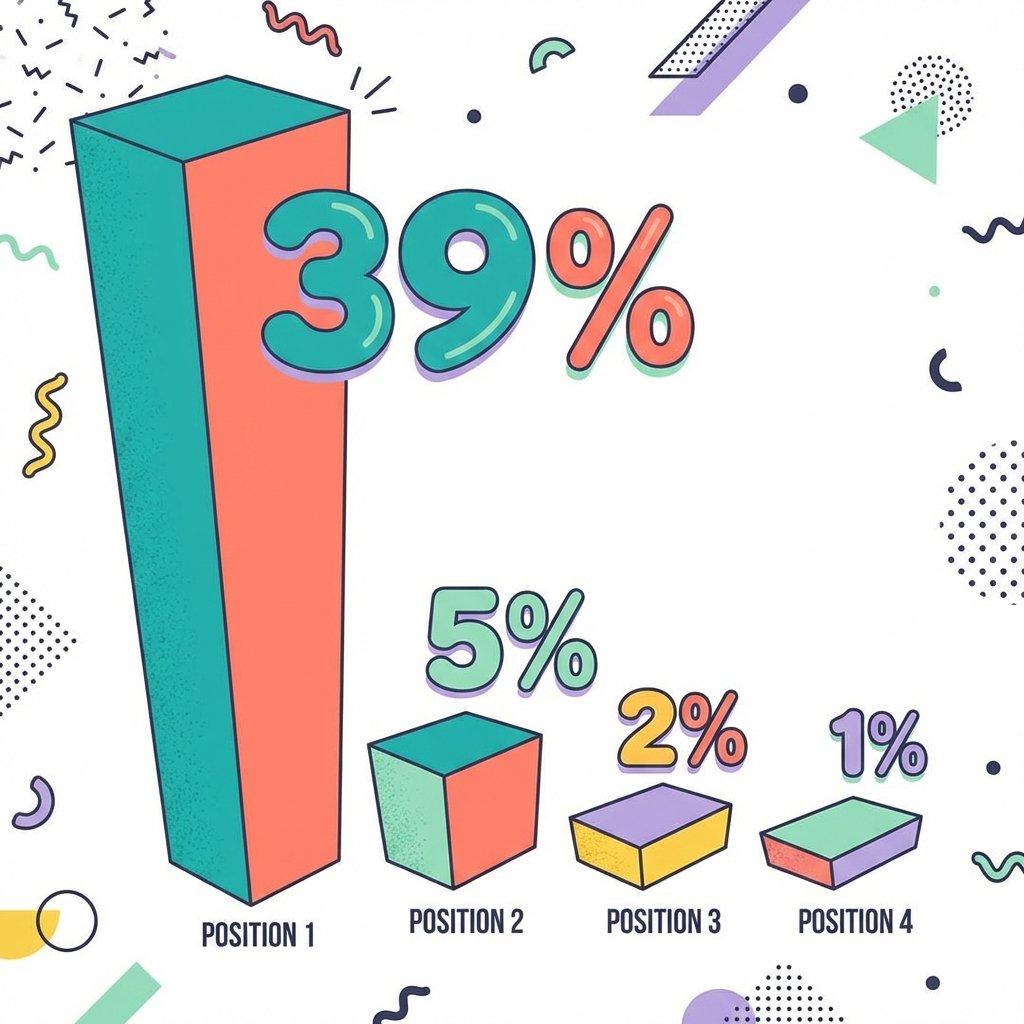
Click-Through Rates by Position (2025 Data)
These numbers reveal a stark reality: Ranking #1 is worth twice as much as #2, and four times as much as #3. If you are sitting at position #8, you are fighting for scraps—capturing less than 3% of the potential traffic. This highlights the immense value of striving for the true top spot.
🎯 The Compounding Effect
The CTR facts advantage compounds over time. Higher CTR signals to Google that your result is valuable, which can further improve your rankings. This creates a virtuous cycle where the #1 position becomes increasingly defensible once achieved.
Understanding Google’s Traffic Monopoly
Why is the drop-off in CTR facts so severe? The answer lies in the intersection of user behavior, cognitive psychology, and trust. Google has spent over two decades refining its algorithm, and users have been conditioned to believe that the best answer is almost always at the top.
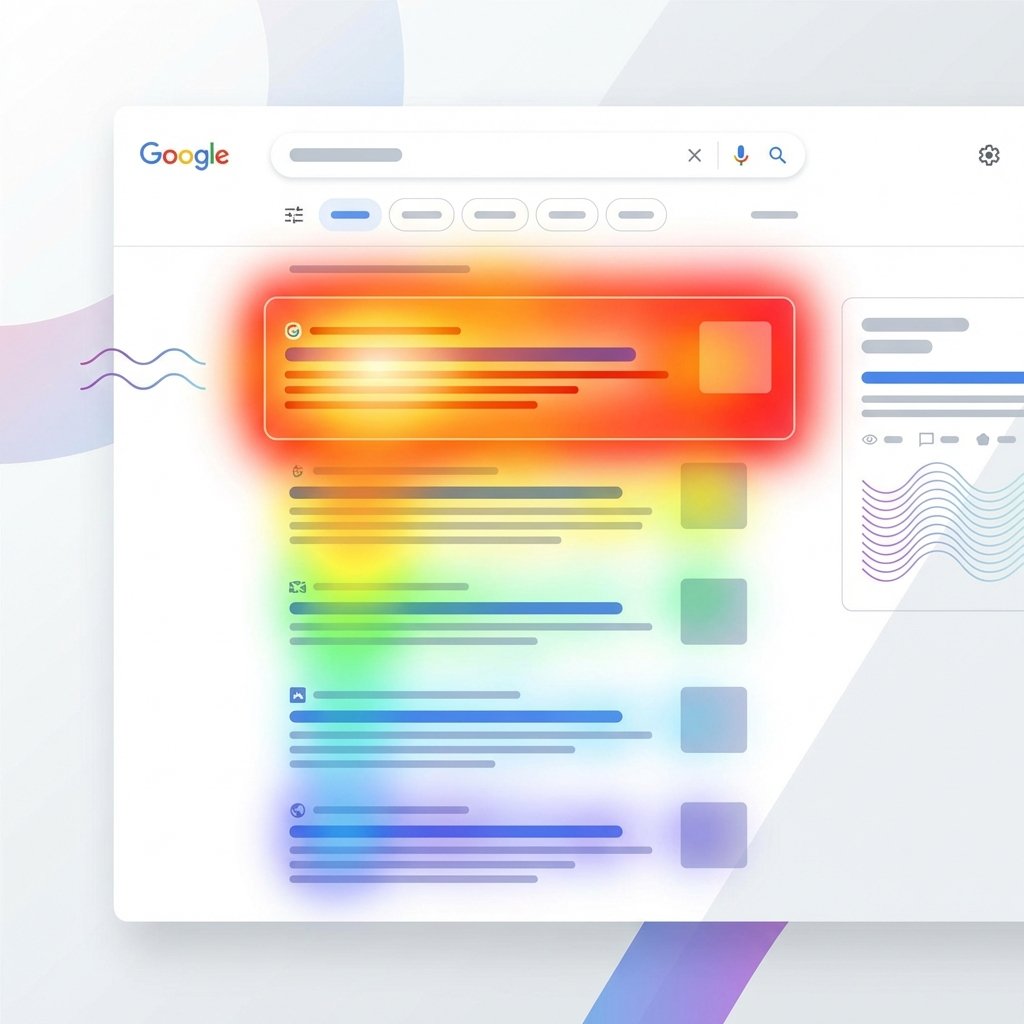
According to research published by the Nielsen Norman Group, users exhibit predictable scanning patterns when viewing search results. The famous “F-pattern” of reading behavior means users focus intensely on the top few results, then their attention rapidly diminishes as they move down the page.
🔥 The Heatmap Effect
Eye-tracking studies consistently produce “F-shaped” patterns. Users scan the top horizontal area heavily, then vertically scan down the left side, but their attention fades rapidly. By the time they reach the bottom of the page (Results #7-10), less than 20% of users are even looking. This directly impacts CTR facts for lower positions.
This “trust bias” means that even if a lower-ranked result is technically better, it won’t get clicked simply because it isn’t first. Users have been trained to believe that Google’s algorithm has already done the work of finding the best result. The CTR facts essentially acts as a vote of confidence from the search engine that users blindly accept.
The Psychology Behind Position #1
There’s a powerful psychological phenomenon at play called “primacy bias”—the tendency to trust and remember the first item in a list more than subsequent items. When combined with Google’s reputation for delivering relevant results, this creates an almost insurmountable advantage for the top-ranked website.
Consider this: users don’t just click on the #1 result more often; they also spend more time on those pages and are more likely to convert. The benefits of ranking first on Google extend far beyond raw traffic numbers—they include higher engagement, better brand perception, and ultimately, more revenue.
Complete CTR Breakdown by Position
To fully understand the CTR facts landscape, let’s examine the complete breakdown of CTR by position. This data is essential for calculating the true ROI of SEO investments and understanding where your website stands in the competitive hierarchy.
| Position | Average CTR | Traffic vs #1 | Strategic Value |
|---|---|---|---|
| Position #1 | 39.6% | 100% (Baseline) | Maximum value—must defend |
| Position #2 | 18.4% | 46% of #1 | Strong ROI, worth investing |
| Position #3 | 10.1% | 25% of #1 | Still above the fold on mobile |
| Position #4 | 7.6% | 19% of #1 | Diminishing returns begin |
| Position #5 | 5.1% | 13% of #1 | Below fold on many devices |
| Position #6-7 | 3-4% | 8-10% of #1 | Minimal traffic value |
| Position #8-10 | 2-3% | 5-7% of #1 | Near-invisible to most users |
The CTR by ranking position data reveals a crucial insight: there’s effectively a “top 3 club” that captures the vast majority of organic traffic. According to Ahrefs’ CTR research, the top three positions together capture approximately 68% of all clicks for a given query. If you’re not in this club, you’re competing for the remaining 32%—shared among seven other results plus “no-click” searches.
⚠️ The “Page 2” Death Zone
If position #10 receives only 2.1% of clicks, what about page 2? Studies consistently show that fewer than 1% of users ever click on a page 2 result. The old SEO joke—”The best place to hide a dead body is page 2 of Google”—is uncomfortably accurate. Your CTR facts effectively drops to near-zero once you leave page 1.
The “Winner Takes All” Economy of SEO
In digital marketing, second place is indeed the first loser. The disparity in Google ranking click through rate leads to a massive disparity in business outcomes. This isn’t just about bragging rights—it’s about survival in competitive markets.
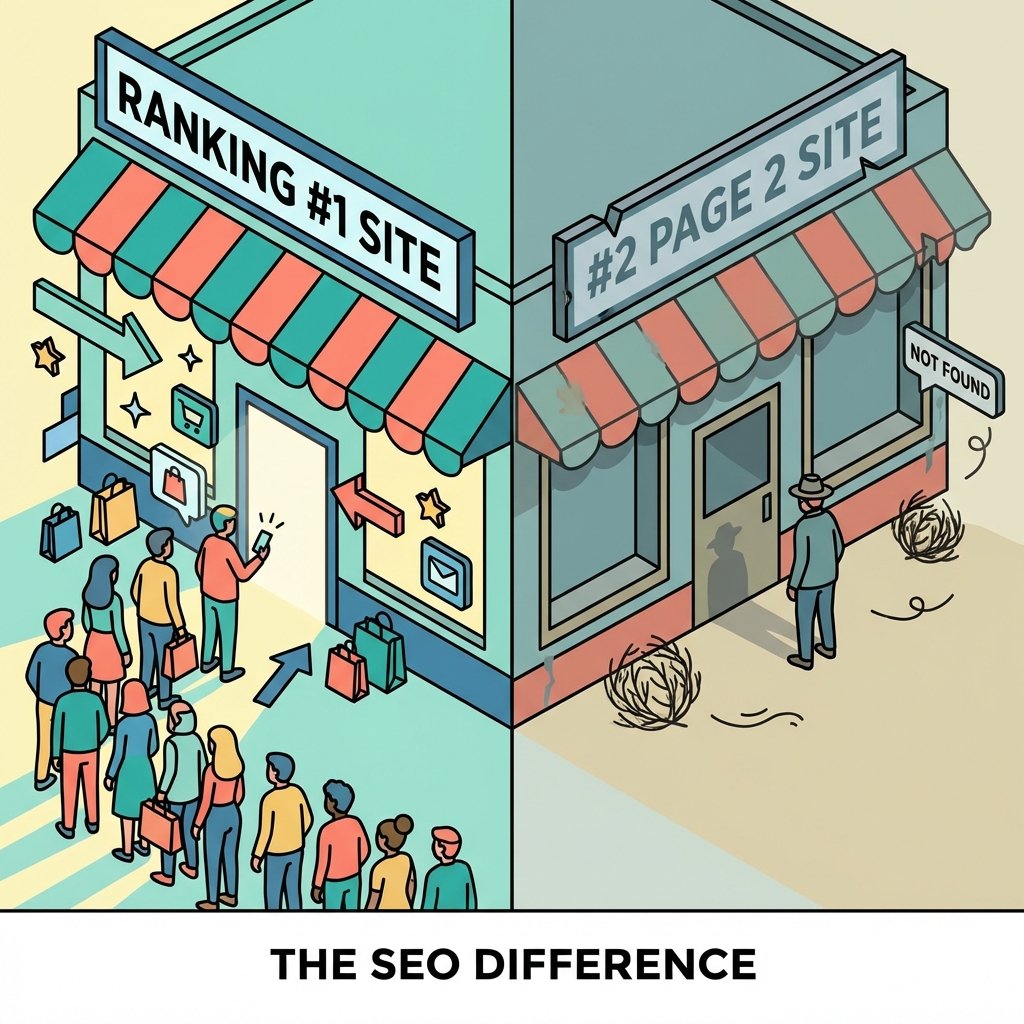
Real Business Impact Analysis
Let’s translate the abstract organic search traffic statistics into concrete business terms. Consider a keyword with 10,000 monthly searches—not a high-volume term, but typical for many B2B or local service queries:
| Metric | Rank #1 Website | Rank #5 Website |
|---|---|---|
| Monthly Clicks | ~3,960 | ~510 |
| Leads (at 2% conv.) | ~79 Leads | ~10 Leads |
| Annual Lead Difference | 828 more leads for #1 position | |
| Brand Authority | Perceived Market Leader | “Also ran” / Participant |
| Cost Per Acquisition | Lowest (high volume) | High (low volume) |
The benefits of ranking first on Google go beyond just raw traffic. There is a powerful psychological component: users assume the #1 company is the market leader. This halo effect often leads to higher on-page conversion rates for top-ranked sites compared to lower-ranked ones. When users click on the #1 result, they arrive with higher trust and purchase intent.
Understanding your competitor’s click-through advantage is the first step to developing a strategy to overtake them. Many businesses focus solely on ranking improvements without considering the multiplicative effect of CTR optimization.
Ad Blindness: Why Organic Still Wins
A common question arises: if Google pushes ads to the top of the page, don’t they capture most of the CTR facts? Surprisingly, the data says no.
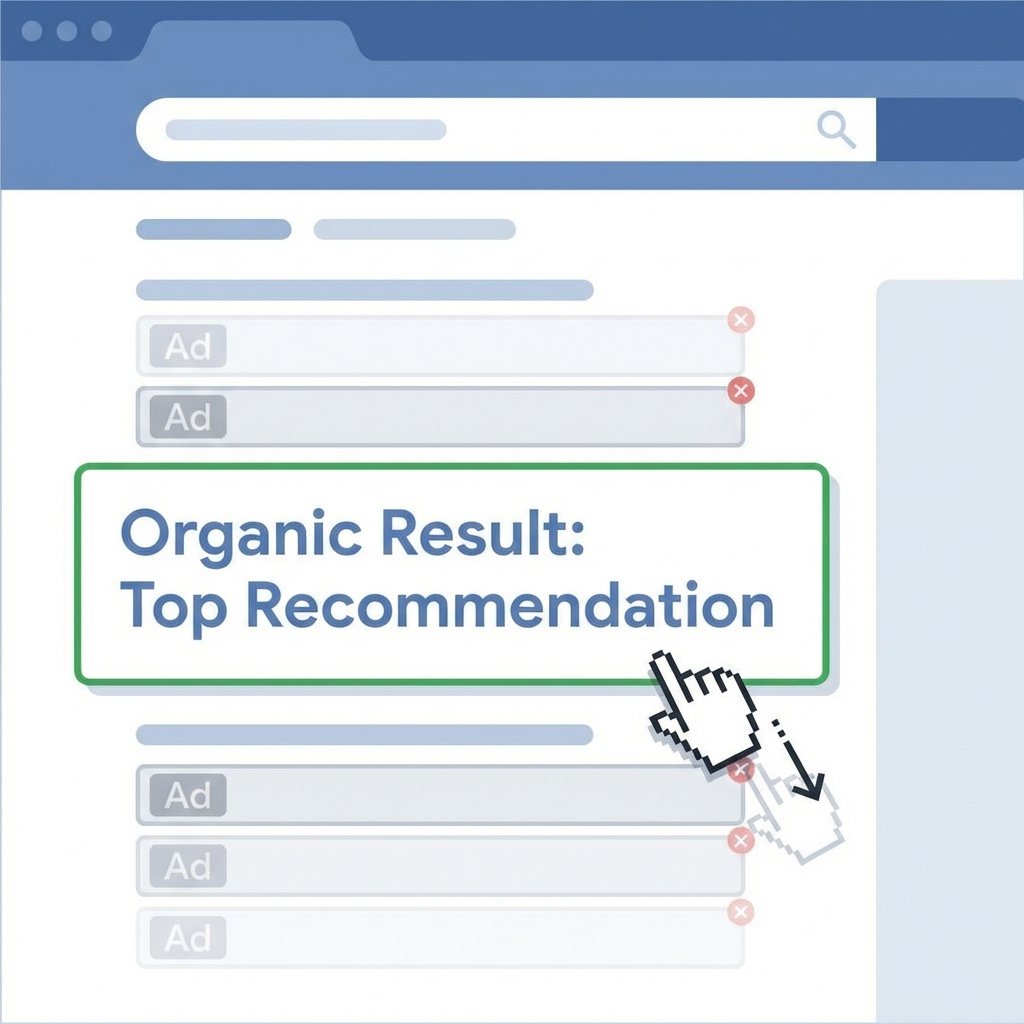
Research from Search Engine Journal confirms that organic results still capture the lion’s share of user engagement. While ads serve a purpose—particularly for high-intent commercial queries—the majority of users have developed sophisticated ad-avoidance behaviors.
⚠️ The Trust Deficit in Ads
While ads capture about 15-20% of clicks for high-intent commercial queries, the vast majority of searchers (70-80%) scroll right past them. Users know ads are paid placements, whereas organic rankings are earned. For information-heavy or research queries, the organic CTR by ranking position dominance is even stronger, with ads capturing less than 5% of total clicks.
Why Users Prefer Organic Results
- Trust signals: Organic rankings are seen as “earned” through quality, not purchased
- Relevance expectations: Users believe organic results better match their query intent
- Banner blindness: Years of internet use have trained users to ignore ad-like elements
- Ad labeling: Google’s “Ad” or “Sponsored” labels trigger immediate skepticism
This doesn’t mean paid advertising has no value—it absolutely does, particularly for immediate visibility and testing. However, for long-term SEO traffic distribution and sustainable growth, organic rankings remain the gold standard.
How CTR Varies by Industry and Query Type
While the overall Google ranking click through rate trends hold true across most searches, there are important variations based on industry and query type that savvy marketers should understand.
CTR by Query Intent
| Query Type | Position #1 CTR | Notes |
|---|---|---|
| Informational | 35-45% | Users seeking answers; high CTR for top result |
| Navigational | 50-70% | Users know where they want to go; extremely high CTR |
| Commercial | 25-35% | Comparison shopping; users check multiple results |
| Transactional | 20-30% | Purchase intent; ads capture more share here |
💡 Targeting High-CTR Query Types
When planning your SEO strategy, prioritize informational and navigational queries where the Google ranking click through rate for position #1 is highest. These queries often form the top of your marketing funnel and can drive significant traffic with relatively less competition than pure transactional terms.
Industries with high trust requirements—such as healthcare, finance, and legal services—tend to see even more concentrated CTR in the top positions. Users in these sectors are more risk-averse and less likely to experiment with lower-ranked results.
How to Move from Page 1 to Position #1
Understanding the value of #1 is easy; achieving it requires precision execution. To move from the wasteland of Position #6 to the promised land of Position #1, you need to execute a comprehensive strategy that addresses all ranking factors.
The 7-Step Framework for Position #1
Perfect Technical Foundation
You cannot rank #1 with a slow site. Core Web Vitals, mobile optimization, and crawlability are non-negotiable. Fix critical technical SEO errors that might be acting as an anchor on your rankings.
Content Depth & Quality
The #1 result is usually the most comprehensive resource. It answers the user’s question better than anyone else. Analyze the current #1 and ask: “Is my page 10x better than this?” If not, keep improving until it is.
Click-Through Rate Optimization
Ironically, to improve your Google ranking click through rate, you need to optimize your CTR. Write compelling, emotional title tags (under 60 characters), craft benefit-rich meta descriptions, and use rich schema markup to stand out in SERPs.
Build Authority Signals
Backlinks still matter enormously. Focus on earning high-quality, relevant links from authoritative sources in your industry. A single link from a major publication can be worth more than hundreds of low-quality links.
Improve User Engagement Metrics
Google monitors how users interact with your page. Lower bounce rates, longer dwell time, and higher pages-per-session all signal quality. Optimize your content for engagement, not just rankings.
Develop Topical Authority
Create a comprehensive content cluster around your target topic. Supporting articles that link to your main page signal to Google that you’re an authority on the subject, boosting your main page’s rankings.
Monitor and Iterate
SEO is not a one-time effort. Track your Google ranking click through rate in Search Console, monitor competitor movements, and continuously update your content to maintain and improve your position.
💡 The “Private Patient” Analogy
Just as in healthcare marketing, where the goal is to guide a specific type of user through a conversion funnel, SEO is about guiding both users and the algorithm. Learn more about funnel strategies that convert to apply similar principles to your general SEO strategy.
Ready to Dominate Your Market?
Stop settling for mediocre rankings. Our team specializes in moving businesses from “page 1” to “position 1.”
Explore Our SEO Services →Frequently Asked Questions
Yes, multiple studies from 2024 and 2025 confirm that for non-branded organic searches, the #1 position captures between 27% and nearly 40% of all clicks. The exact Google ranking click through rate varies by industry and query type (informational vs. transactional), but it is consistently the dominant share of traffic. Sistrix, Backlinko, and Ahrefs have all published supporting data.
Both have value, but ranking #1 organically is generally more sustainable and cost-effective in the long run. Paid ads stop delivering traffic the moment you stop paying. Organic rankings provide continuous traffic 24/7 without a per-click cost, offering a much higher long-term ROI. However, the best strategy often combines both: use ads for immediate visibility while building organic authority.
To improve your Google ranking click through rate, focus on your “snippet appearance”: write compelling, emotional title tags (under 60 characters) that include power words and numbers, craft benefit-rich meta descriptions that create urgency, use rich schema markup (like star ratings, FAQ schema, or How-To schema), and ensure your URL structure is clean and descriptive.
The dramatic drop after position 3 is due to limited user attention spans and the constraints of mobile screens. On mobile devices, the top 3 results take up most of the visible screen space. Users rarely feel the need to scroll further if their question appears to be answered by one of the top choices. Additionally, cognitive load research shows users prefer simpler decision-making, defaulting to top options.
The timeline varies significantly based on competition, your current position, and the resources invested. For low-competition keywords, you might reach #1 within 3-6 months of targeted optimization. For highly competitive terms, it can take 12-24 months or longer. Consistent effort, quality content creation, and authority building are the keys to sustained improvement in Google ranking click through rate.
Absolutely. Featured snippets (position 0) can capture 8-12% of clicks on top of regular position #1 traffic. However, some studies suggest they may slightly cannibalize the #1 position’s clicks. The net effect is usually positive if you hold both the featured snippet and position #1, giving you dominant visibility for the query.
Stop Settling for “Page 1” Participation Trophies
If you aren’t #1, you’re leaving 70%+ of the market to your competitors. Let us help you audit your current strategy and build a roadmap to the top spot, maximizing your CTR facts advantage and ROI.
Claim Your Strategy Audit →