
Local SEO for dentists in the UK has never been more critical. With 97% of consumers searching online for local businesses—and dental practices being no exception—your visibility on Google can make or break your patient acquisition strategy. Yet, many UK dental clinics remain invisible in local search results, losing hundreds of potential patients to competitors who’ve mastered local SEO.
Whether you’re a single-chair practice in Birmingham, a family dentist in Leeds, a cosmetic dental clinic in Bristol, or a multi-location group across London and Manchester, the fundamentals of local SEO for dental clinics remain the same. From Edinburgh to Cardiff, the difference between appearing on page one and being buried on page three often comes down to seven strategic steps that most practices overlook.
In this comprehensive guide, we’ll walk you through exactly how to optimise your dental practice for Google ranking success. From claiming your Google Business Profile to building citations and generating reviews, you’ll have a complete roadmap to dominate local search in 2026. If you’re considering professional help, our local SEO services are designed specifically for healthcare practices like yours.
⚡ TL;DR — Quick Takeaways
- Local SEO for dentists UK focuses on Google Business Profile, citations, reviews, and on-page optimisation
- 97% of patients search online before choosing a dentist—visibility is everything
- Consistent NAP (Name, Address, Phone) across all directories is non-negotiable
- Reviews directly impact your local pack rankings—aim for 50+ quality reviews
- Most dental practices see measurable results within 3-6 months of implementing these 7 steps
Why Local SEO Matters for UK Dental Practices
Before diving into the tactical steps, let’s understand why local SEO for dentists in the UK deserves your attention and investment. The dental industry is inherently local—patients rarely travel more than 10-15 miles for routine dental care. This geographical constraint makes local search optimisation your most powerful patient acquisition channel.
According to BrightLocal’s 2024 Local Consumer Review Survey, 98% of consumers used the internet to find information about local businesses in 2023—a figure that continues to climb. For dental practices, this means patients are actively searching terms like “dentist near me,” “emergency dentist [city],” and “NHS dentist accepting patients.”
The challenge? Only three practices appear in Google’s coveted Local Pack—the map results that dominate the top of search results. If your practice isn’t there, you’re effectively invisible to the majority of potential patients. Understanding the real dental marketing costs in the UK can help you budget appropriately for these efforts.
💡 Key Insight
Dental practices ranking in the Local Pack receive 42% more clicks than those appearing only in organic results. For any local SEO dental clinic strategy, securing a top-three position isn’t optional—it’s essential for sustainable growth.
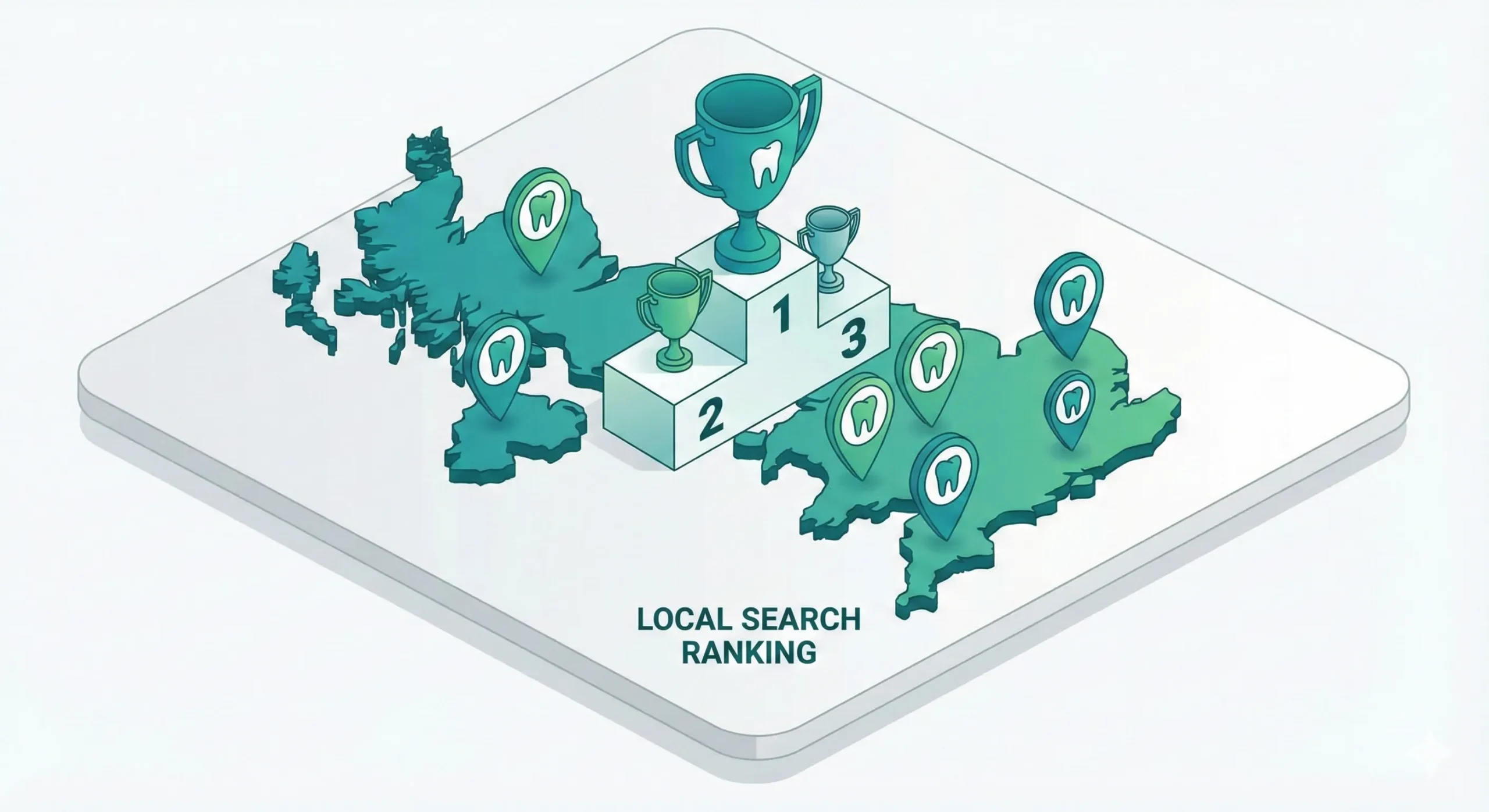
Local Pack positions are crucial for dental practice visibility
Claim and Optimise Your Google Business Profile
Your Google Business Profile (GBP) is the foundation of local SEO for any dental clinic. Formerly known as Google My Business, this free tool determines whether you appear in Google Maps and the Local Pack. For Google Business Profile dentist optimisation, claiming and completing your profile is step one. If you haven’t done this yet, you’re handing patients directly to your competitors.
Setting up your Google Business Profile correctly is the foundation of local SEO
How to Claim Your Profile
- Visit business.google.com and sign in with your Google account
- Search for your dental practice by name and address
- If it exists, claim it. If not, create a new listing
- Complete the verification process (usually via postcard or phone)
Optimisation Checklist for Dental Practices
- Business Name: Use your exact practice name (no keyword stuffing)
- Primary Category: Select “Dentist” as your primary category
- Secondary Categories: Add relevant categories like “Cosmetic Dentist,” “Emergency Dental Service,” “Dental Implants Provider”
- Description: Write a compelling 750-character description including your services, specialities, and location keywords
- Services: List all treatments with descriptions and pricing where appropriate
- Photos: Upload 20+ high-quality images including interior, exterior, team, and before/after treatment photos
- Hours: Keep your opening hours accurate, including lunch breaks and bank holidays
- Attributes: Enable all relevant attributes (wheelchair accessible, accepts NHS, free parking, etc.)
⚠️ Common Mistake
Don’t add keywords to your business name like “Best Dentist London – Smith Dental.” Google penalises this practice and may suspend your listing. Use your exact registered business name only.
Nail Your NAP Consistency
NAP consistency might sound technical, but it’s straightforward: your Name, Address, and Phone number must be identical everywhere your practice appears online. Google cross-references this information across the web to verify your legitimacy. Inconsistencies signal unreliability and can tank your local rankings.
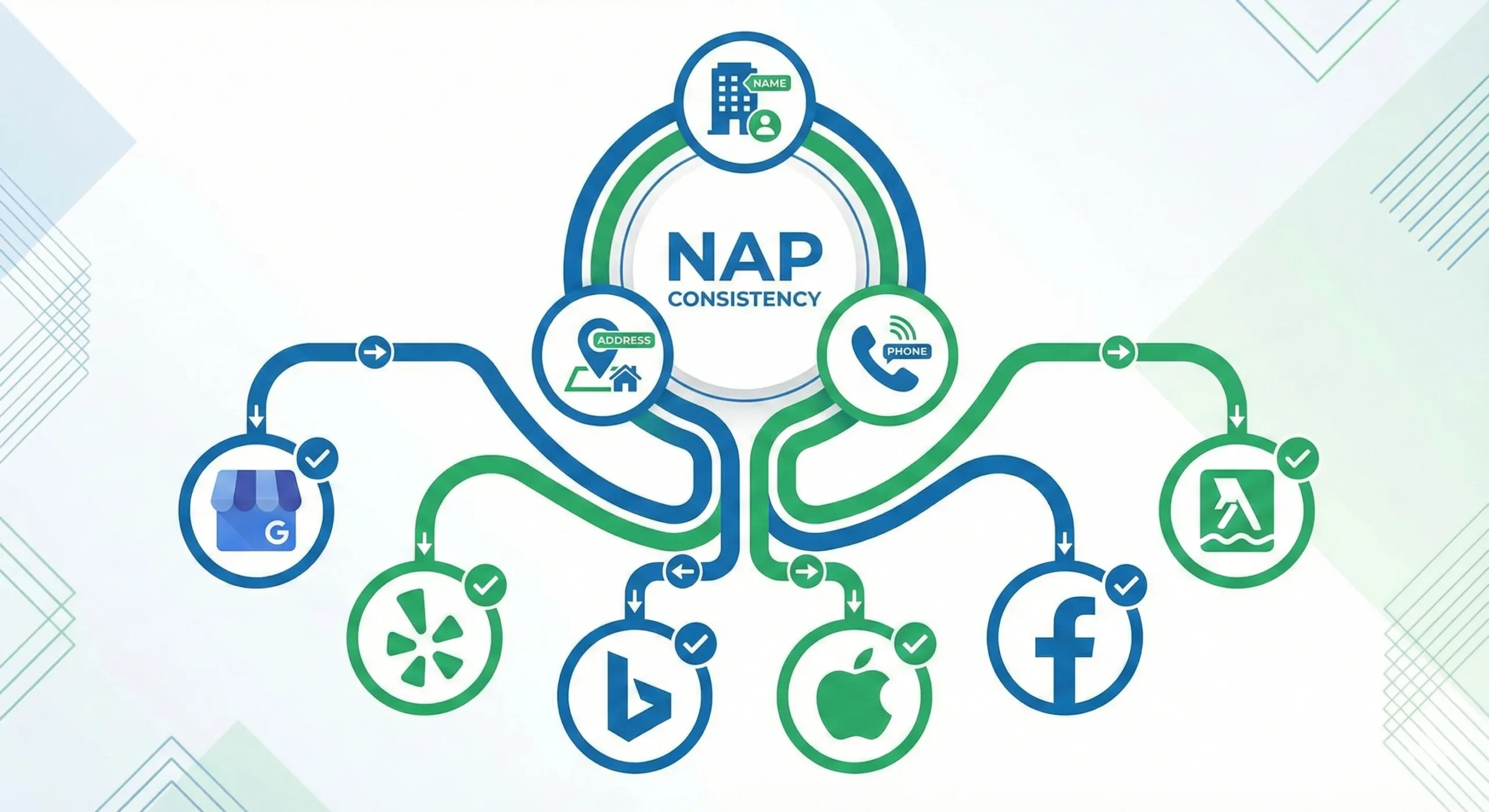
NAP consistency is essential for local SEO success
| ❌ Inconsistent NAP | ✅ Consistent NAP |
|---|---|
| Smith Dental Practice | Smith Dental Practice Ltd |
| 123 High St, Birmingham | 123 High Street, Birmingham, B1 2AB |
| 0121 123 4567 | 0121 123 4567 |
| Smith Dental | Smith Dental Practice Ltd |
| 123 High Street, Birmingham B1 | 123 High Street, Birmingham, B1 2AB |
💡 Pro Tip
Create a “master NAP document” with your exact business details. This is a fundamental local SEO for dentists UK practice. Use this as a reference whenever listing your practice anywhere online. Include company number, VAT registration, and other identifiers for consistency.
Build Local Citations
Citations are online mentions of your dental practice’s NAP information. They appear on business directories, review sites, social platforms, and industry-specific sites. For local SEO for dentists UK strategies, citations are particularly important because they validate your legitimacy and locality to search engines.
Priority UK Citation Sources for Dentists
| Directory | Type | Priority |
|---|---|---|
| Yell.com | General Business | 🔴 High |
| NHS.uk | Healthcare | 🔴 High |
| Bing Places | Search Engine | 🔴 High |
| Facebook Business | Social | 🔴 High |
| Dentagama | Dental-Specific | 🟡 Medium |
| WhatClinic | Healthcare | 🟡 Medium |
| FreeIndex | General Business | 🟡 Medium |
| Thomson Local | General Business | 🟢 Standard |
Beyond these major directories, consider local citations specific to your area—local newspaper websites, chamber of commerce listings, and regional business associations. These hyperlocal citations are essential for local SEO for dentists UK because they send powerful relevance signals to Google about your geographic service area.
Generate and Manage Patient Reviews
Reviews are the currency of local SEO for dentists UK. According to Moz’s Local Search Ranking Factors, review signals account for approximately 17% of how Google ranks local businesses. For dental practices, reviews also directly influence patient decisions—nobody wants to risk their oral health on an unreviewed dentist.

Patient reviews are crucial for both rankings and trust
Review Generation Strategies
- Ask at the right moment: Request reviews immediately after positive treatment experiences, not weeks later
- Make it easy: Send a direct link to your Google review page via SMS or email
- Train your team: Reception staff should feel comfortable asking satisfied patients to leave reviews
- Use automated follow-ups: Implement a patient management system that sends review requests automatically
- Display in-practice reminders: Add QR codes to reception areas linking directly to your review page
📊 Review Benchmarks for UK Dentists
Minimum target: 50 reviews with 4.5+ average rating
Competitive target: 100+ reviews with 4.7+ average rating
Market leader: 200+ reviews with consistent monthly growth
Responding to Reviews
Responding to reviews—both positive and negative—demonstrates engagement and professionalism. Google confirms that businesses that respond to reviews are viewed more favourably. For negative reviews, respond professionally, acknowledge concerns, and take the conversation offline when necessary.
⚠️ Never Do This
Never offer incentives for reviews (it violates Google’s guidelines), never ask for only positive reviews, and never respond defensively to criticism. One unprofessional response can undo months of reputation building.
Optimise Your Website for Local Search
While your Google Business Profile handles map results, your website determines organic rankings and converts visitors into patients. For comprehensive local SEO for dentists UK success, on-page SEO requires a strategic approach combining technical optimisation with locally-focused content.
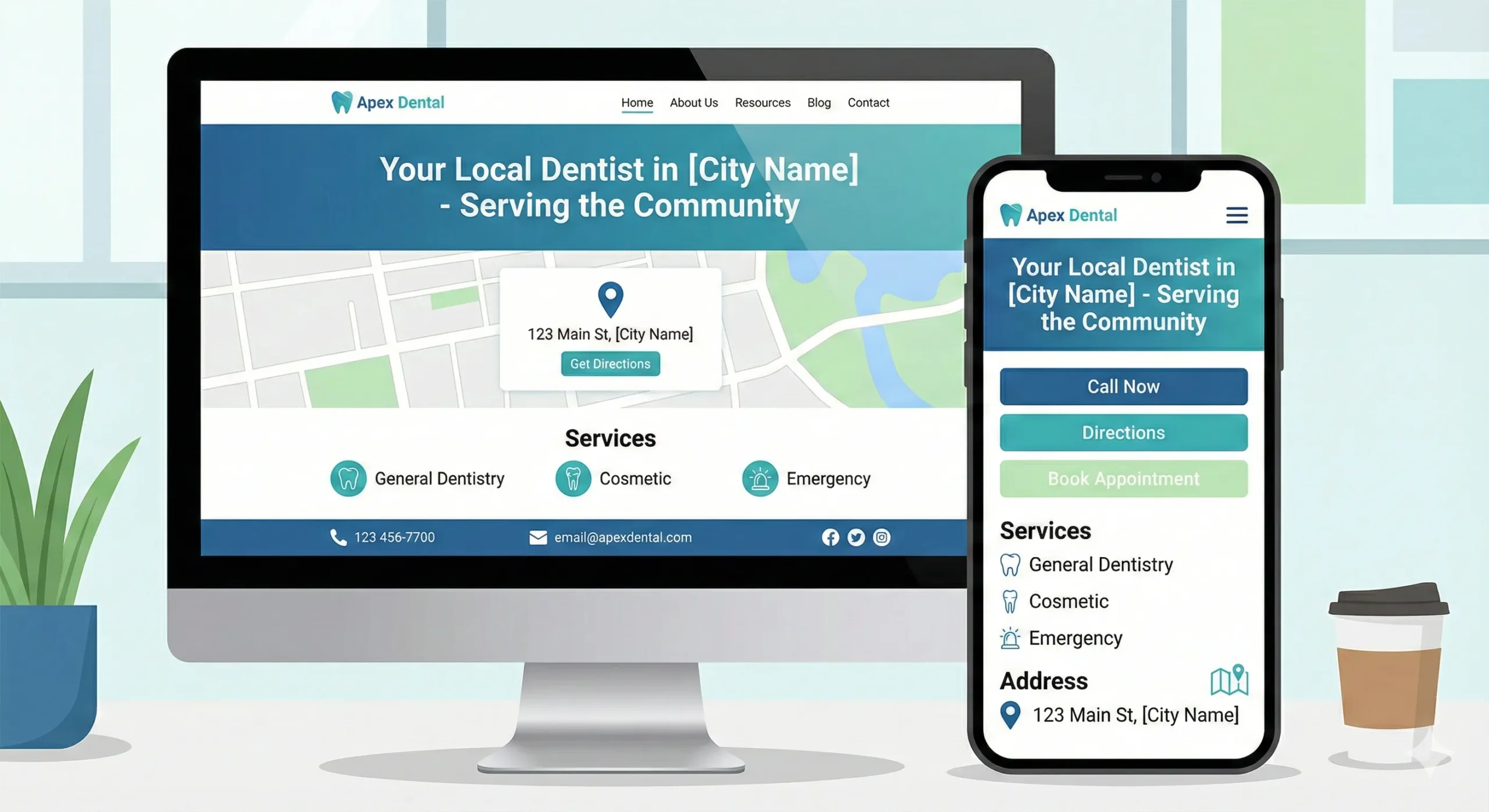
Your website must be optimised for both local search and mobile users
Essential On-Page Elements
- Title Tags: Include city/area + “Dentist” in every page title (e.g., “Emergency Dentist Birmingham | Smith Dental”)
- Meta Descriptions: Write compelling descriptions mentioning your location and key services
- H1 Headers: Each page should have one H1 containing relevant local keywords
- Schema Markup: Implement LocalBusiness and Dentist schema to help Google understand your practice details
- NAP Footer: Display your full NAP information in the footer of every page
- Embedded Map: Add a Google Maps embed on your contact page
- Mobile Responsiveness: Ensure your site works flawlessly on all devices—60% of local searches happen on mobile
Technical SEO Considerations
Page speed is critical for both rankings and user experience. According to Google PageSpeed Insights, pages that take longer than 3 seconds to load see a 53% bounce rate increase. Compress images, leverage browser caching, and consider a content delivery network (CDN) if serving patients across multiple UK regions.
💡 Quick Win
Add your exact GBP business name, address, and phone number to your website’s footer in HTML text (not as an image). This simple local SEO for dentists UK tactic creates a consistent NAP signal that Google can easily verify.
Optimising for “Dentist Near Me” and Voice Search
With the rise of smart speakers and mobile voice assistants, voice search optimisation has become increasingly important for local SEO for dentists UK strategies. According to Think with Google, “near me” searches have grown by over 500% in recent years, and a significant portion of these are now voice-activated.
🎙️ Voice Search Statistics
71% of consumers prefer voice search over typing for quick queries
58% of consumers have used voice search to find local business information
46% of voice search users look for local businesses daily
How “Near Me” Searches Actually Work
Here’s what many dentists don’t realise: you don’t need to stuff “near me” into your website content. Google automatically handles proximity-based intent using the searcher’s location data. When someone in Leeds searches “dentist near me,” Google shows dental practices near Leeds—regardless of whether those websites contain the phrase “near me.”
What You Should Optimise For Instead
- City + Service combinations: “Emergency dentist Manchester,” “Cosmetic dentist Bristol,” “NHS dentist London”
- Neighbourhood-specific terms: “Dentist in Edgbaston,” “Dental clinic Headingley,” “Family dentist Clifton”
- Conversational long-tail queries: “Where can I find a good dentist in Birmingham?”
- Question-based content: “What’s the best dental practice near the city centre?”
💡 Voice Search Tip
Voice searches tend to be longer and more conversational than typed searches. For effective dentist marketing UK strategies, create FAQ content that answers questions exactly as patients would ask them verbally: “How much do dental implants cost in the UK?” rather than just “dental implant costs.”
Create Location-Specific Content
Local content differentiates your dental practice from national competitors and signals geographic relevance to search engines. This is where dentist marketing UK becomes truly strategic—creating content that speaks directly to patients in your service area.
Content Ideas for UK Dental Practices
| Content Type | Example | Local SEO Benefit |
|---|---|---|
| Service + Location Pages | “Dental Implants in Manchester” | Targets high-intent local searches |
| Neighbourhood Guides | “Finding an NHS Dentist in Edgbaston” | Captures hyperlocal search traffic |
| Local Event Content | “Free Dental Check-ups at Birmingham Health Fair” | Builds community presence and links |
| Patient Success Stories | “How We Helped Sarah from Solihull…” | Social proof with local relevance |
| FAQ Content | “Is There a Weekend Dentist Near Me in Leeds?” | Answers voice search queries |
“The practices that dominate local search are those that produce consistent, location-specific content that addresses patient questions before they even think to ask.”
Consider creating dedicated pages for each major service in each location you serve. This local SEO for dentists UK approach requires more content investment, but these pages can rank independently and capture valuable long-tail search traffic that boosts your overall dental practice Google ranking.
Monitor, Measure, and Iterate
Local SEO for dentists in the UK isn’t a one-time project—it’s an ongoing process of refinement. The UK dental market is competitive, and your competitors are actively working to outrank you. For successful dental practice Google ranking, regular monitoring and strategic adjustments keep you ahead.
Essential Metrics to Track
- Google Business Profile Insights: Views, searches, actions (calls, direction requests, website clicks)
- Search Console Data: Impressions and clicks for local keywords
- Ranking Positions: Track your position for target keywords weekly
- Review Velocity: Number of new reviews per month
- Citation Accuracy: Regular audits of NAP consistency across directories
- Website Analytics: Local traffic, conversion rates, and user behaviour
Recommended Tools
| Tool | Purpose | Cost |
|---|---|---|
| Google Search Console | Keyword tracking & indexing | Free |
| Google Analytics 4 | Traffic & user behaviour | Free |
| BrightLocal | Local rankings & citations | From £29/month |
| Whitespark | Citation building & tracking | From £25/month |
📈 Realistic Timeline
Month 1-2: Foundation work (GBP, citations, NAP cleanup)
Month 3-4: Content creation and link building
Month 4-6: Initial ranking improvements visible
Month 6+: Sustained growth and refinement
Local SEO: DIY vs Hiring an Agency
One of the most common questions we hear from UK dental practices is whether to handle local SEO in-house or hire a specialist agency. The honest answer depends on your practice size, budget, and available time. Here’s a transparent comparison to help you decide:
| Factor | DIY Approach | Agency Support |
|---|---|---|
| Time Investment | 10-15 hours/month ongoing | 2-3 hours/month for approvals |
| Monthly Cost | £0 (+ your time value) | £500-£2,000/month typical |
| Learning Curve | Steep—SEO changes constantly | None—experts handle updates |
| Results Timeline | 6-12 months (trial & error) | 3-6 months (proven strategies) |
| Best For | Single-location, low competition | Multi-location, competitive markets |
🤔 Which Should You Choose?
Go DIY if: You have a single location in a smaller town, enjoy learning digital
marketing, and have consistent time to dedicate each week.
Consider an agency if: You’re in a competitive city (London, Manchester, Birmingham),
have multiple locations, or simply want to focus on dentistry while experts handle marketing. The ROI
from just 2-3 additional patients per month typically covers agency fees.
If you’re considering professional support, our team at LineUp specialises in local SEO for healthcare practices. We understand the unique challenges UK dentists face and have helped practices across Birmingham, Manchester, London, and beyond achieve page-one rankings.
Frequently Asked Questions
How long does local SEO take to work for dental practices?
Most UK dental practices implementing local SEO for dentists UK strategies begin seeing measurable improvements within 3-6 months. However, this varies based on competition, starting position, and consistency of effort. Highly competitive areas like London may take longer, while smaller towns often see faster results.
What’s the most important local SEO factor for dentists?
For any local SEO dental clinic strategy, your Google Business Profile dentist listing is the single most impactful element. A fully optimised, regularly updated GBP with strong reviews will outperform competitors who neglect this foundation—regardless of their website quality.
Should I target “dentist near me” as a keyword?
While “dentist near me” searches are common, you don’t need to optimise directly for this phrase. Google handles the “near me” intent automatically based on the user’s location. Instead, focus on “dentist [your city]” and specific service + location combinations that you can actually rank for.
How many Google reviews do I need to rank well?
There’s no magic number, but research suggests a minimum of 50 reviews with a 4.5+ rating puts you in competitive territory. More importantly than quantity is velocity—consistent new reviews signal an active, trusted practice. Aim for 5-10 new reviews monthly.
Can I do local SEO myself or do I need an agency?
The basics of local SEO for dental clinics can absolutely be handled in-house, especially for single-location practices. However, competitive markets, multi-location practices, or practices without dedicated marketing staff often benefit from professional support. The investment typically pays for itself within months through increased patient acquisition.
Is local SEO different for NHS vs private dentists?
The fundamentals are identical, but the keyword strategy differs. NHS dentists should target phrases like “NHS dentist accepting patients [city]” while private practices focus on specific treatments like “cosmetic dentist [city]” or “dental implants [area].” Both should maintain excellent GBP profiles and review management.
Ready to Dominate Local Search?
Stop losing patients to competitors with better Google visibility. Our team specialises in local SEO for dentists UK—from Google Business Profile dentist optimisation to content strategy and beyond.
Get Your Free SEO Audit →Final Thoughts on Local SEO for Dentists UK
Implementing these 7 steps to page one isn’t about quick hacks or gaming the system—it’s about building a sustainable digital presence that accurately represents your practice to patients searching online. Local SEO for dentists in the UK rewards practices that invest in genuine optimisation, patient experience, and consistent effort over time.
The dental practices that will thrive in 2026 and beyond are those taking action on dentist marketing UK now. While your competitors debate whether local SEO is worth the effort, you can be building the foundation that secures your dental practice Google ranking in the Local Pack for years to come.
Whether you implement these strategies yourself or partner with specialists who understand dental practice marketing, the key is to start. Every day without local SEO optimisation is another day of lost patient opportunities.
Have questions about implementing local SEO for your dental practice? Get in touch with our team—we’re always happy to help UK dentists understand and leverage the power of local search.